Artwork
Olive Trees at Tivoli
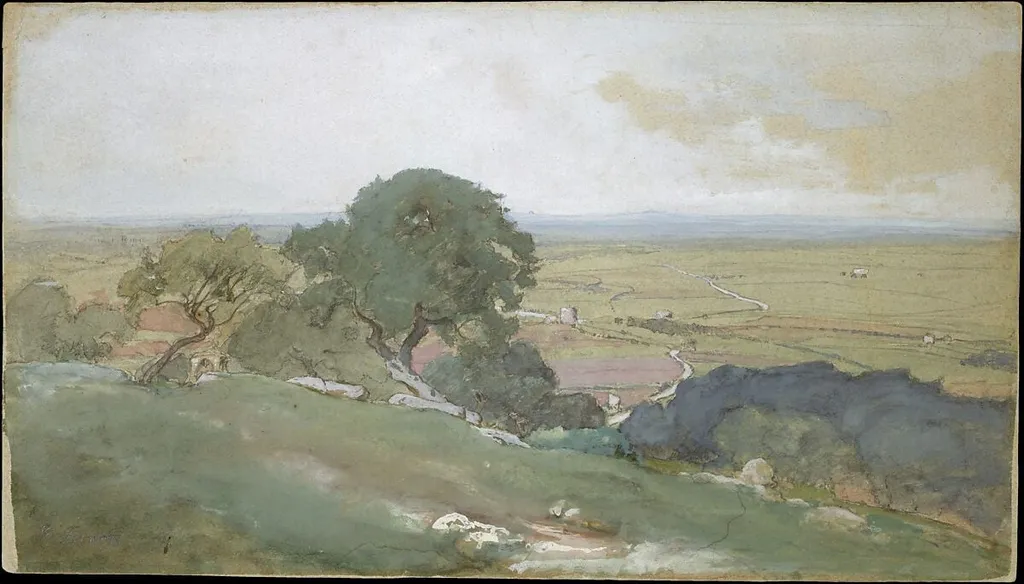
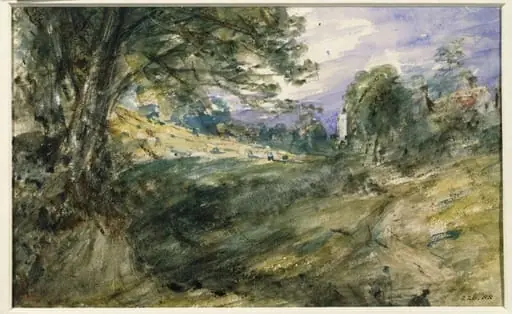
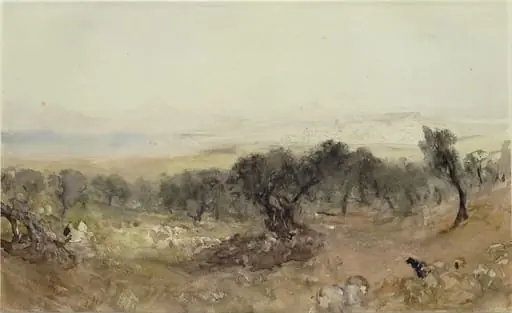
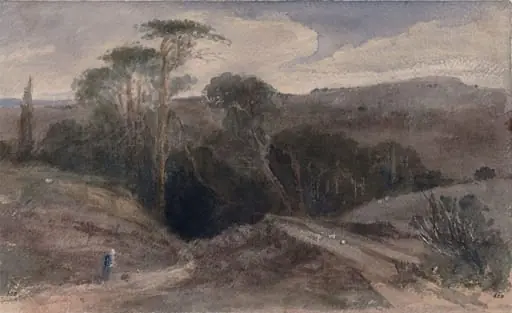
Olive Trees at Tivoli is a watercolor work on paper by the Hudson River School artist George Inness. It dates from 1873 and is held in the collection of the Metropolitan Museum of Art.
- Accession no.
- 1989.287
- Credit line
- Morris K. Jesup Fund, 1989
About this work
Subject & Meaning
Inness renders the olive grove with loose, atmospheric handling, emphasizing the silvery-green foliage and gnarled trunks against a hazy, luminous sky.
The painting depicts a landscape centered on olive trees set in the countryside near Tivoli, Italy. Inness renders the olive grove with loose, atmospheric handling, emphasizing the silvery-green foliage and gnarled trunks against a hazy, luminous sky.
Scholars interpret the scene as a meditation on the spiritual resonance of the Italian campagna, aligning with Inness’s mature style that fused Tonalist mood with religious undertones. The olive tree motif carries layered associations, from classical antiquity to Christian symbolism, evoking peace, endurance, and divine favor, which Inness often wove into his American landscapes.
Technique & Style
Created in 1873, this landscape work by George Inness utilizes a mixed-media approach on a specific paper support. The artist applied gouache, watercolor, and graphite onto blue wove paper that contains visible colored fibers. This combination of opaque and transparent paints alongside dry drawing media allows for varied textural handling across the composition.
The sheet measures 17.8 cm in height and 31.4 cm in width. As a work on paper, it is classified within the American Wing of the Metropolitan Museum of Art, reflecting its status as an American landscape painting. The use of blue-toned paper serves as a mid-tone ground, influencing the overall atmospheric quality of the scene.
History & Provenance
Olive Trees at Tivoli is a 1873 gouache, watercolor, and graphite drawing on blue wove paper with colored fibers created by George Inness and housed in The American Wing of the Metropolitan Museum of Art. The work entered the museum's collection through an acquisition recorded in 1989 under the accession number 1989.287, establishing its provenance within the MET's holdings. Its creation history is anchored to the year 1873, consistent with both the internal catalog entry and the Wikidata inception date.
Overview
Created in 1873, Olive Trees at Tivoli is a small-scale landscape executed on blue wove paper that incorporates gouache, watercolor, and graphite. The composition depicts a cluster of olive trees set against rolling hills, rendered with a muted palette that emphasizes atmospheric depth. The work exemplifies George Inness’s mature period, when his approach to nature had moved beyond the early Hudson River School conventions.
Context
Inness’s artistic development was shaped by early training within the Hudson River School, but his later exposure to the Barbizon painters and to the philosophical writings of Emanuel Swedenborg prompted a shift toward softer, more contemplative landscapes. Olive Trees at Tivoli illustrates this evolution, merging precise natural observation with an emphasis on spiritual resonance that marked American landscape painting in the post‑Civil War era.
Artist & collection

Artist
George Inness (May 1, 1825 – August 3, 1894) was an American landscape painter. Now recognized as one of the most influential American artists of the nineteenth century, Inness was influenced by the Hudson River School…