Artwork
The Circus Parade
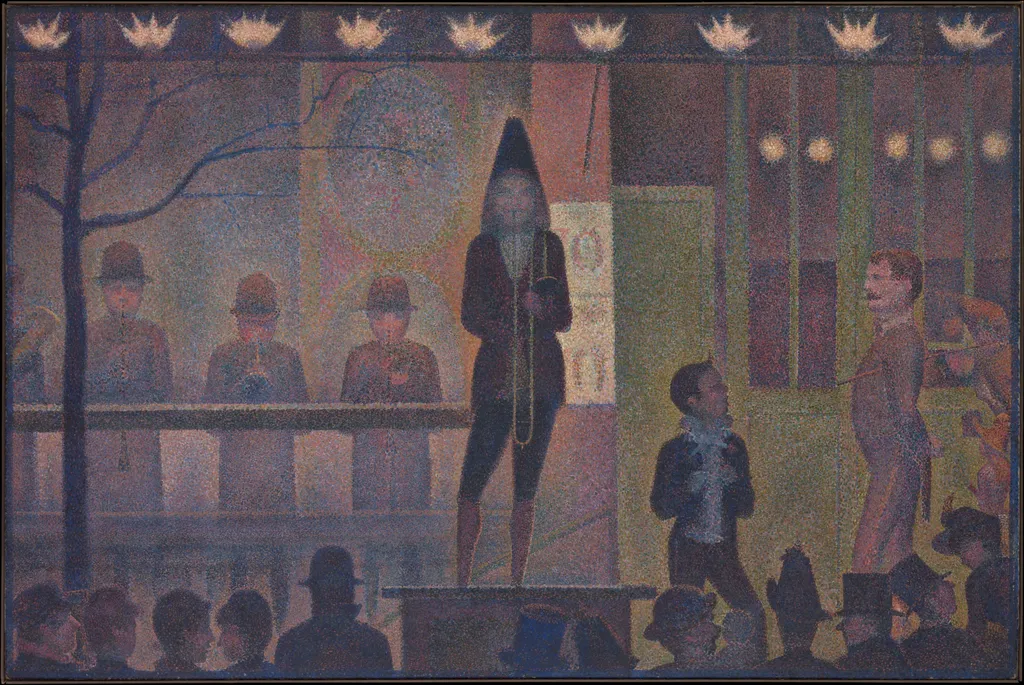
The Circus Parade is an oil painting by the Neo-Impressionist artist Georges Seurat. It is held in the collection of the Metropolitan Museum of Art.
About this work
Subject & Meaning
The work depicts the sideshow parade of the itinerant Circus Corvi at the Place de la Nation in Paris, specifically capturing musicians and acrobats performing on a platform under artificial gas lighting to attract spectators. This nocturnal genre scene features immobile figures, including cornet and trombone players arranged in a solemn, flattened formation that evokes the rhythm of Egyptian reliefs rather than classical perspective. The composition is governed by a rigid geometric structure based on simple mathematical ratios and a grid of vertical and horizontal lines, creating a sense of frozen time where form dominates content.
By applying Charles Henry's theories on the emotional implications of line direction and utilizing a divisionist technique with violet-gray and orange hues, Seurat transforms a popular entertainment subject into a mysterious, highly formalized study of light and shadow, marking his first exploration of the circus theme.
Technique & Style
9 cm, executed in Seurat’s Divisionist technique with small, juxtaposed dots of violet‑gray, blue‑gray, orange and green pigment.
The Circus Parade is an oil painting on canvas measuring 99.7 × 149.9 cm, executed in Seurat’s Divisionist technique with small, juxtaposed dots of violet‑gray, blue‑gray, orange and green pigment. The support is a regular canvas whose 1:1.5 proportion is divided into twenty‑four equal squares (four by six), providing a vertical and horizontal grid that structures the composition and the placement of figures. Seurat supplemented this geometric framework with Charles Henry’s direction theory, assigning emotional values to lines and creating a checkerboard‑like Cartesian plan.
The work’s handling reflects six years of preparatory study, and a 1990 Met examination under gas‑lamp illumination showed dramatic shifts in perceived colour and shadow, indicating the painting’s sensitivity to lighting conditions. Stylistically, the scene is markedly flattened, movement is minimized, and forms are rendered stylized and devoid of volume, emphasizing formal order over narrative detail.
History & Provenance
The Circus Parade, also known as Parade de cirque, was created by Georges Seurat between 1887 and 1888. Seurat worked on the theme for nearly six years, drawing inspiration from the Circus Corvi's sideshow at the place de la Nation in Paris during the spring of 1887. The artist employed a rigorous compositional structure based on a 1:1.5 canvas ratio divided into a grid of 24 squares, integrating theories by Charles Henry regarding line and emotion.
The work was first exhibited at the 1888 Salon de la Société des Artistes Indépendants in Paris, where it received a modest reception and was reportedly less favored by Seurat himself. Following its creation, the painting entered the collection of Stephen C. Clark and was subsequently bequeathed to the Metropolitan Museum of Art in New York in 1960. Prior to this, the work was also associated with the collection of Jacques Gelman.
The Circus Parade (Parade de cirque) is held by the Metropolitan Museum of Art in New York, where it is installed in Gallery 826. It entered the collection through the Bequest of Stephen C. Clark in 1960 and carries the accession number 61.101.17. The painting was first publicly exhibited at the 1888 Salon de la Société des Artistes Indépendants in Paris under the title Parade de cirque (catalogue no. 614), where it met with a modest reception and was overshadowed by Seurat's larger Models (Les Poseuses).
The work was subsequently neglected by Seurat himself and was not included among the major canvases listed in his personal aesthetic inventory. A 1990 technical examination of the painting was conducted at the Metropolitan Museum of Art laboratory under gas-lamp-simulating illumination, revealing how Seurat's Divisionist palette was calibrated to the contre-lumiere effect of the depicted scene.
Context
Circus Parade (Parade de cirque) holds a complex position in art history, marked initially by cool reception and later by reassessment. When exhibited at the 1888 Salon des Indépendants, the canvas was overshadowed by Seurat's larger Models (Les Poseuses) and was characterized by critic Gustave Kahn as "so willfully pallid and sad"; Seurat himself subsequently neglected the work and excluded it from his list of major canvases. Later scholarship reframed this judgment.
Alfred H. Barr Jr. described it as one of Seurat's most important paintings, citing its "formality," "symmetry," and its status as "the most geometric in design as well as the most mysterious in sentiment" among his major canvases. Robert Herbert, examining the work under gas-lamp illumination in 1990, documented an "extraordinary transformation" in which Seurat's contre-lumière effects resolved into naturalistic flesh tones and shadows. The painting is now recognized as a foundational Neo-Impressionist work that influenced the Fauves, Cubists, Futurists, and Orphists, and it is held at the Metropolitan Museum of Art as a bequest of Stephen C. Clark.
Legacy
Initially shown at the 1888 Salon des Artistes Indépendants, the painting received modest acclaim and was later reevaluated as a pivotal work that shaped modernist developments. Critics such as Alfred H. Barr Jr. highlighted its formal geometry and innovative use of light, calling it one of Seurat’s most important canvases. Its influence extended to the Fauves, Cubists, Futurists and Orphists, who cited its structured composition and flattened space as a model for later abstraction.
The work’s significance for subsequent artistic experiments, including the ballet Parade, is noted in French and Italian encyclopedias, underscoring its enduring legacy in art history.
Overview
Georges Seurat's painting, The Circus Parade, completed between 1887 and 1888, is a significant example of Neo-Impressionist art. Rendered in oil, it captures a scene of popular entertainment. This work is notable as Seurat's initial exploration of a nocturnal setting and public spectacle.
Despite its initial reception, it is now housed in the collection of the Metropolitan Museum of Art in New York.
Own this work as a print
Artist & collection
Artist
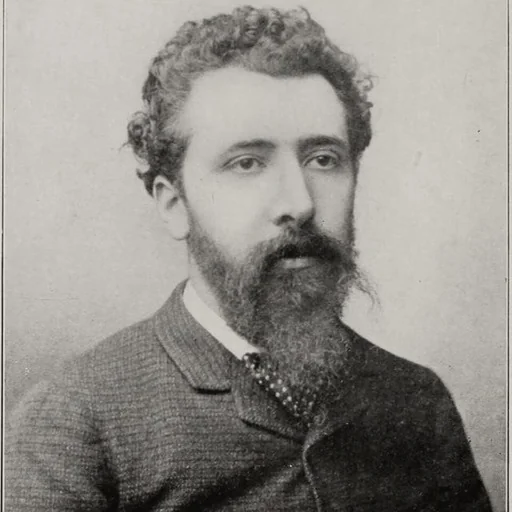
Georges Pierre Seurat (UK: SUR-ah, -ə, US: suu-RAH; French:; 2 December 1859 – 29 March 1891) was a French post-Impressionist artist.

 Studied in the Color & Light course