Artwork
Views of Rome: Temple of Cybele
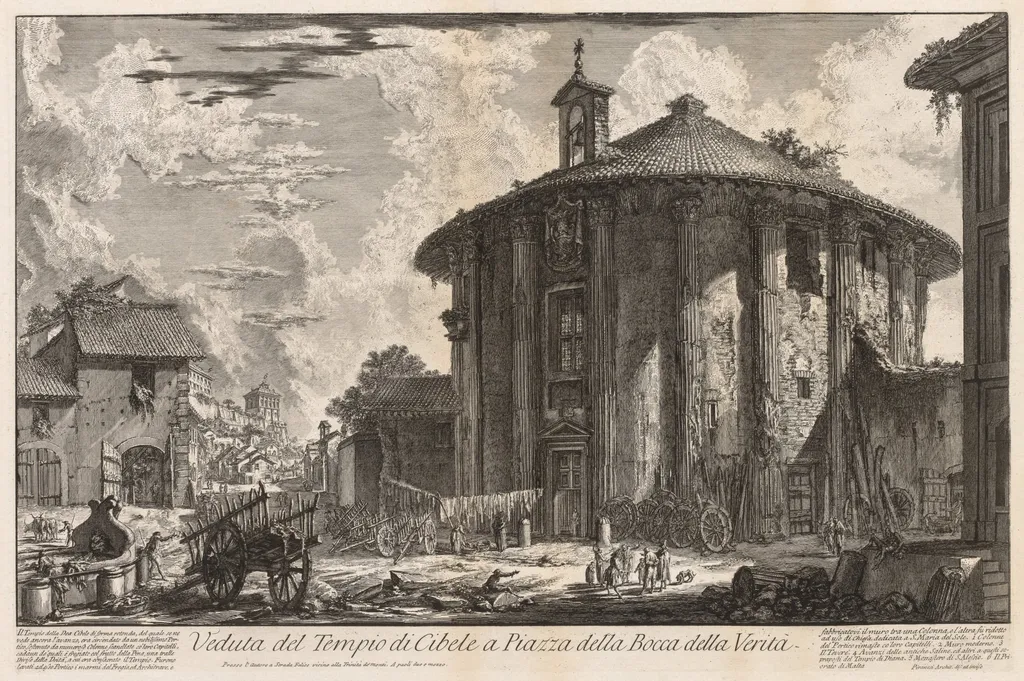
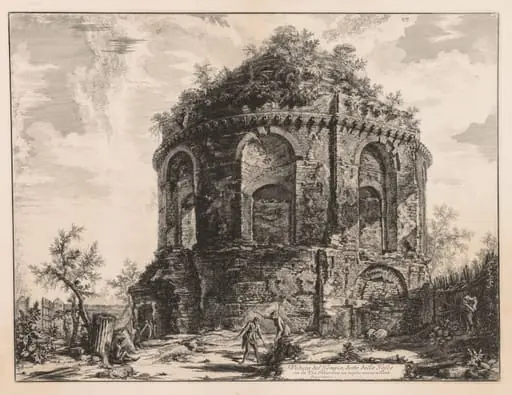
Views of Rome: Temple of Cybele is a print by the Romanticist artist Giovanni Battista Piranesi. It dates from 1758 and is held in the collection of the Cleveland Museum of Art.
- Accession no.
- 1941.146
- Credit line
- Gift of Mrs. Henry S. Upson
About this work
Overview
Created in 1758, this print by Giovanni Battista Piranesi captures a fragment of ancient Rome amid active urban life. Part of a series documenting the city’s architectural remains, it presents the Temple of Cybele not as a preserved monument but as a structure integrated into the rhythms of daily existence. The work reflects Piranesi’s interest in the layered history of Rome’s built environment.
Subject & Meaning
Rather than idealizing the structure, Piranesi shows it weathered and partially reclaimed by the city, surrounded by modest dwellings, passersby, and carts.
The print centers on the ruins of a temple dedicated to Cybele, an ancient Phrygian mother goddess whose cult was adopted in Rome. Rather than idealizing the structure, Piranesi shows it weathered and partially reclaimed by the city, surrounded by modest dwellings, passersby, and carts. This juxtaposition suggests continuity between antiquity and contemporary Roman life, emphasizing time’s passage rather than mere decay.
Technique & Style
Piranesi employed etching to achieve fine detail and dramatic contrast. Deep shadows and sharp highlights, characteristic of chiaroscuro, enhance the texture of weathered stone, carved reliefs, and crumbling surfaces. The composition directs attention to the temple’s grandeur while grounding it in the clutter of ordinary streets, using scale and lighting to evoke both awe and intimacy.
History & Provenance
The print was produced during Piranesi’s early years in Rome, when he was developing his reputation through detailed architectural studies. It entered The Cleveland Museum of Art’s collection as part of a broader acquisition of his vedute, or city views. Its preservation reflects the 19th-century European fascination with Roman antiquity and the role of printmaking in disseminating such imagery.
Context
In the mid-18th century, Rome was a destination for Grand Tour travelers and scholars drawn to its ruins. Piranesi’s prints responded to this interest by documenting structures with archaeological precision while infusing them with emotional weight. His work differed from idealized classical views, instead presenting ruins as living elements within an evolving urban fabric.
Legacy
Piranesi’s approach influenced later generations of architects and artists who saw in his prints a model for engaging with historical layers rather than erasing them. His emphasis on atmospheric effect and the coexistence of antiquity with modernity helped shift perceptions of ruins from relics to dynamic parts of the urban landscape, shaping how cities are visually interpreted today.
Own this work as a print
Artist & collection

Artist
Giovanni Battista (or Giambattista) Piranesi (Italian pronunciation:; also known as simply Piranesi; 4 October 1720 – 9 November 1778) was an Italian classical archaeologist, architect, and artist, famous for his…

 Views of Rome: The So-called Tempio della Tosse, near Tivoli
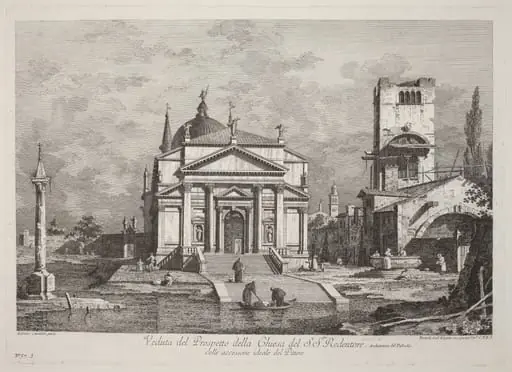 Veduta del Prospetto della Chiesa del SS. Redentore
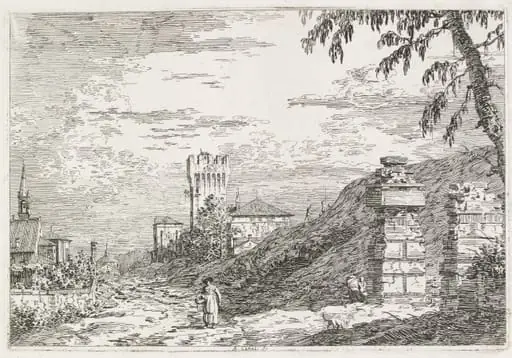
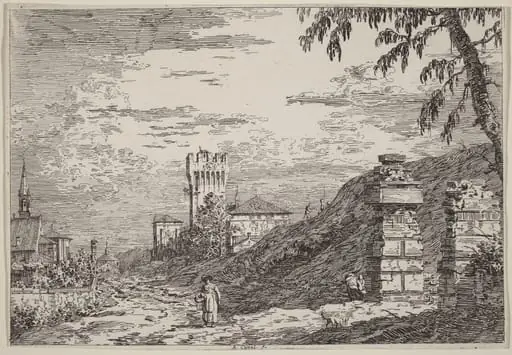 Landscape with Tower and Two Ruined Pillars
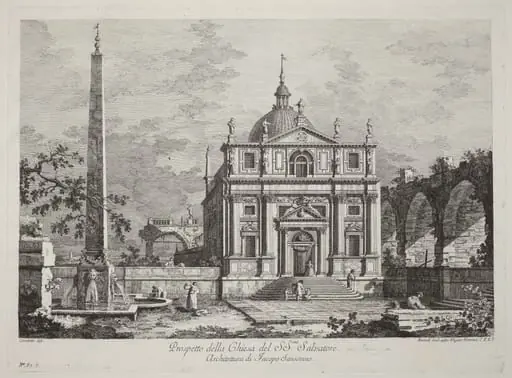 Prospetto della Chiesa del SS. Salvatore
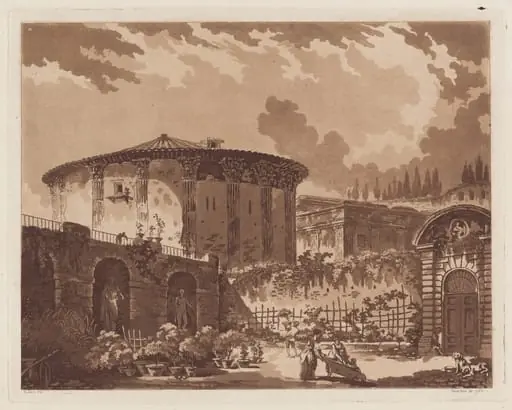 View in the Garden of a Roman Villa, with the Temple of Hercules Victor and the Temple of Portunus
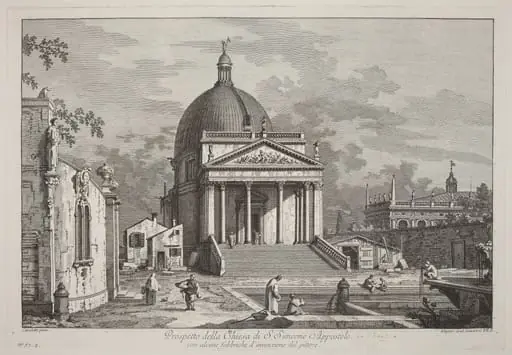 Prospetto della Chiesa di S. Simeone Appostolo
 Views: Two Ruined Pillars
 Views: The Portico with the Lantern
 The Little Trellis