Artwork
Lamentation of Christ
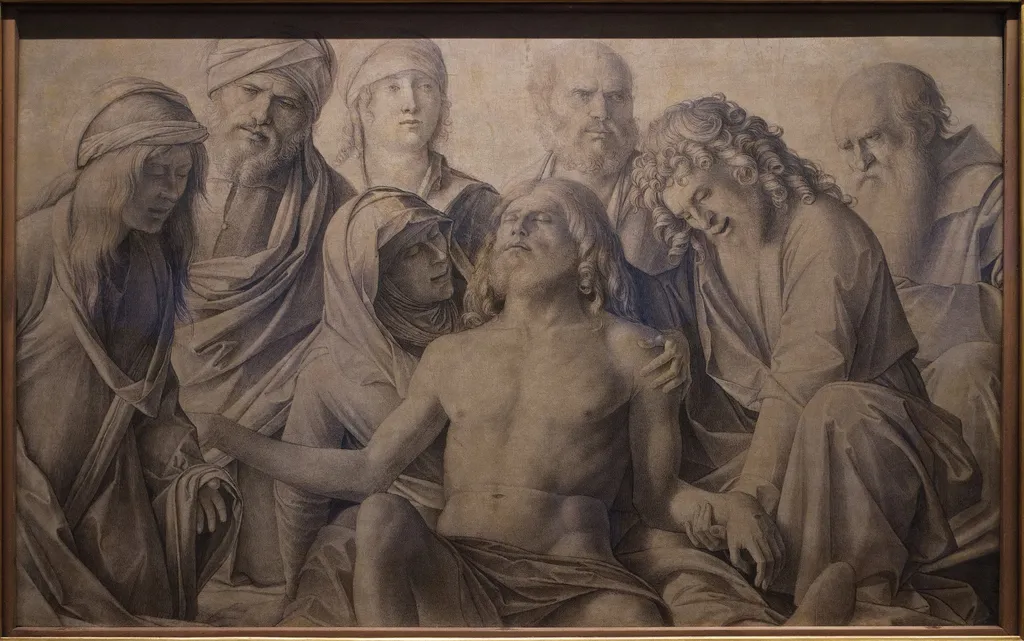
Lamentation of Christ is an oil painting by the Early Renaissance artist Giovanni Bellini. It dates from 1496 and is held in the collection of the Uffizi Gallery.
About this work
Overview
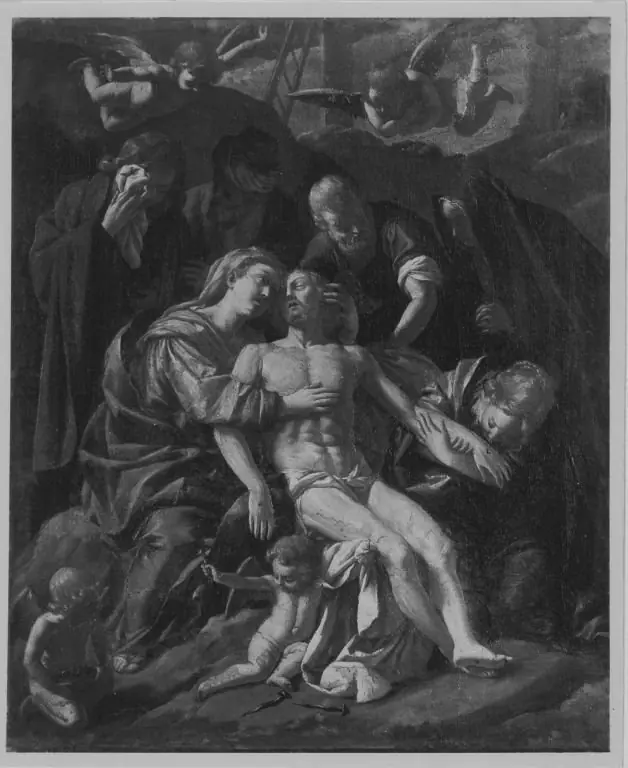
Measuring 76 by 121 centimeters, the work depicts the mourning of Christ and is distinguished by its monochromatic, graphic appearance.
Lamentation of Christ is an oil on panel painting by the Italian Renaissance master Giovanni Bellini, executed around 1490 to 1500. Measuring 76 by 121 centimeters, the work depicts the mourning of Christ and is distinguished by its monochromatic, graphic appearance. Unlike typical polychrome altarpieces, this composition utilizes a restricted palette of muted grays, browns, and blacks over a beige ground, leading to debates regarding its completion status. The painting entered the Uffizi Gallery in Florence on October 22, 1798, where it remains on display today.
Subject & Meaning
The work portrays the biblical Lamentation, featuring a pale, lifeless Christ seated centrally with his head tilted back. He is supported by an expressive Madonna and Saint John the Baptist. To the left, Mary Magdalene and Joseph of Arimathea are recognizable among the mourners. Three fainter figures occupy the background: a young girl, a bald bearded man, and the long-bearded Nicodemus. The tight, semi-circular arrangement of seven figures creates a crowded, intimate scene of grief. Christ's foreshortened, protruding knees break the picture plane, creating an illusionistic connection with the viewer and heightening the emotional pathos of the divine image.
Technique & Style
Executed in oil on a wooden panel, the painting adopts a pronounced chiaroscuro style. The beige ground is not a preparatory layer but a substantial, intentional layer of paint. Precise linear hatching and smooth tonal gradations model the faces and draped garments, demonstrating careful attention to anatomical detail and fabric folds. Soft, directional light emerges from a blank, neutral space devoid of background setting. While the restricted palette suggests a monochromatic sketch or underdrawing, the high degree of finish and intentional composition establish it as a finished work for its wooden support, distinguishing it from mere workshop graphics.
History & Provenance
Scholars date the painting to the peak of Bellini's maturity at the turn of the 16th century. It may have served as a reference model for the artist's workshop or as a preparatory base for a painting never completed in color. Doge Alvise Giovanni Mocenigo gifted the work to Ferdinand III, Grand Duke of Tuscany, in exchange for a gold and gem-encrusted pietra dura snuffbox. Ferdinand III subsequently donated the painting to the Uffizi Gallery on October 22, 1798. A related study for the figure of Nicodemus, possibly from Bellini's workshop, resides in the Uffizi's Gabinetto dei disegni e delle stampe.
Context
Critics unanimously assign the Lamentation to Bellini's period of full maturity. Compared to his other Pietà compositions, this work is notably more crowded, departing from the sparer arrangements seen elsewhere in his oeuvre. The decision to exhibit the work in the main museum galleries rather than the prints and drawings cabinet reflects its critical evaluation as a highly finished pictorial achievement rather than a mere graphic exercise. The intense pathos dominating the composition and the sophisticated illusionism of the foreshortened anatomy underscore Bellini's late mastery of emotional and spatial representation.
Own this work as a print
Artist & collection

Artist
Giovanni Bellini (Italian: ; Venetian: Zuane Belin; c. 1430 – 29 December 1516) was an Italian Renaissance painter, probably the best known of the Bellini family of Venetian painters. He was raised in the household of…