Artwork
An Episode from the Life of Publius Cornelius Scipio
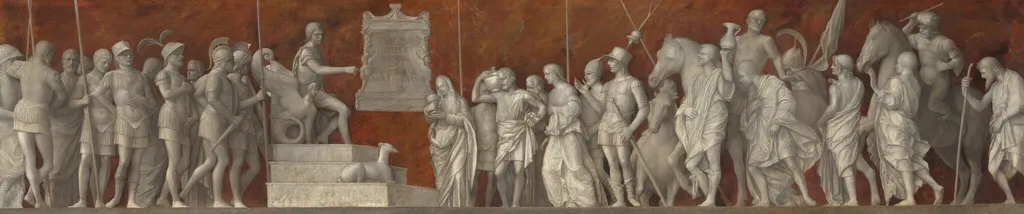
An Episode from the Life of Publius Cornelius Scipio is an oil painting by the High Renaissance artist Giovanni Bellini. It dates from 1506 and is held in the collection of the National Gallery of Art.
- Inscription
- Inscribed:upper center on plaque: TVRPIVS / IMPER / VENERE / .Q. A. / MIS AI
About this work
Subject & Meaning
Scipio sits enthroned at left, while the maiden stands before him with Allucius, who wears sword and helmet; her parents offer gold nearby.
The painting depicts the Continence of Scipio, an episode from the Second Punic War drawn from Livy and Valerius Maximus. After capturing Carthago Nova in 209 BC, Scipio Africanus receives a beautiful virgin hostage but refuses to keep her, instead returning her to her parents and Celtiberian fiancé Allucius without accepting their gold ransom. His sole condition is that her betrothed work for peace between Rome and Carthage.
Scipio sits enthroned at left, while the maiden stands before him with Allucius, who wears sword and helmet; her parents offer gold nearby. A central plaque bears the inscription "TVRPIVS / IMPER / VENERE /.Q. A. / MIS AI." The subject celebrates Roman civic virtue and magnanimity, themes particularly resonant for the Cornaro family, who claimed descent from the ancient Cornelia gens.
Bellini executed the work in grisaille, a monochrome technique associated with Mantegna, though his softer chiaroscuro and more animated figures reflect Giorgione's influence rather than Mantegna's rigid classicism.
Technique & Style
Executed in oil on canvas and measuring 74.8 by 356.2 cm, the work adopts the grisaille (monochrome) manner that was a hallmark of Andrea Mantegna, with whom Bellini had trained and who was his brother-in-law. Bellini took over the commission after Mantegna's death in 1506, and the painting is conceived as a pendant to Mantegna's Introduction of the Cult of Cybele at Rome, sharing its format. Stylistically, Bellini's soft, enveloping chiaroscuro and more animated figures diverge from Mantegna's rigid, archaeological classicism, reflecting his absorption of Giorgionesque innovations while resisting influence from Dürer.
The more peripheral figures are attributed to Bellini's workshop, contrasting with the master's own handling in the central group.
History & Provenance
The painting was probably commissioned in 1505 by Cardinal Marco Cornaro for the studiolo of his brother Francesco Cornaro's palace in San Polo, Venice, though it was originally intended for Andrea Mantegna, who only completed a companion piece before his death in 1506. Giovanni Bellini, then elderly, took over the commission, executing it in grisaille around 1506–1508. After remaining with the Cornaro family, the work reappeared in 1873 when Sir John Charles Robinson sold it to Sir Francis Cook, 1st Bt., at Doughty House, Richmond.
It descended through three generations of Cooks until Sir Francis Ferdinand Maurice Cook sold it in February 1948 to Gualtiero Volterra, agent for Count Alessandro Contini Bonacossi of Florence. The Kress Foundation acquired it in March 1949 and gifted it to the National Gallery of Art in 1952.
The painting is held by the National Gallery of Art in Washington, D.C., as part of the Samuel H. Kress Collection. It was given to the NGA in 1952 by the Samuel H. Kress Foundation, which had acquired it in March 1949 from Count Alessandro Contini Bonacossi of Florence, who had purchased it in February 1948 through his London agent Gualtiero Volterra from Sir Francis Ferdinand Maurice Cook, 4th Bt., at Doughty House, Richmond, and Cothay Manor, Somerset. It had descended through the Cook family after Sir Francis Cook, 1st Bt., acquired it in 1873 from Sir John Charles Robinson, and is documented as no. 133 in Maurice Brockwell's 1932 abridged catalogue of Doughty House. The painting's documented exhibition history includes "Mantegna and Bellini."
Context
The painting represents a significant late-career intersection between Giovanni Bellini and Andrea Mantegna, whose early training had been shared. Roberto Longhi (1951) reconnected the work with Mantegna's 'The Introduction of the Cult of Cybele at Rome,' proposing they formed a planned series for Francesco Cornaro's studiolo, though documentary evidence remains lacking. Longhi also suggested two smaller grisaille works by Mantegna ('Sofonisba' and 'Tuccia') as possible companions, but scholars note the discrepancy in supports, canvas versus panel, makes this hypothesis improbable.
Art historically, the work demonstrates Bellini's divergence from Mantegna's rigid classicism: despite employing the grisaille format associated with his brother-in-law, Bellini introduced softer, more enveloping chiaroscuro and greater figural animation, incorporating Giorgione's innovations while resisting Dürer's influence. The peripheral figures are attributed to Bellini's workshop. Scholars emphasize this commission as the final professional convergence of two artists whose careers had diverged substantially by the early sixteenth century.
Overview
Giovanni Bellini's oil on canvas painting, known as An Episode from the Life of Publius Cornelius Scipio, was completed between 1507 and 1508. This Renaissance work, currently housed at the National Gallery of Art in Washington, D.C., portrays a significant event from ancient Roman history. The composition reflects the artist's engagement with classical narratives, presenting a detailed visual account of a celebrated general's actions.
Artist & collection

Artist
Giovanni Bellini (Italian: ; Venetian: Zuane Belin; c. 1430 – 29 December 1516) was an Italian Renaissance painter, probably the best known of the Bellini family of Venetian painters. He was raised in the household of…


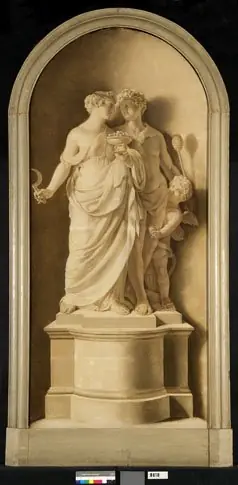
- Ceres, Bacchus en Amor
 Overdoor Painting
 The Presentation of Christ in the Temple, and the Baptism of Christ
 Annunciation of the birth of John the Baptist
 The Death of Achilles
 Justice of Brutus
 The Death of Achilles
 Allegorie
 St Barbara pursued by her Father
 Königin von Saba vor Salomon
 Allegory of the arts
 A Sculptor's Studio