Artwork
The Feast of the Gods
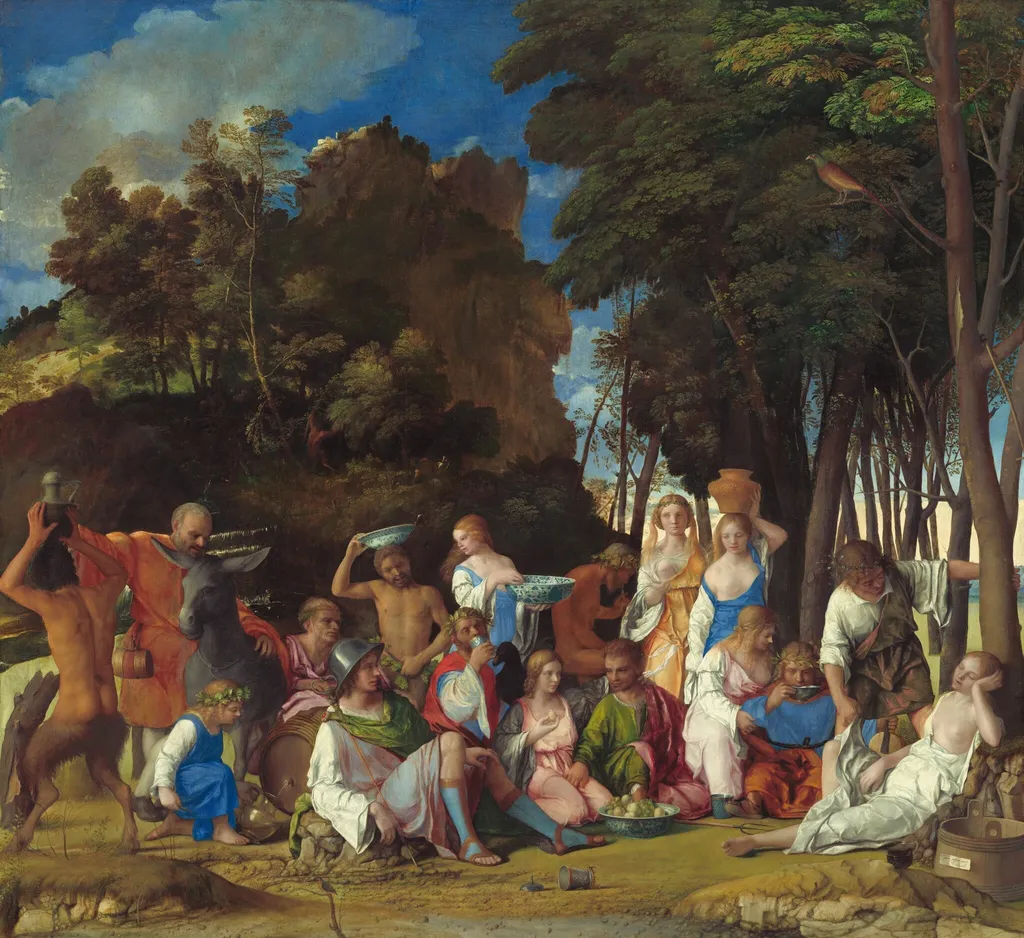
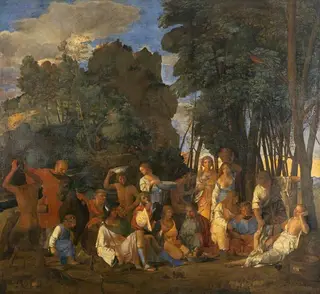
The Feast of the Gods is an oil painting by the High Renaissance artist Giovanni Bellini. It is held in the collection of the National Gallery of Art.
- Inscription
- Inscribed:lower right on wooden tub: joannes bellinus venetus / p MDXIIII
About this work
Gods feast at a table under the trees. Bellini painted the scene twice, first in 1514 and again in 1529 after damage, the second version adding figures and richer color. Myth mixes with earthy realism, and the soft light and glowing fabrics show the Venetian touch.
Subject & Meaning
The scene unfolds in a lush, idyllic landscape, where Olympian deities, satyrs, and nymphs gather in a convivial yet subtly charged atmosphere.
Giovanni Bellini’s The Feast of the Gods (1514) depicts a mythological banquet drawn from Ovid’s Fasti, specifically the moment before the attempted seduction of the nymph Lotis by Priapus. The scene unfolds in a lush, idyllic landscape, where Olympian deities, satyrs, and nymphs gather in a convivial yet subtly charged atmosphere. At the right, Priapus lurks near the sleeping Lotis, while Silenus’s braying ass, central to the narrative, occupies the left, foreshadowing the comic disruption of the feast.
The figures, identified as Jupiter, Mercury, Neptune, Apollo, and others, are rendered with humanizing realism, eschewing idealized grandeur for earthy intimacy. Symbolic details, such as the quince held by a female figure, a fruit associated with fertility, and the Ming porcelain vessels, underscore themes of abundance and courtly sophistication. The work’s meaning lies in its duality: a celebration of classical pastoral ideals and a playful, almost ironic meditation on desire and folly within the pantheon.
History & Provenance
Commissioned in 1514 by Alfonso I d’Este, Duke of Ferrara, The Feast of the Gods was the inaugural work for his camerino d’alabastro, a private chamber designed to showcase mythological cycles. The humanist Mario Equicola selected the Ovidian subject by 1511, providing Bellini with thematic guidelines. Bellini completed the figures and foreground by 1514, as confirmed by a signed cartellino and a payment record dated November 14, 1514.
After Bellini’s death in 1516, Dosso Dossi and Titian successively modified the landscape, Dosso adding classical elements and Titian, c. 1529, repainting the left side to harmonize with his own Bacchanal of the Andrians. The work remained in the Este collection until Ferrara’s annexation by the Papal States in 1598, when it entered the Aldobrandini collection before passing through the Borghese, Camuccini, and Northumberland families, ultimately reaching the National Gallery of Art in 1942.
The Feast of the Gods is held by the National Gallery of Art in Washington, D.C., where it has been part of the collection since 1942. It was acquired that year as a gift from Joseph E. Widener, son of the American businessman Peter A.B. Widener, who had purchased the work in 1922 for his estate, Lynnewood Hall, north of Philadelphia. Earlier, in 1853, the painting had been sold with the entire Camuccini collection by Giovanni Battista Camuccini to Algernon Percy, 4th Duke of Northumberland, at Alnwick Castle.
The provenance traces back through the Camuccini family (acquired 1796/1797 by Pietro Camuccini for his brother Vincenzo), the Borghese Aldobrandini heirs (from 1769), and the Aldobrandini line, into whose possession the canvas entered in 1598 when Cardinal Pietro Aldobrandini confiscated it from the Castello at Ferrara. Originally commissioned by Alfonso I d'Este for his camerino d'alabastro at the Castello Estense, the painting was recorded in Aldobrandini inventories of 1603 and 1626 and in Olimpia Aldobrandini Borghese Pamphilj's pre-1665 and 1682 posthumous inventories. The National Gallery of Art displays it in a dedicated room as one of its Renaissance masterpieces.
Context
The Feast of the Gods (1514) is Bellini’s only major mythological canvas and his last major work, commissioned by Alfonso I d'Este for the camerino d'alabastro in Ferrara. The painting, signed and dated 1514, introduced the first large‑scale Renaissance treatment of the Ovidian feast of the gods and remained a reference point for Northern Mannerist depictions. Bellini, then over eighty and inexperienced in mythological iconography, rendered the deities in a surprisingly earthy manner, with figures possibly modeled on members of the Ferrara court.
Subsequent landscape revisions by Dosso Dossi and Titian integrated the composition with later bacchanalia in the same room. The work’s scholarly significance lies in its role as a visual synthesis of humanist themes and Venetian technique, influencing later mythological painting.
Legacy
The Feast of the Gods holds a pivotal place in Renaissance art as the first major depiction of its mythological subject, establishing a visual template that endured until the late Northern Mannerist period. Its influence extended to the camerino d’alabastro of Alfonso I d’Este, where it shaped the stylistic cohesion of subsequent works by Titian and Dosso Dossi, including Bacchus and Ariadne and The Bacchanal of the Andrians. Praised by the National Gallery of Art as "one of the greatest Renaissance paintings in the United States," the work’s blend of Venetian tonalism and humanist classicism redefined mythological painting, bridging Bellini’s religious solemnity with the emerging pastoral idylls of Giorgione and Titian.
Its technical refinements and narrative ambiguity, such as the Ovidian scene’s understated eroticism, inspired later interpretations of classical themes, cementing its legacy as a cornerstone of the High Renaissance.
Overview
Giovanni Bellini's The Feast of the Gods, an oil on canvas, represents a rare mythological subject within the Venetian master's oeuvre. Originally completed in 1514, it underwent subsequent revisions, notably in 1529, and features landscape contributions from Dosso Dossi and Titian. This painting, considered Bellini's final major work, is now housed in the National Gallery of Art in Washington D.C., where it holds a prominent position among Renaissance holdings.
Technique & Style
Executed in oil on canvas, The Feast of the Gods exemplifies the Venetian school's distinctive aesthetic. The painting is characterized by its luminous quality, with soft light illuminating figures and drapery, rendering fabrics with a rich, glowing texture. The later revisions, particularly the 1529 iteration, introduced even more vibrant colors and additional figures, enhancing the visual richness and complexity of the composition.
Own this work as a print
Artist & collection

Artist
Giovanni Bellini (Italian: ; Venetian: Zuane Belin; c. 1430 – 29 December 1516) was an Italian Renaissance painter, probably the best known of the Bellini family of Venetian painters. He was raised in the household of…