Artwork
Santa Trinità dei Monti in the Snow
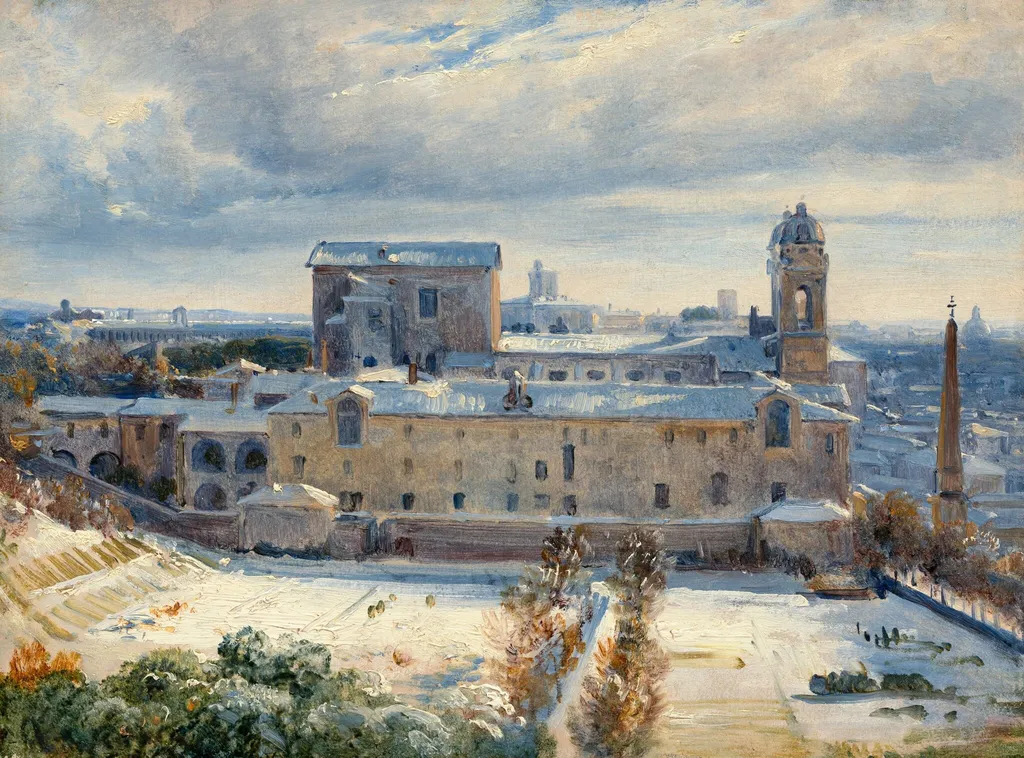
Santa Trinità dei Monti in the Snow is an oil painting by the Romanticist artist André Giroux. It dates from 1828 and is held in the collection of the National Gallery of Art.
- Inscription
- Inscribed:on edge of paper tape folded over top stretcher bar, reverse, in ink: A. Giroux 1825 [or 1829?]
About this work
Overview
, where it entered the collection in 1997 as a purchase through the Chester Dale Fund.
Santa Trinità dei Monti in the Snow is an oil painting on paper mounted on canvas by the French artist André Giroux, created around 1827 during his residency at the Académie de France in Rome. Measuring 22 by 30 centimeters, this compact winter cityscape depicts the famous church and convent of Santissima Trinità dei Monti on Rome's Pincian Hill, blanketed in snow. The work is now held by the National Gallery of Art in Washington, D.C., where it entered the collection in 1997 as a purchase through the Chester Dale Fund. The painting matters as a significant example of early nineteenth-century French open-air landscape practice, bridging the gap between academic tradition and the more naturalistic, immediate approach to nature that would increasingly characterize the century. It also documents a rare meteorological event in Rome and preserves a specific viewpoint from the Villa Medici, the seat of the French Academy, during a formative period for Giroux and his contemporaries.
Subject & Meaning
The painting depicts a panoramic view of the church and convent of Santissima Trinità dei Monti, seen from the north side of the Villa Medici on the Pincian Hill. In the foreground lies the convent's snow-covered kitchen garden, with patches of exposed earth and scattered vegetation including rows of trees and shrubs. The central architectural complex presents a long horizontal facade with multiple windows and arched openings, flanked by a taller block with pitched roof and a separate bell tower capped with a dome. To the right stands the obelisk that marks the top of the Spanish Steps. Beyond the church, the Palazzo Quirinale blocks the horizon. No human figures appear in the scene, emphasizing the quiet solitude of the wintry day. The iconography is primarily topographical and atmospheric rather than symbolic or narrative. The snow itself is the exceptional element, as Rome rarely experiences significant snowfall, making this view a record of an unusual meteorological occurrence. The absence of people and the muted, diffused illumination create a contemplative, almost meditative mood that privileges the experience of weather and light over human activity or historical anecdote.
Technique & Style
The medium is oil on paper mounted on canvas, a support commonly used by Giroux and his contemporaries for open-air studies because prepared paper was lightweight and portable. The dimensions of 22 by 30换算为 22 by 30 centimeters indicate a small, intimate format typical of such sketches. The palette consists of cool blues, whites, and grays, with touches of warm ochre and brown in the architecture and dormant foliage. Light enters from the left, casting soft shadows and creating hazy atmospheric depth; distant buildings fade into a blue-gray horizon. The brushwork is visibly varied: thicker, more textured strokes appear in the foreground snow and clouds, while smoother, more blended handling characterizes the middle-distance architecture. The sky occupies the upper half of the canvas, filled with sweeping, textured clouds that allow glimpses of lighter tones to break through. Philip Conisbee noted that Giroux brilliantly combines sharp topographical accuracy with a lively, sketchy, painterly touch. The work was most likely painted from a window rather than strictly in the open air, since winter conditions would have made outdoor work impractical. An old pencil inscription on the stretcher reads "A. Giroux 1825 [or 1829?]", suggesting the date of 1827-1828 that is consistent with Giroux's residence at the Villa Medici. The painting is not signed.
History & Provenance
The painting's creation dates to Giroux's period of study at the Académie de France in Rome, where he resided from 1825 to 1830 after winning the Prix de Rome for historical landscape in 1825. The date of 1827-1828, suggested by an old pencil inscription on the stretcher, falls within this residency. The provenance traces from a private collection in France, through John Lishawa in London, and Didier Aaron Gallery, Inc. in New York, from which it was purchased by the National Gallery of Art on June 2, 1997, using the Chester Dale Fund. The accession number is 1997.65.1. The work has been exhibited at least twice in major shows: in 2000-2001 at the National Gallery of Art in "Art for the Nation: Collecting for a New Century," where it appeared as an unnumbered catalogue entry with reproduction; and in 2020-2022 in the traveling exhibition "True to Nature: Open-Air Painting in Europe, 1780-1870," which visited the National Gallery of Art, Washington; Fondation Custodia, Collection Frits Lugt, Paris; and The Fitzwilliam Museum, Cambridge, where it was catalogue number 91 with reproduction.
Context
André Giroux was born in Paris in 1801, first studying painting under his father and beginning to exhibit landscapes at the Salon in 1819. He entered the École des Beaux-Arts in 1821 and won the Prix de Rome in 1825, which took him to Rome until 1830. There he associated with a circle of innovative young landscape painters including Jean-Baptiste-Camille Corot, Théodore Caruelle d'Aligny, Edouard Bertin, and Léon Fleury. Although idealized historical landscapes won official academic favor, Giroux and his contemporaries shared a passion for working out-of-doors, seeking to capture their experience of nature as immediately as possible by painting in oils, usually on prepared paper, in the open air. In 1831, Giroux submitted a group of such oil studies made in Italy for exhibition at the Paris Salon, where they won him a gold medal, indicating growing public and official acceptance of a more naturalistic aesthetic immediately following the Revolution of 1830. Giroux continued exhibiting at the Salon until 1877 and later developed an interest in photography. The painting has been discussed in scholarly literature including Lorenz Eitner's "French Paintings of the Nineteenth Century, Part I: Before Impressionism" (2000) and John Oliver Hand's "National Gallery of Art: Master Paintings from the Collection" (2004).
Legacy
Santa Trinità dei Monti in the Snow stands as an important document of the early nineteenth-century French landscape tradition and the cultural phenomenon of the Prix de Rome. It exemplifies the shift from idealized, studio-composed historical landscapes toward more immediate, observation-based approaches that would eventually lead to Impressionism. The work's inclusion in the National Gallery of Art's systematic catalogue and its selection for major exhibitions, including the widely traveled "True to Nature: Open-Air Painting in Europe, 1780-1870," attest to its continued scholarly and institutional significance. As a record of Giroux's association with Corot and other progressive landscape painters in Rome, it helps illuminate the collaborative and competitive environment that fostered innovation in French landscape painting. The painting also preserves a specific moment in the history of the Villa Medici and its role as a crucible for French artistic talent. Its acquisition by the National Gallery of Art in 1997 strengthened the museum's holdings in early nineteenth-century French landscape, filling an important gap in the narrative of plein-air painting before the Barbizon School and Impressionism.
Own this work as a print
Artist & collection

Artist
André Giroux (April 30, 1801 – November 18, 1879) was a French photographer and painter.

 View of Ariccia
 The Aventine from the Palatine
 Torvet i Sulmona
 Porta Angelica and Part of the Vatican
 The Market Place in Priverno
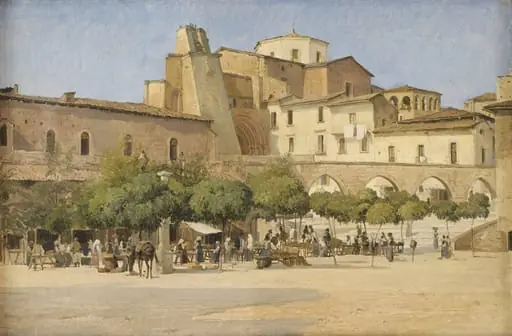 Torvet i Sulmona
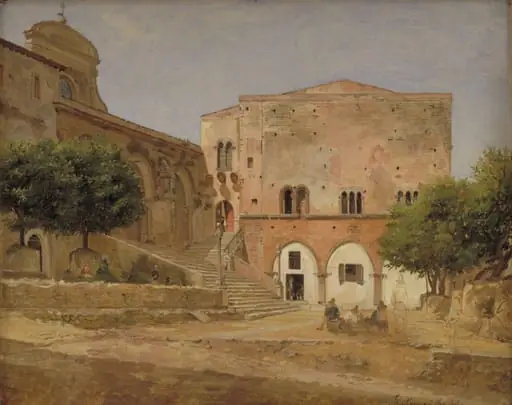 The Market Place in Priverno
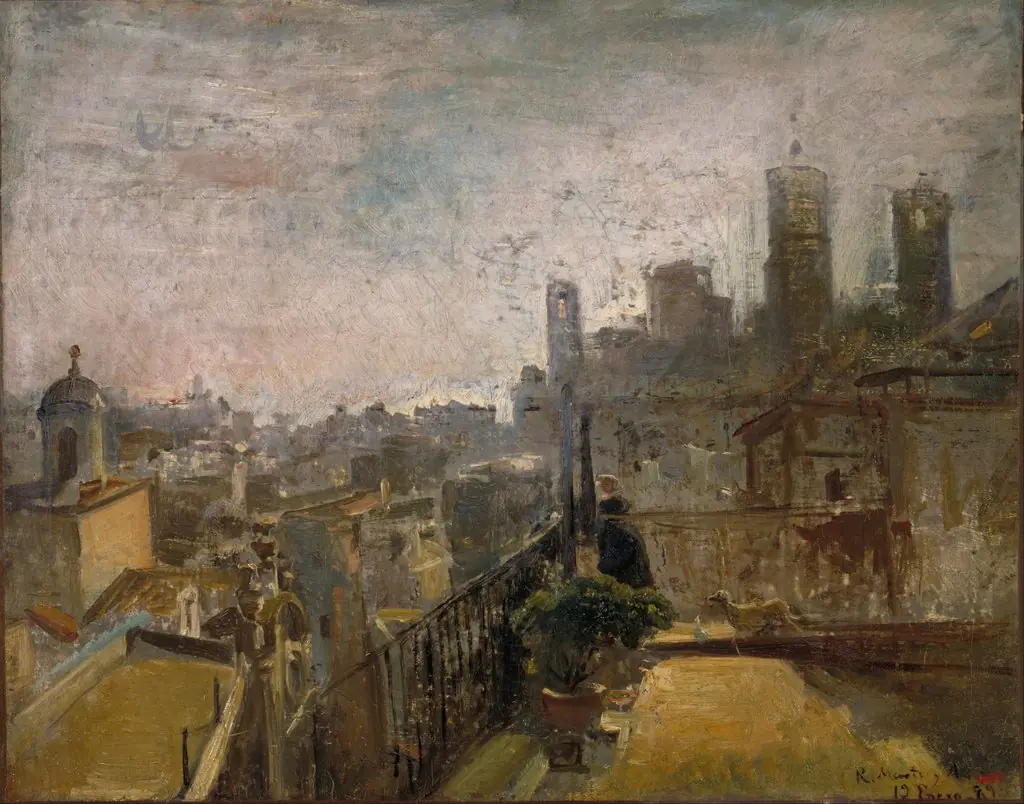 View of Barcelona from a Rooftop in Riera de Sant Joan
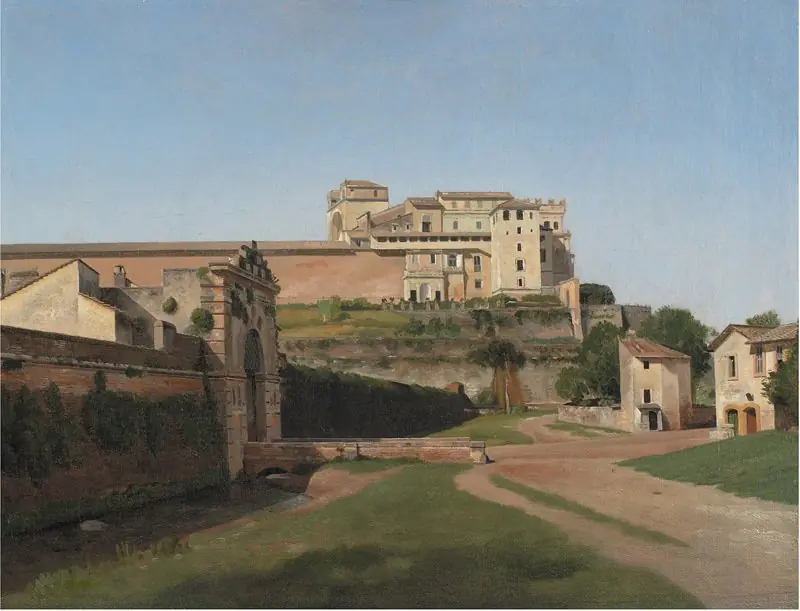 Porta Angelica and Part of the Vatican
 Iarnă
Iarnă Monte Pincio, Rome
- Garden in Snow