Artwork
One Hundred Horses

One Hundred Horses is an ink painting by the Qing dynasty painting artist Giuseppe Castiglione. It dates from 1728 and is held in the collection of the National Palace Museum.
About this work
Subject & Meaning
The composition’s right-to-left movement culminates in three horses crossing a river, guiding the viewer’s eye across the 7.
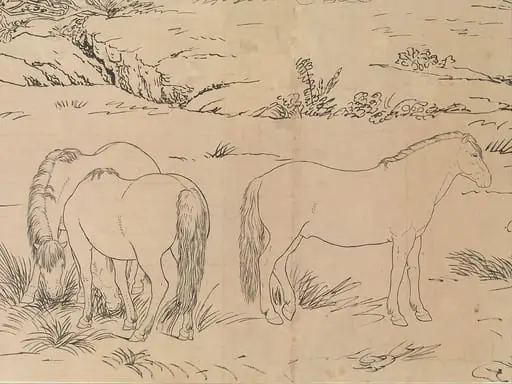
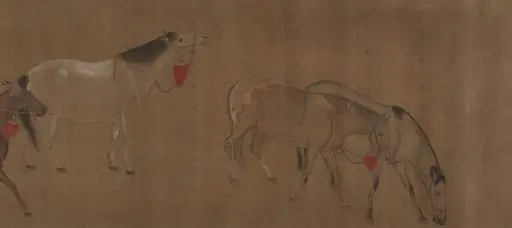
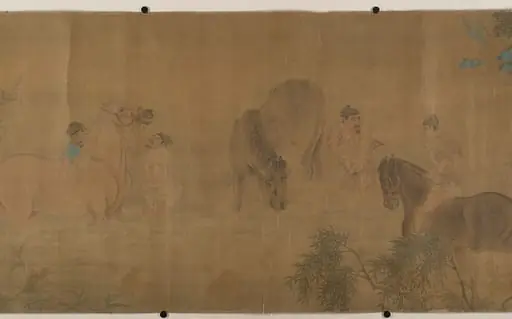
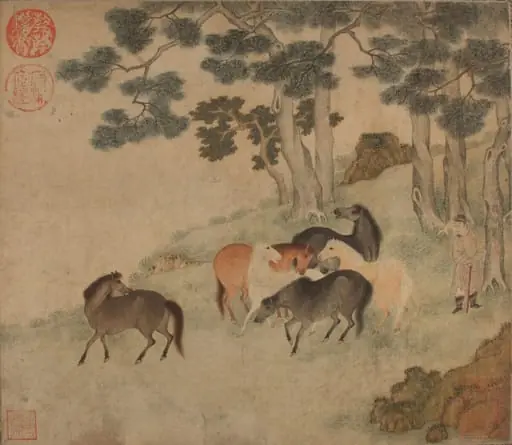
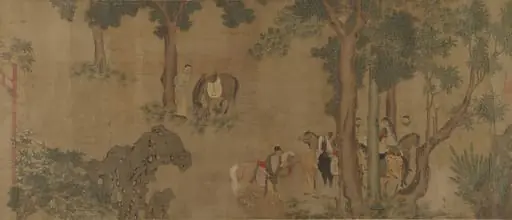
The scroll depicts over a hundred horses in varied poses, some resting by a river, others galloping, set within a layered landscape of rivers, mountains, and trees. Castiglione merged European perspectival techniques with Qing-dynasty conventions: chiaroscuro and volumetric modeling appear alongside Chinese compositional devices such as unpainted voids and symbolic flora. Trees carry Buddhist associations, the pine conveys longevity, the oak masculine strength, the willow humility, the maple abundance, and the sophora encounters with immortals, while lingzhi mushrooms at their roots signify sacred auspiciousness. The inclusion of a partially nude groom reflects Castiglione’s negotiation between European realism and Chinese decorum, reducing overt figural exposure in the final scroll compared to an earlier sketch. The composition’s right-to-left movement culminates in three horses crossing a river, guiding the viewer’s eye across the 7.76-meter horizontal format. By synthesizing Western spatial recession with Chinese iconographic trees and motifs, the work embodies the Yongzheng court’s patronage of a transcultural pictorial language.
Technique & Style
One Hundred Horses is a handscroll executed in ink on silk, measuring 94.5 cm in height and 776.2 cm in width. Created in 1728, the work synthesizes Western realism with traditional Chinese painting techniques. Castiglione employs European perspective, utilizing multiple vanishing points and a horizon line positioned at two-thirds of the image height to generate volumetric space. The artist applies chiaroscuro and dark-light tonal contrasts to render three-dimensional forms, particularly in the tree trunks and landscape elements. However, the horses are depicted with defined lines and color areas while consciously avoiding strong, contrasting shadows to maintain stylistic harmony with Chinese aesthetics. The composition features spontaneous cross-hatching for vegetation and incorporates traditional motifs such as symbolic trees and sacred lingzhi mushrooms alongside innovative elements like a partially nude figure.
History & Provenance
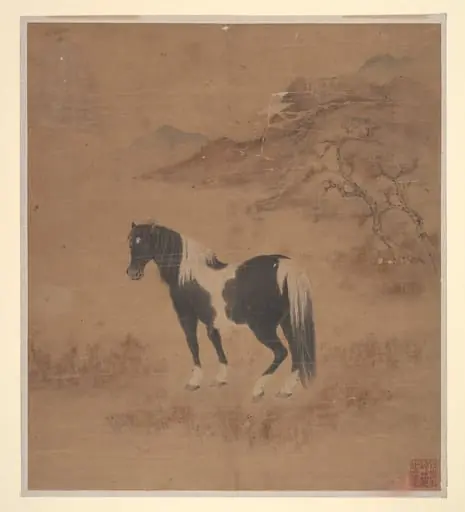
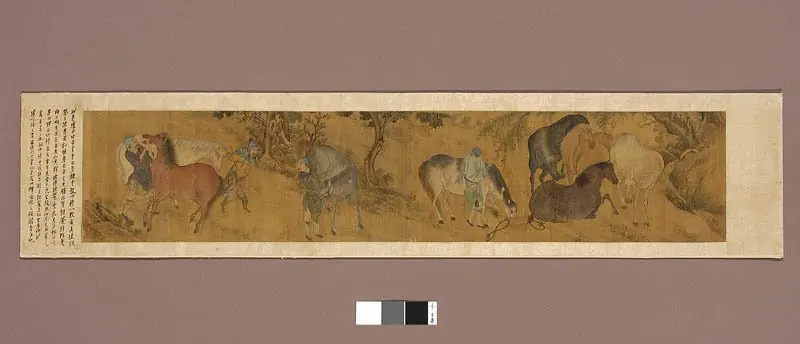
One Hundred Horses was commissioned by the Qing imperial court in 1724, with the final silk and ink handscroll completed in 1728 during the reign of the Yongzheng Emperor. Although created for Yongzheng, the emperor never viewed the finished work; his successor, the Qianlong Emperor, subsequently declared it a masterpiece in 1735 and named Giuseppe Castiglione chief court painter. The artist, an Italian Jesuit missionary known in China as Lang Shining, produced the 7.76-meter-long scroll to consolidate his position at court, drawing inspiration from earlier horse paintings such as Li Gonglin's "Herd on Pasture". A preparatory sketch for the work, dated between 1723 and 1725, is held in the Metropolitan Museum of Art, while the completed painting resides in the National Palace Museum in Taipei.
The work is held in the collection of the National Palace Museum in Taipei, with inventory designation recorded in museum records. It was painted in 1728 for the Yongzheng Emperor and has been exhibited in museum displays focusing on Qing dynasty court art and European influences in Chinese painting. A sketch related to the work is housed in the Metropolitan Museum of Art in New York.
The painting measures 94.5 cm in height by 7.76 meters in width and is accessioned under the museum's inventory for Qing dynasty silk paintings. It has been featured in exhibitions highlighting the artistic exchange between Jesuit missionaries and the Qing court, including displays at the National Palace Museum and referenced in scholarly publications on Castiglione's role in Qing court painting.
The work is recognized as one of Castiglione's most celebrated paintings, alongside the depiction of the Qianlong Emperor on horseback, and has been included in special exhibitions and philatelic tributes, such as a 1970 Taiwan stamp series commemorating the painting.
Context
One Hundred Horses (c. 1728) is a silk-and-ink handscroll commissioned by the Qing court for the Qianlong Emperor, though painted during Yongzheng's reign. It depicts over a hundred horses in varied poses across a 7.76-meter landscape, blending European techniques like chiaroscuro and perspective with traditional Chinese motifs such as symbolic trees (pine for longevity, willow for humility) and lingzhi mushrooms. The composition flows right-to-left, featuring innovative elements like a partially nude rider, previously absent in Chinese art, while adhering to canons like unpainted spaces and Buddhist symbolism. The work reflects Giuseppe Castiglione's (Lang Shining) synthesis of Western realism and Qing aesthetics, establishing horses as a central theme in his oeuvre.
Scholarship highlights its revolutionary scale and hybrid style, noting influences from Li Gonglin's horse paintings and European draftsmanship, while its 1735 acclaim by Qianlong cemented its status as Castiglione's masterpiece. The painting, housed in Taipei's National Palace Museum, was celebrated in 1970 with a stamp series and remains emblematic of cross-cultural artistic exchange.
Legacy
One Hundred Horses is regarded as Castiglione's masterpiece and one of his two most celebrated paintings, alongside his equestrian portrait of the Qianlong Emperor. The Qianlong Emperor declared it a masterpiece in 1735 and elevated Castiglione to chief court painter, after which horses became one of the artist's principal subjects. The scroll has been described as the high point ("l'apoteosi") of the "hundred horses" theme, whose prototype dates back to the Tang dynasty in the seventh century. In 1970, Taiwan issued a se-tenant strip of five postage stamps dedicated to the work, extending its recognition beyond the museum context.
Artist & collection