Artwork
Jan Nicquet
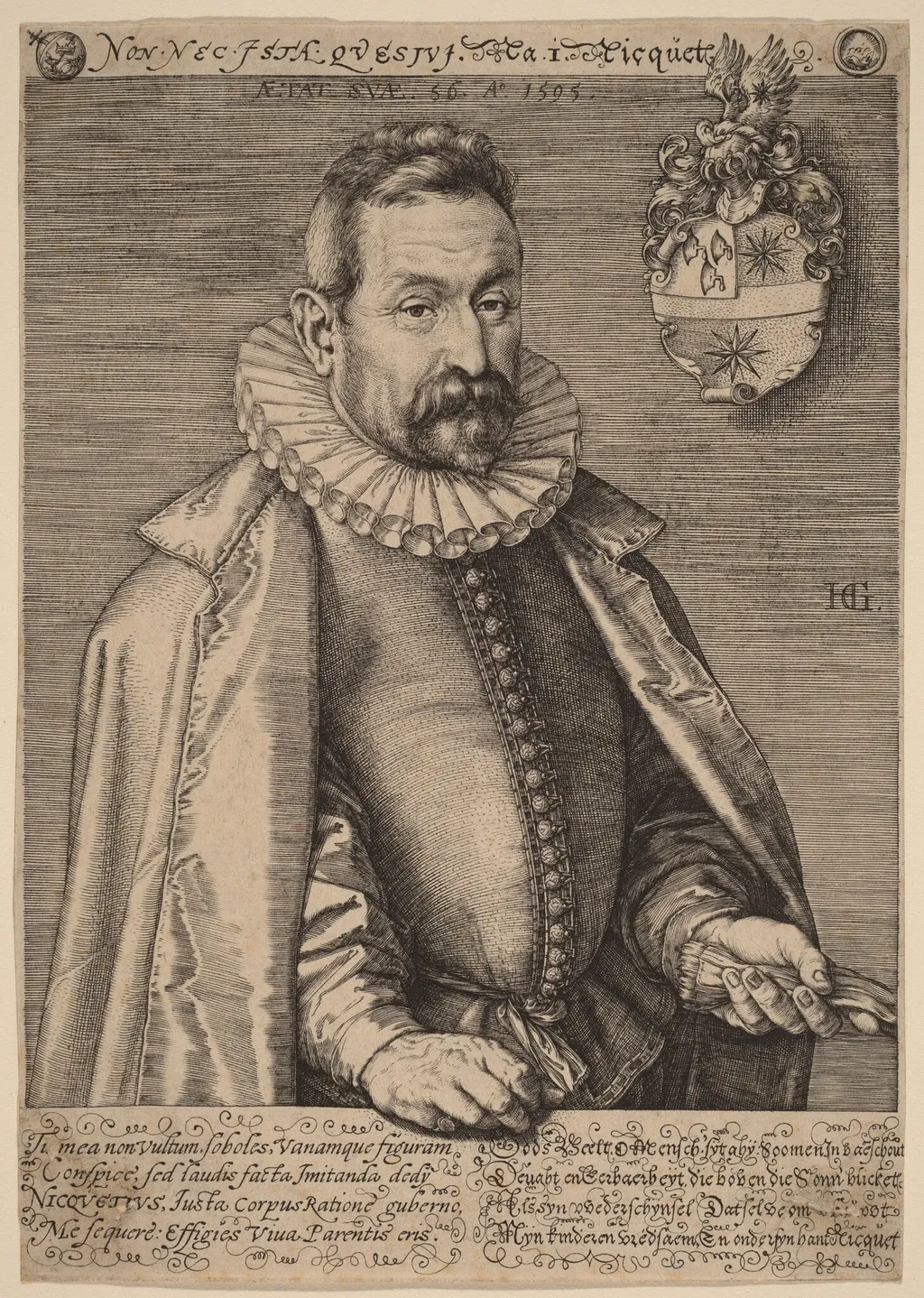
Jan Nicquet is an ink print by the Renaissance artist Hendrick Goltzius. It dates from 1595 and is held in the collection of the National Gallery of Art.
- Inscription
- Inscribed:above portrait, in plate: Non. nec Ista quesivi. Ma. I Nicquet / Aetat. Suae. 56. Ao. 1595; in image at right, in plate: HG; lower left, in margin below image, in plate: Tu mea non vultum, sobols, vanamque figuram / Conspice, sed laudis facta Imitanda dedy / Nicquiettus, Iusta Corpus Ratione guberno, / Me sequere: Effigies Viva Parentis eris. (You, my son, look not upon my face nor solely at my appearance, but I have also performed praisworthy deeds worthy of emulation. I, Nicquet, direct my Body in the Right Manner. Follow me and you will be the Living Image of your father.); lower right, in margin below image, in plate: Gods Beelt, o mensch, sijt ghij. Soomen In u aenschout / Deught and Eerbaerheijt, die boven die Sonn' blicket / Als syn wederschijnsel Datselve om u houwt / Mijn kinderen vred'saem, En onder syn hant Nicquet. (God's image art thoughh, oh man. While in you one detects Virtue and Honour, that glitters above the Sun, as his reflection. Remember this my children, peacefully, and yield to his hand.) [translations from Leeflang, Huigen, and Ger Luijten. _Hendrick Goltzius (1558-1617): Drawings, Prints and Paintings._ Amsterdam: Rijksmuseum, 2003, p. 163.]
- Markings
- Marked:vero, in black ink, by hand of collector Thomas Thane: Enaht / oct. 12[?] - 08
About this work
Overview
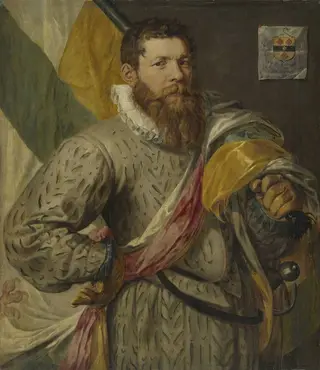
Hendrick Goltzius, a Dutch printmaker of German origin, produced the engraving titled Jan Nicquet in 1595. Executed in black-and-white, the image presents a solemn, bearded gentleman dressed in a patterned doublet, a ruff, and a chain across his chest, set against a heraldic shield bearing a crown and stars. Latin inscriptions frame the portrait at the top and bottom.
Subject & Meaning
The portrait depicts a dignified male figure, likely a contemporary of Goltzius, whose attire and heraldic backdrop suggest a status of wealth or official rank. The inclusion of a coat of arms and regal symbols reinforces the sitter’s social standing, while the austere expression conveys the seriousness associated with portraiture of the period.
Technique & Style
Goltzius employed the engraving method, incising fine lines into a copper plate to achieve delicate gradations of light and shadow. The meticulous hatching renders the texture of fabric, skin, and metal with a near‑tactile realism. The composition reflects the Northern Mannerist taste for intricate detail and elaborate ornamentation.
History & Provenance
Created during the early Baroque era, Jan Nicquet exemplifies Goltzius’s reputation for producing images that were widely copied by other artists and printmakers. The work circulated through the print market of the late sixteenth century, contributing to Goltzius’s standing as a leading figure in Dutch engraving.
Own this work as a print
Artist & collection
Artist
Hendrick Goltzius (German: , Dutch: ; né Goltz; January or February 1558 – 1 January 1617) was a German-born Dutch printmaker, draftsman, and painter.