Artwork
Jan Nicquet
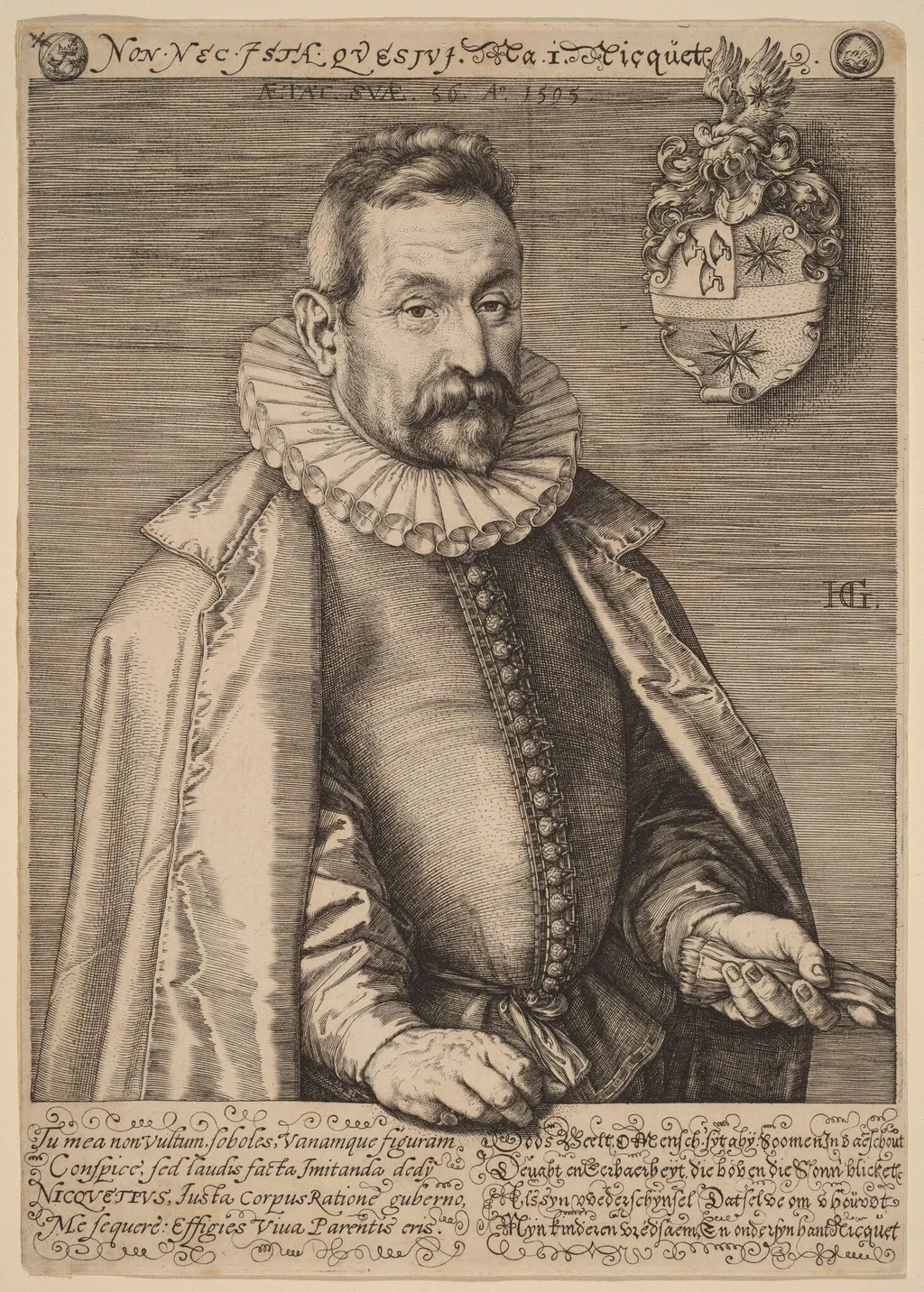
Jan Nicquet is an ink print by the Renaissance artist Hendrick Goltzius. It dates from 1595 and is held in the collection of the National Gallery of Art.
- Inscription
- Inscribed:above portrait, in plate: Non. nec Ista quesivi. Ma. I Nicquet / Aetat. Suae. 56. Ao. 1595; in image at right, in plate: HG; lower left, in margin below image, in plate: Tu mea non vultum, sobols, vanamque figuram / Conspice, sed laudis facta Imitanda dedy / Nicquiettus, Iusta Corpus Ratione guberno, / Me sequere: Effigies Viva Parentis eris. (You, my son, look not upon my face nor solely at my appearance, but I have also performed praisworthy deeds worthy of emulation. I, Nicquet, direct my Body in the Right Manner. Follow me and you will be the Living Image of your father.); lower right, in margin below image, in plate: Gods Beelt, o mensch, sijt ghij. Soomen In u aenschout / Deught and Eerbaerheijt, die boven die Sonn' blicket / Als syn wederschijnsel Datselve om u houwt / Mijn kinderen vred'saem, En onder syn hant Nicquet. (God's image art thoughh, oh man. While in you one detects Virtue and Honour, that glitters above the Sun, as his reflection. Remember this my children, peacefully, and yield to his hand.) [translations from Leeflang, Huigen, and Ger Luijten. _Hendrick Goltzius (1558-1617): Drawings, Prints and Paintings._ Amsterdam: Rijksmuseum, 2003, p. 163.]
About this work
Overview
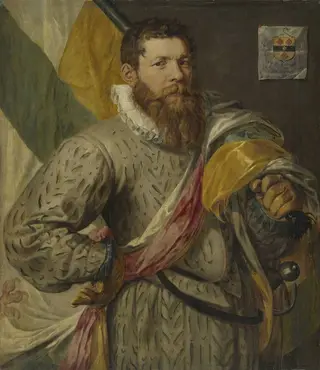
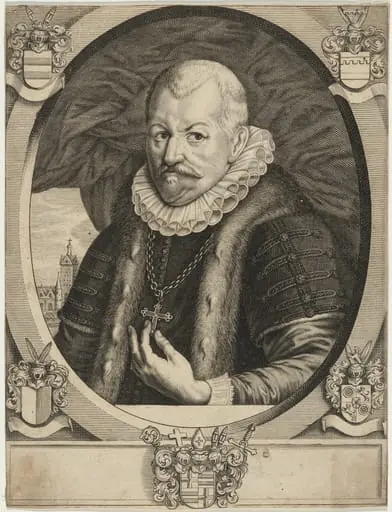
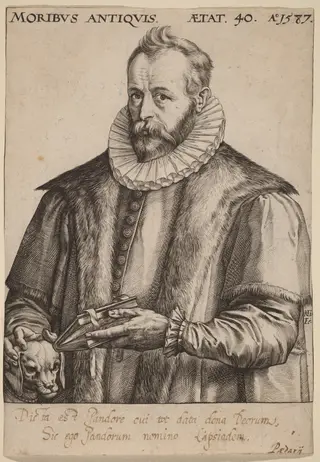
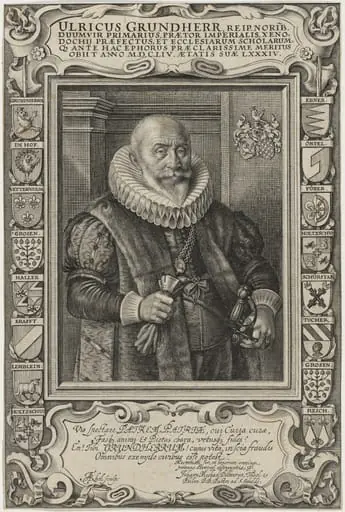
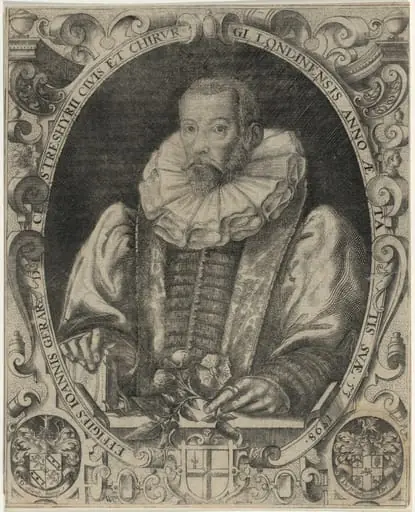
Jan Nicquet is a portrait engraving created by Hendrick Goltzius in 1595. The work depicts a man dressed in attire characteristic of the late 16th century, including a stiff ruffled collar, a dark coat with a chain, and a crest with stars and a shield behind his head. One hand is positioned on his shoulder.
Subject & Meaning
The subject of the engraving is Jan Nicquet, though the artwork's deeper meaning or the sitter's significance beyond the portrait itself are not explicitly conveyed through the image. The focus lies in the meticulous representation of the individual and his attire.
Technique & Style
Goltzius employed his renowned engraving technique, characterized by sharp lines, to capture intricate details such as clothing folds and facial wrinkles. The use of tiny lines to achieve shading and depth was a hallmark of his style during the Northern Mannerism period.
History & Provenance
Created in 1595, Jan Nicquet exemplifies Goltzius's technical mastery during the early Baroque/Northern Mannerism era. Specific details on the engraving's provenance (ownership history) are not provided.
Context
This engraving reflects the artistic trends of the late 16th century, where detailed, high-contrast prints were valued. The style aligns with the broader European practice of using engraving for portraitures, emphasizing precision and texture.
Legacy
As a work by Goltzius, Jan Nicquet contributes to the artist's legacy as a leading Dutch engraver of his time, showcasing the technical and artistic achievements of Northern Mannerism in printmaking.
Own this work as a print
Artist & collection
Artist
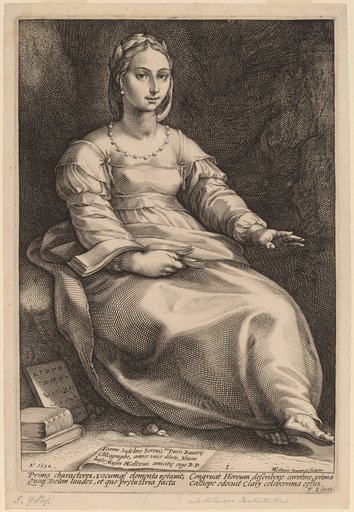
Hendrick Goltzius (German: , Dutch: ; né Goltz; January or February 1558 – 1 January 1617) was a German-born Dutch printmaker, draftsman, and painter.