Artwork
Carlo and Ubaldo Resisting the Enchantments of Armida's Nymphs
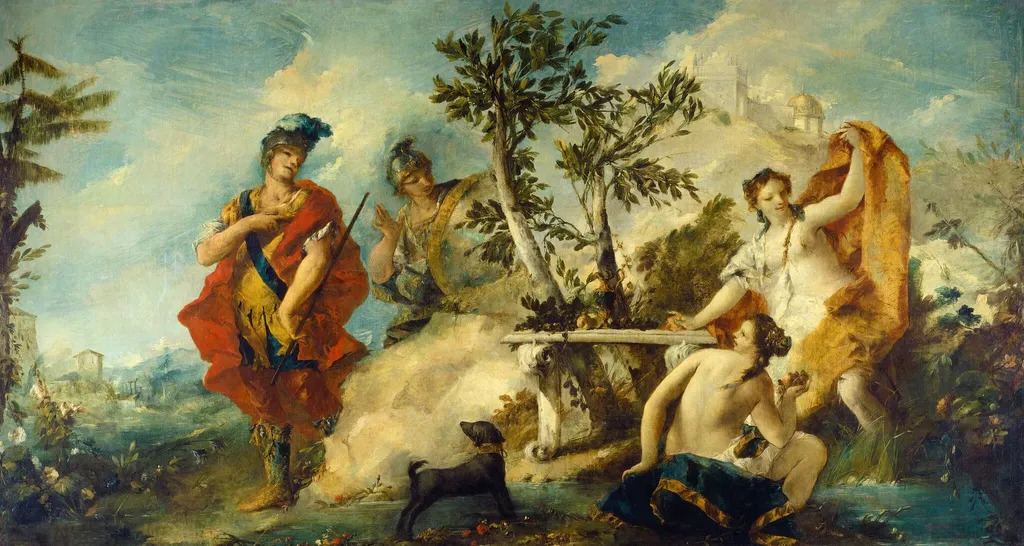
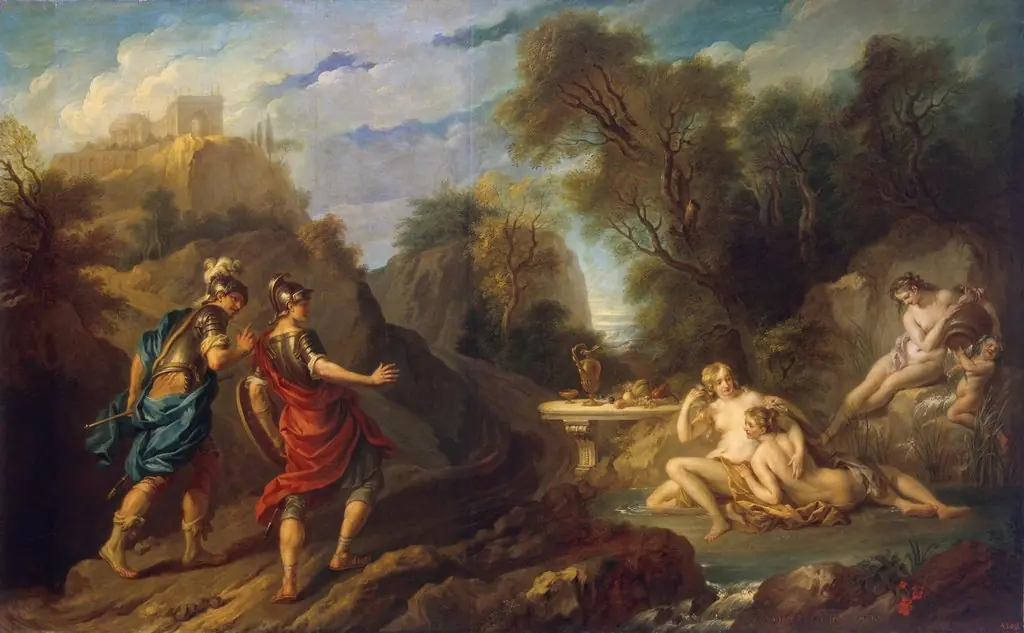
Carlo and Ubaldo Resisting the Enchantments of Armida's Nymphs is an oil painting by the Rococo painting artist Giovanni Antonio Guardi. It dates from 1752 and is held in the collection of the National Gallery of Art.
About this work
Subject & Meaning
Their resistance embodies the triumph of reason and Christian virtue over sensual temptation, a common allegorical theme in 18th-century mythological art.
The painting depicts the moment when the two heroic brothers Carlo and Ubaldo thwart the seductive advances of Armida's nymphs, a scene drawn from Torquato Tasso's epic Jerusalem Delivered. Their resistance embodies the triumph of reason and Christian virtue over sensual temptation, a common allegorical theme in 18th-century mythological art. Guardi's composition captures the dynamic interaction between the figures and the ethereal nymphs, emphasizing the tension between worldly allure and heroic resolve.
The work belongs to Guardi's series of Tasso-related canvases, originally owned by the Earl of Bantry before being acquired by the National Gallery of Art in 1964.
Technique & Style
Executed in oil on canvas, the work measures 250.2 cm in height and 459.8 cm in width. The handling is characterized by fluid, luminous brushwork that animates the scene and distinguishes the figures from the surrounding landscape. Stylistically, the composition aligns with mid-eighteenth-century Venetian tendencies, blending dramatic narrative with a delicate palette and refined figural modeling.
The scene's theatrical lighting and rhythmic arrangement of nymphs and knights emphasize Guardi's engagement with the mythological subject, while the silvery tonality and light-infused passages reflect the influence of contemporary decorative traditions.
History & Provenance
Gian Antonio Guardi created Carlo and Ubaldo Resisting the Enchantments of Armida's Nymphs in 1752 as part of a series depicting scenes from Tasso's Jerusalem Delivered. The painting was likely acquired in Italy around 1820 by Richard White, the 2nd Earl of Bantry, who possibly attributed the work to François Boucher. It descended within the White family to Mrs. Shelswell-White before entering the art market.
In 1955, an unspecified Dublin dealer offered the piece as a work by Pellegrini. The following year, David Carritt, acting for Geoffrey Merton in London, facilitated its sale through Thomas Agnew & Sons. The National Gallery of Art in Washington, D.C., purchased the canvas in 1964, where it is recorded in the NGA inventory as 1964.21.2.
Context
Gian Antonio Guardi's Carlo and Ubaldo Resisting the Enchantments of Armida's Nymphs (1752) is part of a series depicting scenes from Torquato Tasso's Gerusalemme liberata. The work's attribution history reflects early scholarly uncertainty; it was once rumored to have been at Versailles and was reportedly acquired by the Earl of Bantry, who may have believed it to be a work by François Boucher. The series was rediscovered in the mid-20th century, with art historian Antonio Morassi publishing a seminal study in 1960 that helped establish the paintings as a cohesive group by Guardi.
The painting's rediscovery prompted significant curatorial interest, leading to its acquisition by the National Gallery of Art in Washington, D.C., in 1964. While some contemporary accounts suggested the works were found in a shed in Ireland, the precise provenance prior to the 1950s remains partially obscured by conflicting reports regarding the specific dealer involved in their initial sale.
Overview
Gian Antonio Guardi's 'Carlo and Ubaldo Resisting the Enchantments of Armida's Nymphs,' painted in 1752, illustrates a pivotal episode from Torquato Tasso's epic poem 'Jerusalem Delivered.' The composition depicts the knights Carlo and Ubaldo encountering the seductive nymphs sent by the sorceress Armida to distract them from their mission. On the left, the two armored knights, distinguished by their colorful attire and feathered hats, turn resolutely away from the advances of the three nymphs and a dog positioned on the right.
Guardi sets the scene within a lush, natural landscape featuring trees, a body of water, and a distant horizon, characteristic of the Venetian Rococo style. The artist employs a light, fluid brushwork and a vibrant palette to convey the tension between the knights' duty and the nymphs' allure. This work exemplifies Guardi's early career focus on mythological and literary subjects, demonstrating his ability to blend narrative clarity with the decorative elegance typical of mid-18th century Venetian painting.
Artist & collection
Artist
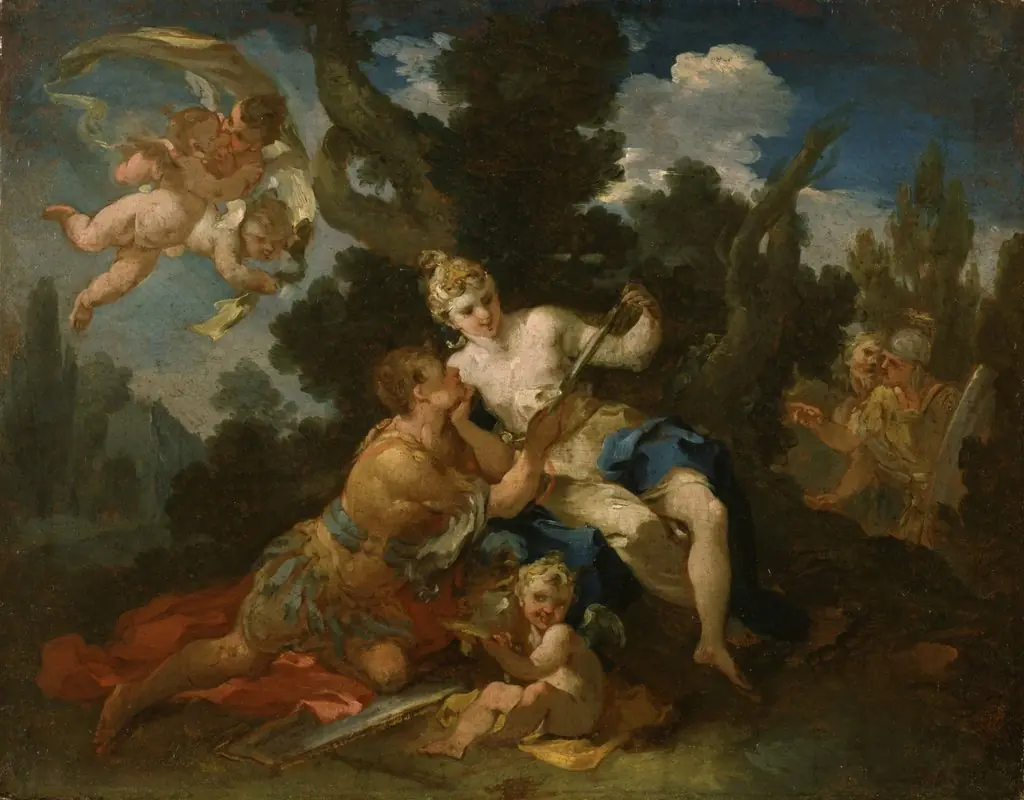
Giovanni Antonio Guardi, also known as Gianantonio Guardi, was an Italian painter and nobleman. Guardi was one of the founders of the Venetian Academy in 1756.