Artwork
Portrait of Agathe, artist’s sister
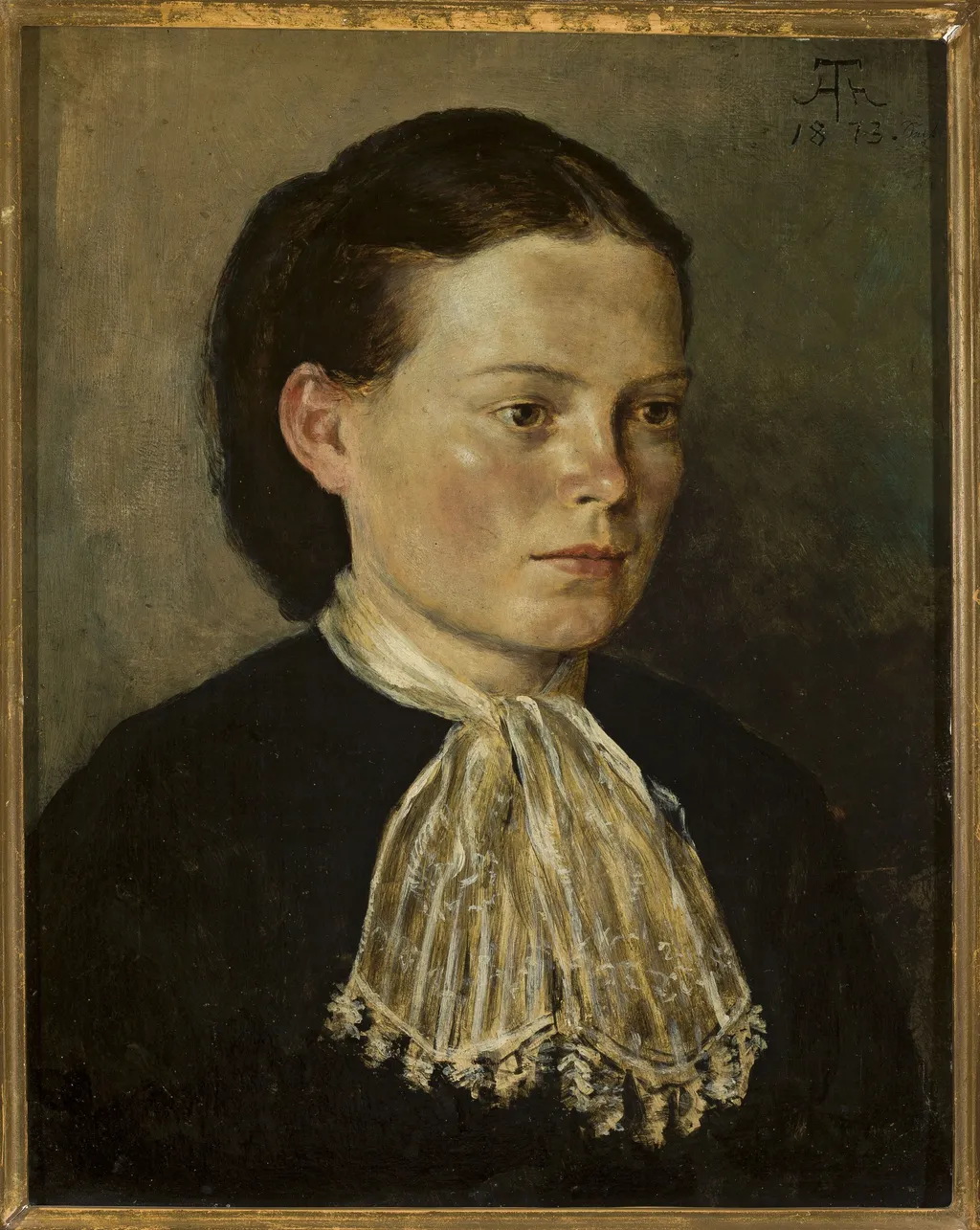
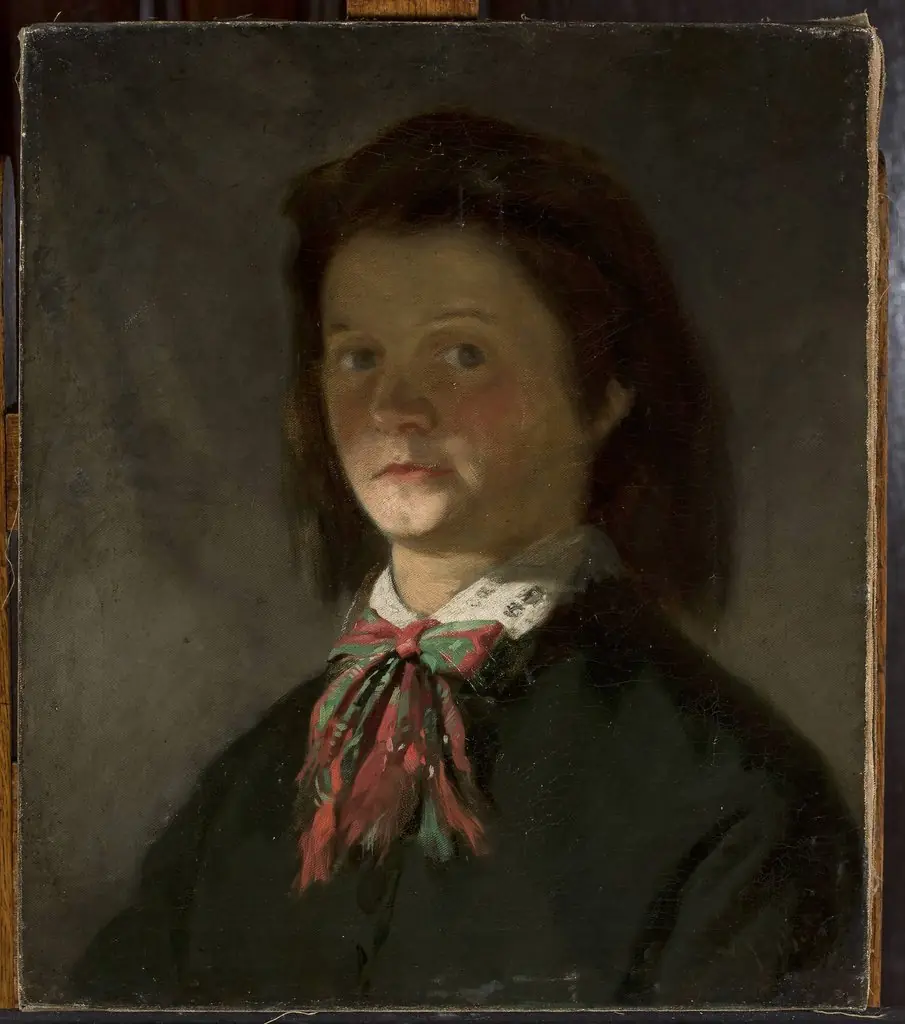
Portrait of Agathe, artist’s sister is an oil painting by the German Romanticist artist Hans Thoma. It dates from 1873 and is held in the collection of the National Museum in Warsaw.
About this work
Overview
Portrait of Agathe, artist's sister is an oil painting on panel created in 1873 by the German painter Hans Thoma (1839-1924).
Portrait of Agathe, artist's sister is an oil painting on panel created in 1873 by the German painter Hans Thoma (1839-1924). Measuring 34.5 by 27.5 centimeters, this intimate bust-length portrait depicts the artist's younger sister, Agathe Thoma, and is now held in the collection of the National Museum in Warsaw. The work represents a pivotal moment in Thoma's early career, when he applied his rigorous academic training to a subject drawn from his private life rather than history or allegory. As one of Thoma's earliest surviving portraits, it demonstrates his emerging ability to combine precise observation with psychological insight, qualities that would define his subsequent reputation as one of Germany's most distinctive painters of the late nineteenth and early twentieth centuries.
Subject & Meaning
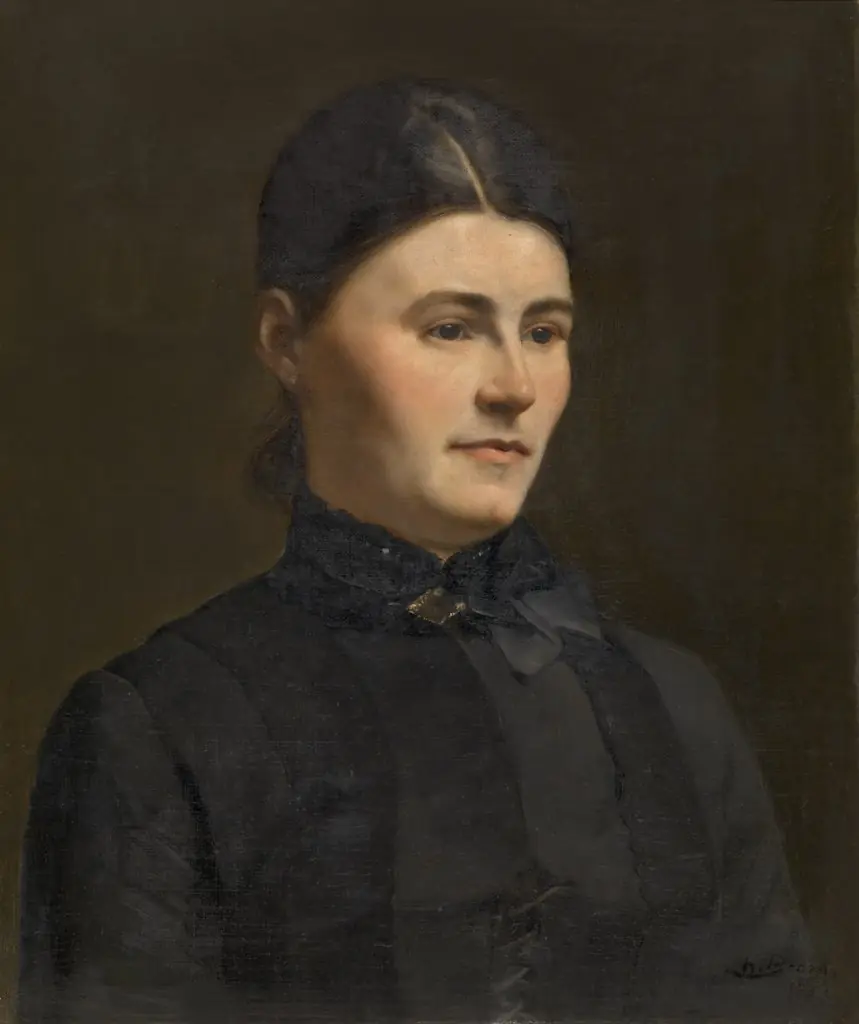
The painting depicts Agathe Thoma, the artist's sister, in a pose of composed introspection. She is shown three-quarters to the right, her brown eyes directed slightly off-canvas, neither fully engaging the viewer nor withdrawing from presence. This reticence has been interpreted as conveying the trust and mutual understanding particular to a sibling relationship, distinct from the performative conventions of commissioned portraiture. Her attire, a dark, high-necked garment with an elaborate cream-colored lace or muslin cravat, signals respectable bourgeois status without ostentation, reflecting the familial austerity of the Thoma household rather than fashionable display. The restrained palette and subdued background focus attention upon Agathe's individual character, transforming a domestic subject into what scholars have described as a meditation on family, memory, and the formative influence of close relationships. The absence of jewelry, props, or architectural setting strips the image of narrative distraction, concentrating meaning in the subtle interplay of gaze, posture, and textile detail.
Technique & Style
Thoma executed the portrait in oil on panel, a support that facilitated the smooth, blended handling visible in the face and the more textured, directional brushwork of the hair and cravat. The dimensions of 34.5 by 27.5 centimeters indicate a modest, portable format appropriate for intimate study. Light enters from the upper left, illuminating the left side of the face, the fully visible left ear, and the elaborate cravat, while the right side of the face and the gray-green background recede into shadow. This chiaroscuro is understated rather than theatrical, with gradations sufficiently delicate to suggest natural daylight. The brushwork varies across the surface: smooth and fused in the flesh tones, more articulated in the lace where fine highlights suggest individual fibers, and broadly directional in the dark garment. The restrained palette of deep browns, blacks, off-whites, and muted flesh tones achieves tonal harmony through finely graded transitions that avoid either chromatic brilliance or muddy neutrality. A monogram and the date "1873" appear in the upper right corner, consistent with Thoma's early practice of discreet signature placement.
History & Provenance
The portrait was painted in 1873, a year that also saw Thoma produce his Self-Portrait from Munich, suggesting a period of concentrated self-examination and familial artistic engagement. The circumstances of the commission remain unrecorded; given the subject and the artist's limited means at this early stage, it is probable that no formal commission existed and that the work arose from the collaborative circumstances of the Thoma household. The painting's provenance before its acquisition by the National Museum in Warsaw has not been fully documented in available sources. The work is now held by that institution, though precise accession details are not specified in the sources consulted. Exhibition history for this particular painting is likewise not recorded, though Thoma's broader exhibition trajectory, including the Munich exhibition of approximately thirty works that established his national reputation, provides context for how such early portraits circulated within German artistic circles.
Context
In 1873, Thoma had recently completed his studies at the Düsseldorf Academy under Philipp Veit, working within an environment shaped by the Nazarene movement's aspiration to revive spiritual content and medieval purity in painting. The aftermath of the Franco-Prussian War and German unification under Bismarck created a cultural climate in which artists negotiated between national heritage and emerging modernity. Thoma's choice to portray his sister rather than a historical, allegorical, or commissioned subject represents a significant redirection of academic discipline toward personal experience. This alignment of rigorous technique with intimate subject matter distinguishes his early portraiture from both the grand manner of official Düsseldorf painting and the emerging naturalism of contemporaries. Critical reception of Thoma's work has emphasized his affinities with early German masters, particularly Albrecht Altdorfer and Lucas Cranach the Elder, and his shared concerns with the Pre-Raphaelites in precise outline and local color. The portrait thus occupies a transitional position: sufficiently academic in execution to demonstrate formal training, yet sufficiently personal in subject to anticipate the idiosyncratic path Thoma would pursue through mythological, landscape, and later portrait subjects.
Legacy
The portrait's afterlife has been shaped primarily by its reproduction and commercial circulation rather than by sustained scholarly attention or prominent exhibition. The image has entered the mass market for museum-quality reproductions, with multiple vendors offering hand-painted copies on canvas that emphasize its "timeless beauty" and suitability for domestic display. This commercial afterlife, while extending the painting's visibility, has not yet generated substantial art-historical literature devoted specifically to the work. Within Thoma's broader oeuvre, the portrait holds significance as an early demonstration of capabilities more fully realized in later portraits such as the 1892 Portrait of Prince Frederick Charles of Hesse and the 1903 Portrait of Ella Blaue. The painting's presence in the National Museum in Warsaw, a major Polish institution, indicates its recognition as representative of nineteenth-century German portraiture, though its acquisition circumstances and display history there await fuller documentation. For scholars of Thoma's development, the portrait remains a touchstone for understanding how the artist's characteristic synthesis of psychological acuity and technical precision first emerged in response to the most immediate of subjects: a familiar face within the family circle.
Own this work as a print
Artist & collection
Artist
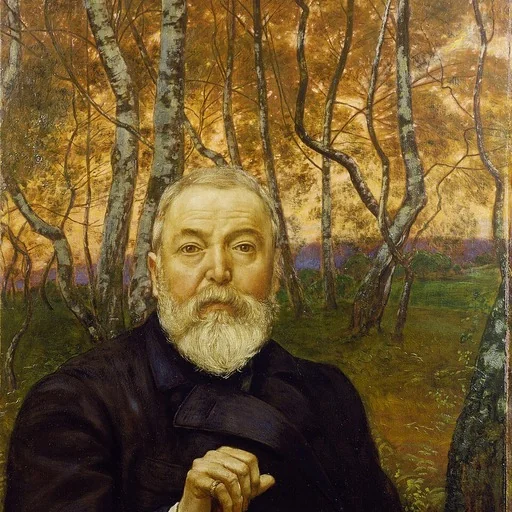
Hans Thoma (2 October 1839 – 7 November 1924) was a German painter. An alumnus and later professor of Karlsruhe Academy, he is known for his landscapes, portraits, and symbolic works rooted in German regional life and…

- Maria Agnes Claesson (1843- efter 1903), gift med konstnären Edvard Perséus
 Portrait of a Woman
 Portrait of artist’s wife
 The Unwilling Model (Mrs. Alice Pratt Burdick)
 Agnete Skovgaard, f. Lange, kunstnerens hustru
 Agnete Skovgaard, f. Lange, kunstnerens hustru
 Goebeler, Elise: Portrait of an Unknown Lady
 Portrait de Juliette Courbet
 Pouline
 Portrait of Maria Levittoux
 Portrait of Hanne Wanscher, née Wegener
 Felicia Kirchdorffer, die Nichte des Künstlers