Artwork
Miss Loïe Fuller
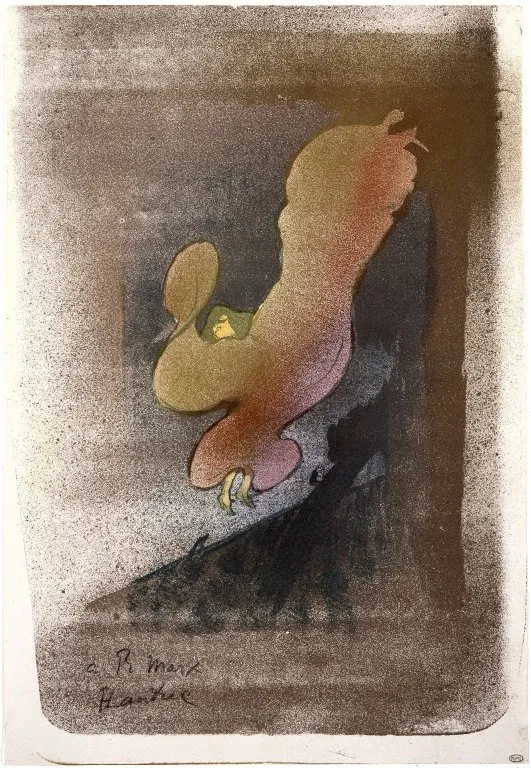
Miss Loïe Fuller is an unspecified painting by the Post-Impressionist artist Henri de Toulouse-Lautrec. It dates from 1897 and is held in the collection of the Brooklyn Museum.
About this work
Overview
Henri de Toulouse-Lautrec produced the lithograph titled Miss Loïe Fuller in 1897. The work exemplifies his post‑impressionist approach and his focus on the lively entertainment venues of late‑19th‑century Paris.
Subject & Meaning
The image captures Loïe Fuller, an American performer celebrated for her flowing, serpentine dance that mesmerized Parisian audiences during the 1890s. By depicting her, Lautrec highlights the fascination with exotic movement and the rise of modern stage spectacle.
Technique & Style
Executed as a lithograph, the piece employs bold outlines and flat areas of colour characteristic of Lautrec’s graphic style. The composition balances stylized forms with a sense of motion, echoing the dynamism of Fuller’s performance.
History & Provenance
Created during Lautrec’s most productive period, the lithograph reflects his personal connection to the cabaret world. It was produced for the commercial market of prints that circulated among collectors of Parisian nightlife imagery.
Context
Lautrec’s aristocratic background, his childhood leg injuries, and his immersion in Montmartre’s nightlife informed his choice of subjects. His work frequently documents dancers, singers, and other performers who defined the cultural atmosphere of Belle‑Epoque Paris.
Artist & collection
Artist
Comte Henri Marie Raymond de Toulouse-Lautrec-Montfa (24 November 1864 – 9 September 1901), known as Toulouse-Lautrec (French: ), was a French painter, printmaker, draughtsman, caricaturist, and illustrator.