Artwork
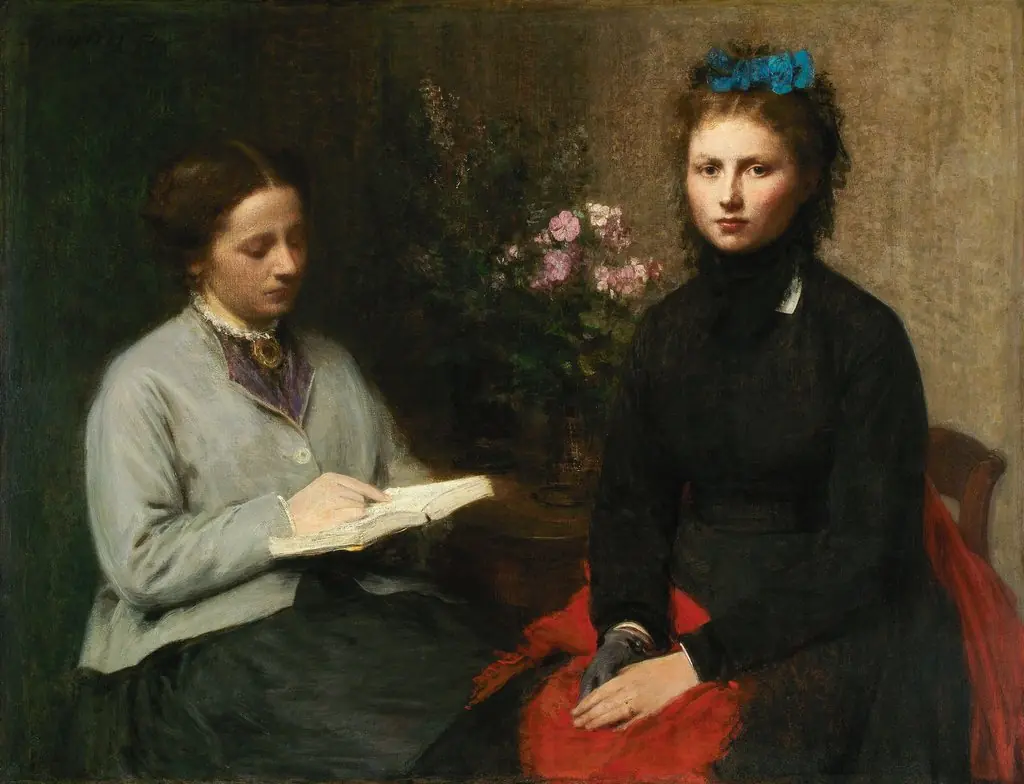
The Reading
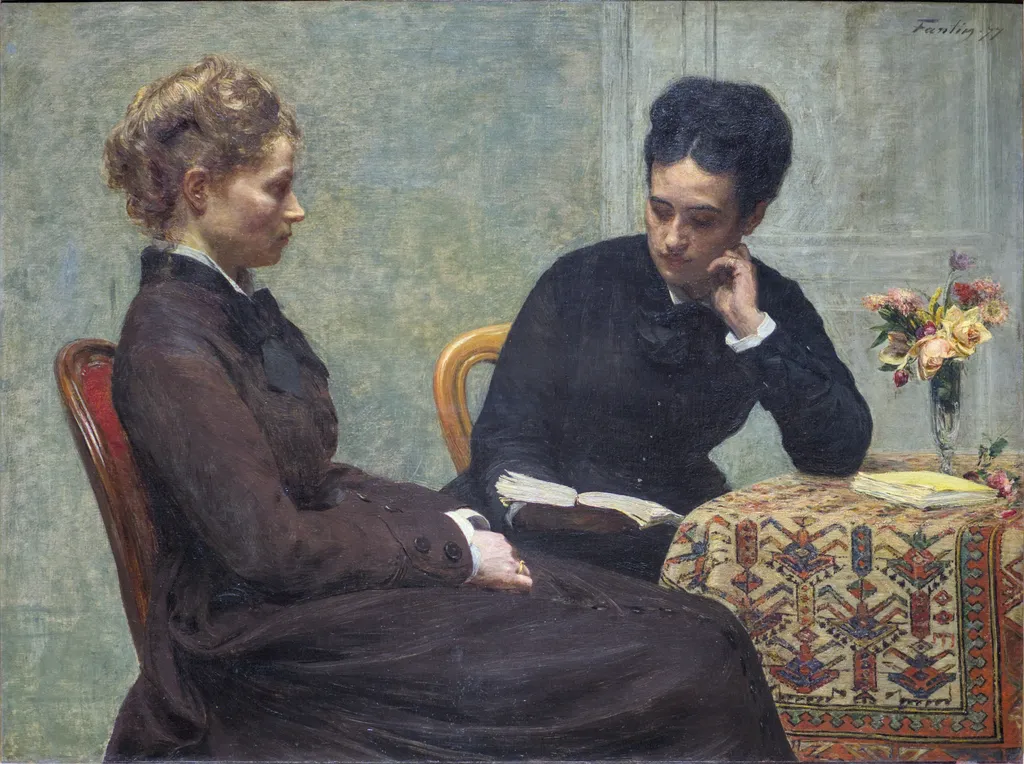
The Reading is an oil painting by the Impressionist artist Henri Fantin-Latour. It dates from 1889 and is held in the collection of the Museum of Fine Arts of Lyon.
About this work
Subject & Meaning
The work is read as evoking women's escape through reading, with the silence, stillness, and muted grays and greens conveying a sense of suspended time.
The Reading depicts two women seated in an austere interior, the figure on the right leaning on a table to read from an open, well-worn book while the woman on the left appears distracted, as though she has already finished the volume. The seated woman on the left is identified as the artist's sister-in-law, Charlotte Dubourg. A patterned tablecloth and a vase of flowers rest on the table, and the composition is dominated by a bare background wall and the black dresses of both sitters, broken only by the red of an armchair and the tablecloth's motif.
The work is read as evoking women's escape through reading, with the silence, stillness, and muted grays and greens conveying a sense of suspended time. Gérard Denizeau has analyzed the canvas as a precursor to the symbolist turn Fantin-Latour would later take, and the painting has inspired literary responses from writers including Jan Baetens and Patrick Raynal.
Technique & Style
Executed in 1877, The Reading is an oil painting on canvas measuring 97 cm by 130 cm. The composition features two women seated in an interior, characterized by a stark austerity achieved through black dresses and a dominant background wall rendered in grey and greenish tones. This somber atmosphere is punctuated only by the red of an armchair and the patterned design of a tablecloth covering the table where a vase of flowers rests. The artist depicts one figure reading from a book that appears worn, while the other sits in distraction.
Critics have identified the work as a precursor to Symbolism, noting how the immobility of the figures and the muted palette evoke a sense of suspended time and silence.
History & Provenance
Henri Fantin-Latour executed this oil-on-canvas work in 1877. It was the third painting the artist presented at the Paris Salon that year, where it received critical acclaim. Following its debut, the piece was shown at the Royal Academy's summer exhibition in London in 1878 and later at the Société des Beaux-Arts in Brussels in 1900.
The Museum of Fine Arts of Lyon acquired the painting in 1901 from a seller named M. Tempelaere for 20,000 francs. This purchase occurred as the Lyon municipality encouraged the museum to expand its collection of modern art. The work underwent restoration at the museum in 1987.
The Reading has been held by the Musée des Beaux-Arts de Lyon since 1901, when the city of Lyon acquired it for 20,000 francs from M. Tempelaere, alongside Corot's studio. The painting underwent restoration in 1987 at the museum. Its documented exhibition history begins with the Salon of 1877 in Paris, where it was shown alongside two earlier works by Fantin-Latour.
It traveled to the summer exhibition of the Royal Academy in London in 1878 and to the Société des Beaux-Arts in Brussels in 1900. Later showings include the 1906 Fantin-Latour exhibition in Paris, the 1936 Grenoble centenary exhibition, the 1937 "Chefs-d'oeuvres de l'art" exhibition in Paris, a Shanghai exhibition from 4 May to 1 June 2010, and the 2016 "Fantin-Latour, magnifique et singulier" at the Musée du Luxembourg.
Context
Exhibited at the Paris Salon of 1877, The Reading received critical acclaim, notably from Paul Mantz in Le temps. Scholar Gérard Denizeau identifies the work as a precursor to the Symbolist turn in Fantin-Latour's later career, citing its austere composition, somber palette, and the palpable sense of silence and immobility. The painting is thematically linked to the artist's 1870 work of the same title and explores the motif of female escape through reading.
Its significance extends into contemporary art, having inspired poets such as Jan Baetens and a 2009 photographic reinterpretation by Wong Hoy Cheong during the Lyon Biennial. The work's placement in art history is further marked by its acquisition in 1901, which signaled the Museum of Fine Arts of Lyon's strategic shift toward modern French painting.
Legacy
Upon its debut at the 1877 Paris Salon, the work received critical praise, notably from Paul Mantz. Art historian Gérard Denizeau later identified the painting as a precursor to the artist's subsequent symbolic turn, emphasizing its austere composition and sense of arrested time. The work's thematic resonance extended into literature, influencing writers such as Jan Baetens and Patrick Raynal, with Baetens creating a photopoem inspired by the scene.
In the contemporary era, the painting served as a direct reference for artist Wong Hoy Cheong, who reinterpreted the image during the 2009 Lyon Biennial of Contemporary Art through a photograph featuring Muslim women in burqas. The piece has also been featured in major retrospectives, including the 1906 Paris exhibition dedicated to the artist, the 1936 centenary show in Grenoble, and the 2016 exhibition "Fantin-Latour, magnifique et singulier" at the Musée du Luxembourg.
Overview
Henri Fantin‑Latour’s 1877 oil on canvas titled The Reading portrays a quiet interior scene with two women seated at a table. The work is part of the collection of the Musée des Beaux‑Arts de Lyon, where it has been held since its municipal acquisition in the early twentieth century.
Own this work as a print
Artist & collection
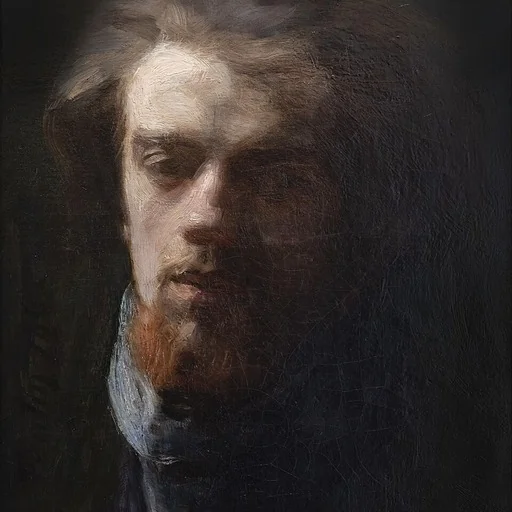
Artist
Ignace Henri Jean Theodore Fantin-Latour (French pronunciation:; 14 January 1836 – 25 August 1904) was a French painter and lithographer best known for his flower paintings and group portraits of Parisian artists and writers.