Artwork
Bouquet of Flowers on a Veranda
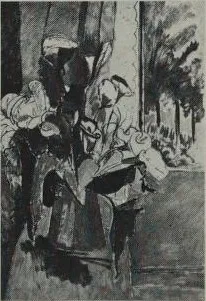
Bouquet of Flowers on a Veranda is an oil painting by the Fauvist artist Henri Matisse. It dates from 1912 and is held in the collection of the Hermitage Museum.
About this work
Overview
Bouquet of Flowers on a Veranda is an oil painting on canvas created by Henri Matisse in 1912.
Bouquet of Flowers on a Veranda is an oil painting on canvas created by Henri Matisse in 1912. Measuring 146 by 97 centimeters, the work is held in the collection of the Hermitage Museum in Saint Petersburg, Russia, where it arrived by 1934 from the State Museum of New Western Art in Moscow. The painting represents a pivotal moment in Matisse's career, demonstrating his conviction that color and line constitute the fundamental structure of visual experience rather than mere descriptive tools. As a still life that expands into a meditation on interior and exterior space, it exemplifies the artist's lifelong fascination with thresholds, windows, and balconies as sites where domestic ritual meets the animated world beyond.
Subject & Meaning
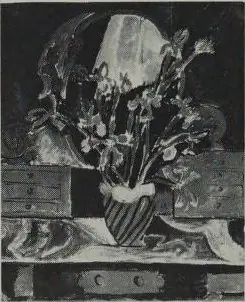
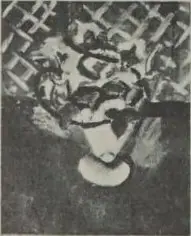
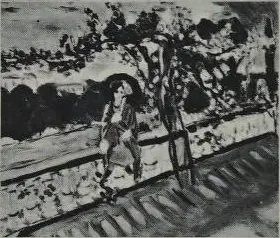
The painting depicts a bouquet of calla lilies arranged in a metal jug, positioned on a blue tabletop upon a veranda. The veranda functions as a conceptual fulcrum, an architectural threshold where the rooted domesticity of the bouquet encounters the changing weather of the outside world. To the right, a vertical panel of warm yellow opens like a door or blind, bordered by a scalloped strip of pale violet suggesting a curtain, beyond which greyed trees and sky are visible. The lilies themselves carry inherent calligraphic qualities, their flared trumpet forms and sleek leaves reducible to flowing curves that Matisse exploits for their arabesque potential. The composition stages a conversation between surface and depth, between the tactile reality of tabletop things and the trembling illusions of distant foliage. No human figures appear, yet the painting pulses with immediacy and the sensation of soft, sunny light. The deliberate contrast of green and greyish-blue tones with softly shining yellow creates an atmosphere of airy luminosity, while the flowers' cold elegance, outlined with light, precise contours, harmonizes with the overall color structure.
Technique & Style
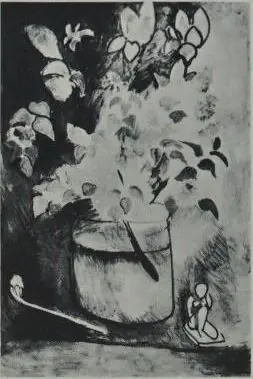
Matisse executed the work in oil on canvas, yet the composition is so light and airy as to seem more like a watercolor. He builds the picture from a limited but eloquent palette: cool lavenders, slate blues, and icy whites for the interior, set against honeyed ochres for the sunlit panel. Green appears sparingly at leaf tips and stem edges, with earthy reds and browns sending warmth through the cluster to prevent the whites from turning chalky. The artist generates luminosity by adjacency rather than illusionistic modeling; a white calla beside lavender reads cooler, while the same white beside ochre flashes warm. Matisse employs assertive dark contours made with a loaded brush, thickening at turns and thinning along quick runs, often leaving a seam of ground beside a line to create a vibrating halo. Many blossoms are rendered by contour alone, their interiors unpainted, allowing the white of the prepared ground to act as light itself. This transparency of process is deliberate, passages of undercolor show through, and some flowers remain incomplete to preserve the sensation of freshness.(Basic observation confirms the linear hatching and cross-hatching visible in tonal areas, with a sketch-like, unfinished quality throughout.) The dark shadow beneath the jug functions not as observed darkness but as a designed weight that lets the bouquet float without losing its connection to the table.
History & Provenance
The painting was created in 1912, a year crowded with breakthroughs for Matisse. The artist traveled to Morocco between October 1912 and February 1913, during which period he painted this composition in France. The work was originally owned by Sergei Shchukin, the Russian collector and patron who assembled one of the most significant collections of modern art in Europe. Following the Russian Revolution, Shchukin's collection was nationalized, and the painting entered the State Museum of New Western Art in Moscow by 1934. It subsequently transferred to the Hermitage Museum in Saint Petersburg, where it remains today. The canvas measures 146 by 97 centimeters, dimensions that allow the composition its monumental yet airy presence.
Context
Matisse's work in 1912 fell within a period of intense experimentation and consolidation. The veranda as subject reflects his long-standing fascination with windows, balconies, and thresholds, architectural devices that permitted him to stage formal dialogues between interior and exterior, between the fixed and the fleeting. This interest connects to broader developments in early modernism, where the dissolution of traditional perspective and the elevation of color to structural status were transforming European painting. The painting's approach to the still life, expanding it beyond mere representation into a meditation on perception and atmosphere, aligns with Expressionist tendencies of the period, though Matisse's particular synthesis of bold color, calligraphic line, and decorative patterning remained distinctively his own. The work's presence in Shchukin's collection placed it at the center of Russian engagement with French modernism, a relationship that would be violently interrupted by political upheaval but whose artistic consequences endured in the development of Russian avant-garde painting.
Legacy
Bouquet of Flowers on a Veranda occupies a significant position in Matisse's oeuvre as a demonstration of how the still life genre could be expanded to address fundamental questions of perception, space, and the nature of painting itself. The work's emphasis on process, its willingness to leave traces of decision-making visible on the surface, and its use of empty, unpainted areas as active compositional elements anticipate later developments in modern art. The calligraphic treatment of the calla lilies prefigures the flowing arabesques that would define Matisse's cut-outs and stained glass designs in his later career. As part of the Hermitage collection, the painting remains accessible to scholars and the public, continuing to inform understanding of Matisse's working methods and aesthetic philosophy. The work's provenance through Shchukin's collection also preserves its importance as a document of the cultural exchange between French modernism and Russian patronage in the early twentieth century, an exchange whose material traces were dispersed and transformed by revolution and political upheaval.
Artist & collection
Artist
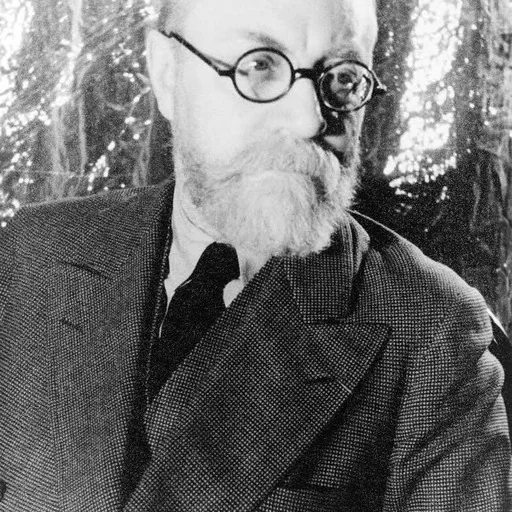
Henri Émile Benoît Matisse (French:; 31 December 1869 – 3 November 1954) was a French visual artist, known for both his use of colour and his fluid and original draughtsmanship.