Artwork
Lemons on a Pewter Plate
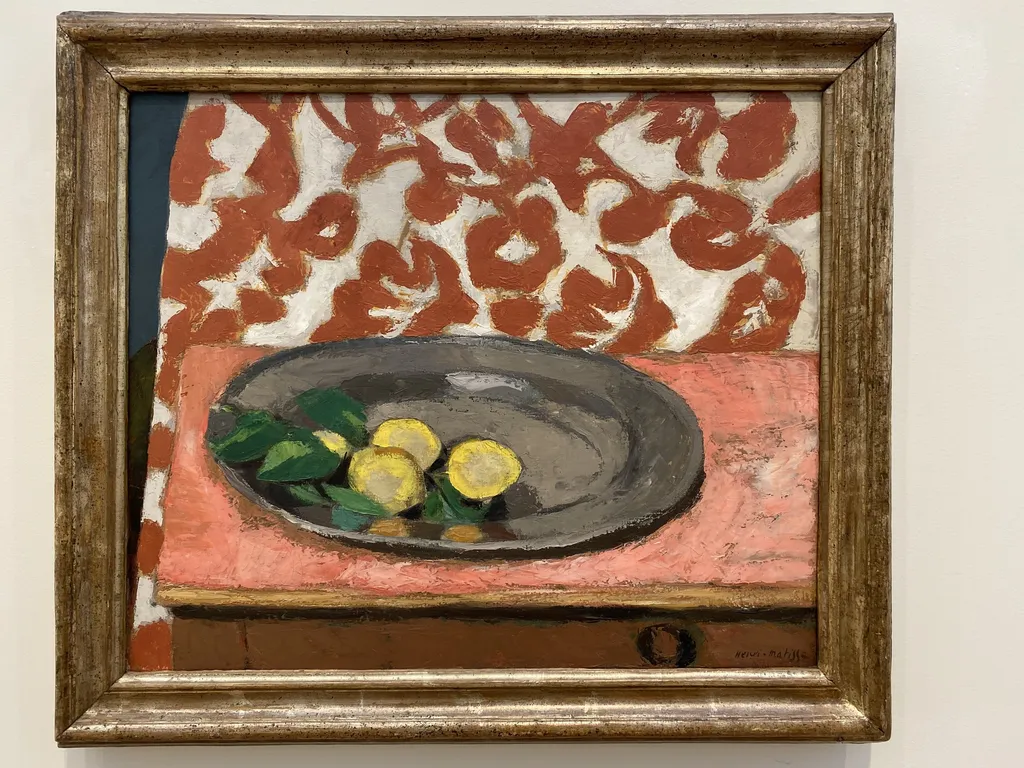
Lemons on a Pewter Plate is an oil painting by the Post-Impressionist artist Henri Matisse. It dates from 1926 and is held in the collection of the Art Institute of Chicago.
About this work
Technique & Style
Its formal qualities include a flattened pictorial space and emphasis on decorative patterning characteristic of his later decorative projects.
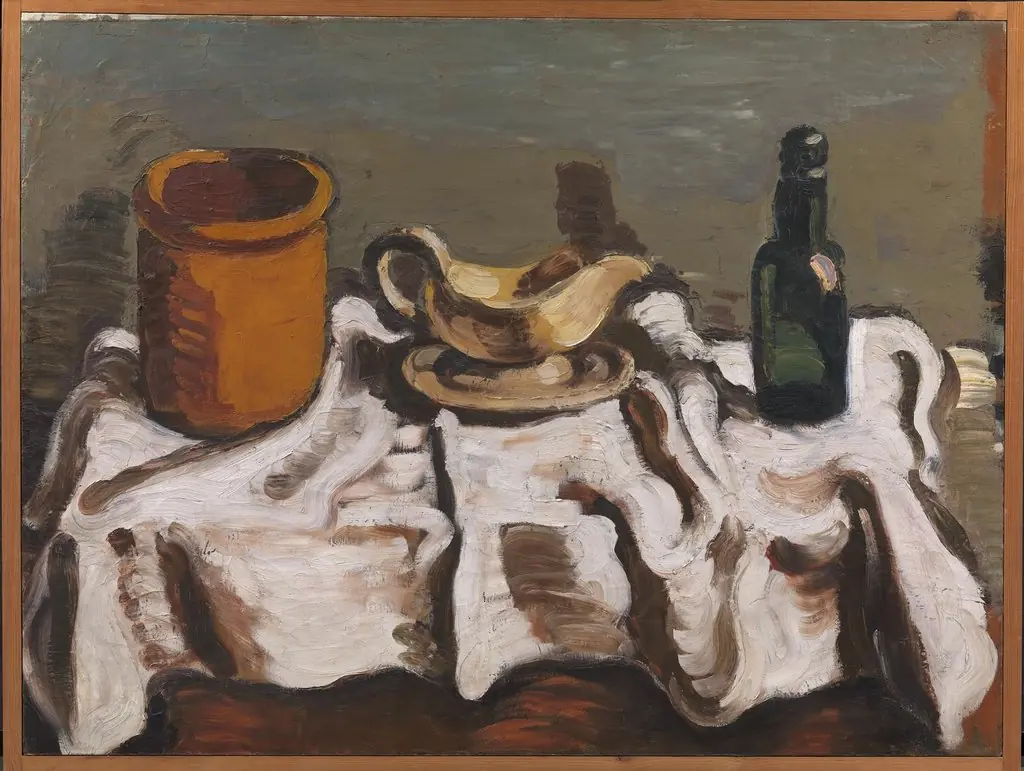
Henri Matisse created Lemons on a Pewter Plate in 1926 using oil paint applied to canvas. The work measures 46.2 x 37.8 cm and depicts a lemon and pewter plate set against patterned wallpaper on a table surface. It is part of the permanent collection at the Art Institute of Chicago.
The painting is classified as an oil on canvas work, reflecting Matisse's mature approach to still life with careful attention to surface texture and spatial arrangement. Its formal qualities include a flattened pictorial space and emphasis on decorative patterning characteristic of his later decorative projects.
Context
Matisse's 1926 still life Lemons on a Pewter Plate entered the Art Institute of Chicago collection shortly after its creation, reflecting his sustained exploration of domestic objects through simplified forms and flattened spatial depth. The work's restrained palette and emphasis on the textural contrast between the fruit's surface and the pewter plate exemplify his late-career approach to compositional balance. Art historians have noted its significance as part of a broader series of studio objects that Matisse painted during his Nice period, where traditional still life subjects were reimagined with heightened chromatic clarity and structural rigor.
This painting stands as a key example of his synthesis of decorative pattern and three-dimensional volume within the evolving language of modernism.
Overview
Henri Matisse completed the oil painting Lemons on a Pewter Plate in 1926. The work presents a modest still‑life arrangement: three lemons with a few green leaves rest on a dark, reflective pewter dish, set upon a pink‑toned tablecloth edged in brown. A patterned red‑and‑white wallpaper forms the background, giving the composition a quiet, domestic atmosphere.
Subject & Meaning
The painting focuses on ordinary objects, a fruit and a metal plate, elevated through careful composition. By isolating the lemons and their subtle shadows, Matisse draws attention to the interplay of form and surface, suggesting a contemplation of everyday beauty without overt narrative.
History & Provenance
Created during the mid‑1920s, Lemons on a Pewter Plate belongs to a period when Matisse was exploring still‑life after his more famous decorative series. The work has remained in private collections before entering a museum holding, where it is displayed as part of the artist’s broader oeuvre.
Artist & collection

Artist
Henri Émile Benoît Matisse (French:; 31 December 1869 – 3 November 1954) was a French visual artist, known for both his use of colour and his fluid and original draughtsmanship.