Artwork
Fight between a Tiger and a Buffalo
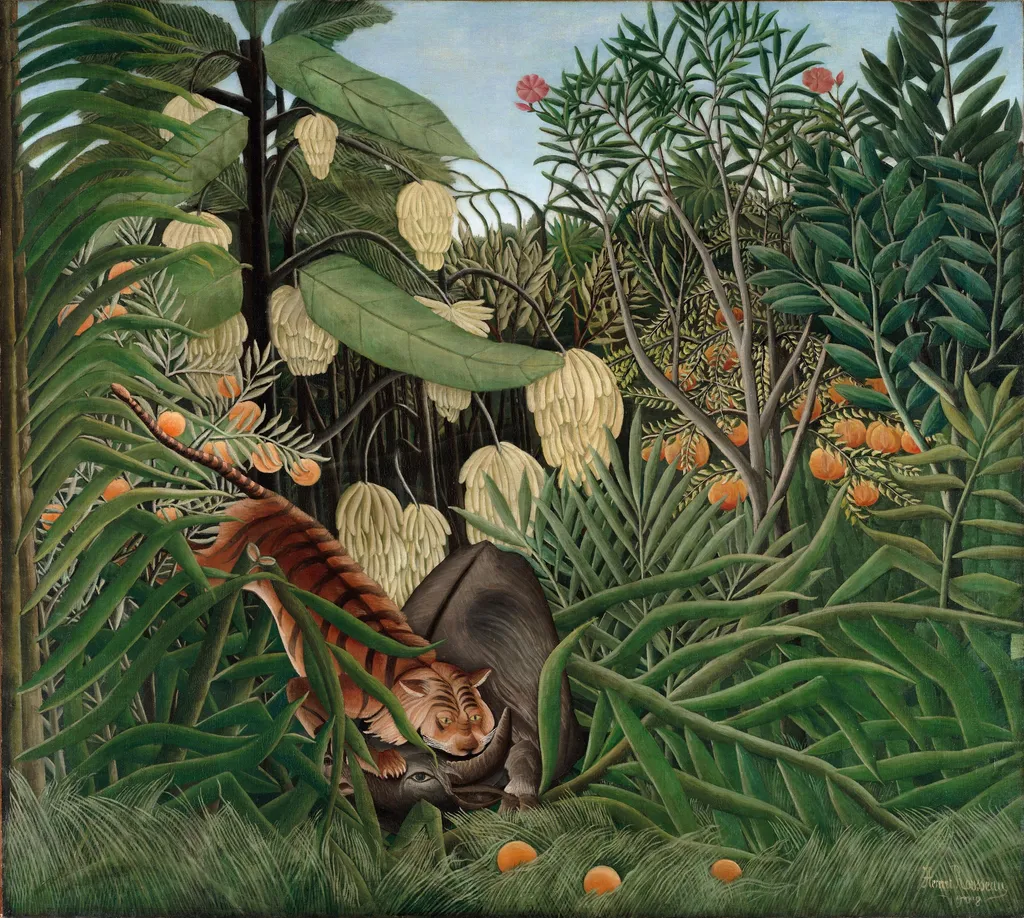
Fight between a Tiger and a Buffalo is an oil painting by the Naïve art artist Henri Rousseau. It dates from 1908 and is held in the collection of the Cleveland Museum of Art.
About this work
Subject & Meaning
The work serves as a representative example of primitivism, emphasizing the elemental clash of wildlife without human intervention.
The painting depicts a dramatic scene of predation set within a dense tropical forest, featuring a tiger immobilizing a buffalo. As a work of naïve art and animal art, the composition focuses entirely on this violent struggle between the two beasts. The subject matter aligns with the artist's renowned "Jungles" series, representing the raw power and danger of untamed nature.
While the primary version in the Cleveland Museum of Art presents this conflict in detail, a smaller, more rapidly executed copy created shortly after the original also captures this same thematic confrontation. The work serves as a representative example of primitivism, emphasizing the elemental clash of wildlife without human intervention.
Technique & Style
Executed in 1908, this work is an oil painting on canvas measuring 170 by 189.5 centimeters. It exemplifies the Naïve art movement and is recognized as a key piece within Rousseau's jungle series. The composition depicts a dramatic predation scene where a tiger immobilizes a buffalo amidst a dense tropical forest.
While the primary version resides in Cleveland, a smaller variant created for the Hermitage Museum (46 × 55 cm) displays noticeably coarser brushwork, a stylistic choice attributed to the artist's haste in fulfilling that specific commission. Both iterations are characterized by their primitivist approach, utilizing the medium to render exotic fauna with a distinctive, flat handling of form and space typical of Rousseau's self-taught technique.
History & Provenance
Fight between a Tiger and a Buffalo was painted by Henri Rousseau in 1908 as an oil on canvas. The work was created in Paris and later entered the collection of the Cleveland Museum of Art, where it remains on display. A second, larger version executed in 1908‑1909 was commissioned by collector Sergei Shchukin; this copy stayed in his collection until 1930, when it was acquired by the Hermitage Museum in Saint‑Pétersbourg.
The original painting reflects Rousseau’s naïve‑art style and his interest in jungle subjects, depicting a tiger immobilizing a buffalo in a tropical forest.
Context
Henri Rousseau's 1908 painting Fight between a Tiger and a Buffalo occupies a significant position within the Naïve art movement and is frequently cited as a representative work of primitivism in painting. The piece is part of the artist's renowned series of jungle scenes, which established his unique stylistic identity despite his lack of formal training. While the primary version resides in the Cleveland Museum of Art, the work's scholarly context is enriched by the existence of a smaller, coarser copy created by Rousseau between 1908 and 1909.
This variant, now held by the Hermitage Museum, was originally commissioned for Sergueï Chtchoukine and reflects the artist's pragmatic approach to meeting deadlines. The painting's depiction of predation within a tropical forest continues to define its legacy as a key example of early 20th-century animal art.
Overview
Fight between a Tiger and a Buffalo (1908) is an oil painting by Henri Rousseau depicting a violent struggle between a tiger and a water buffalo within a dense, stylized jungle. The composition centers on the two animals locked in combat; the tiger, rendered with dark, matted fur, clings to the buffalo's back, while the buffalo's horns are entangled in thick vines. Rousseau fills the background with vibrant, flat planes of bright green foliage and scattered orange fruits, creating a lush yet artificial environment characteristic of his mature style.
Executed in 1908, this work belongs to a series of jungle scenes the artist produced during the final decade of his life, following his retirement from the Paris toll office. Although Rousseau never traveled to the tropics, he constructed these exotic settings using observations from botanical gardens, zoos, and illustrated books. The painting exemplifies his unique approach to narrative, combining precise, almost naive detailing of flora and fauna with a dreamlike, static atmosphere.
It stands as a significant example of his contribution to the Naïve art movement, demonstrating his ability to evoke primal tension through a distinctive, non-naturalistic visual language.
Own this work as a print
Artist & collection

Artist
Henri Julien Félix Rousseau (French: ; 21 May 1844 – 2 September 1910) was a French post-Impressionist painter in the Naïve or Primitive manner.