Artwork
Boy on the Rocks
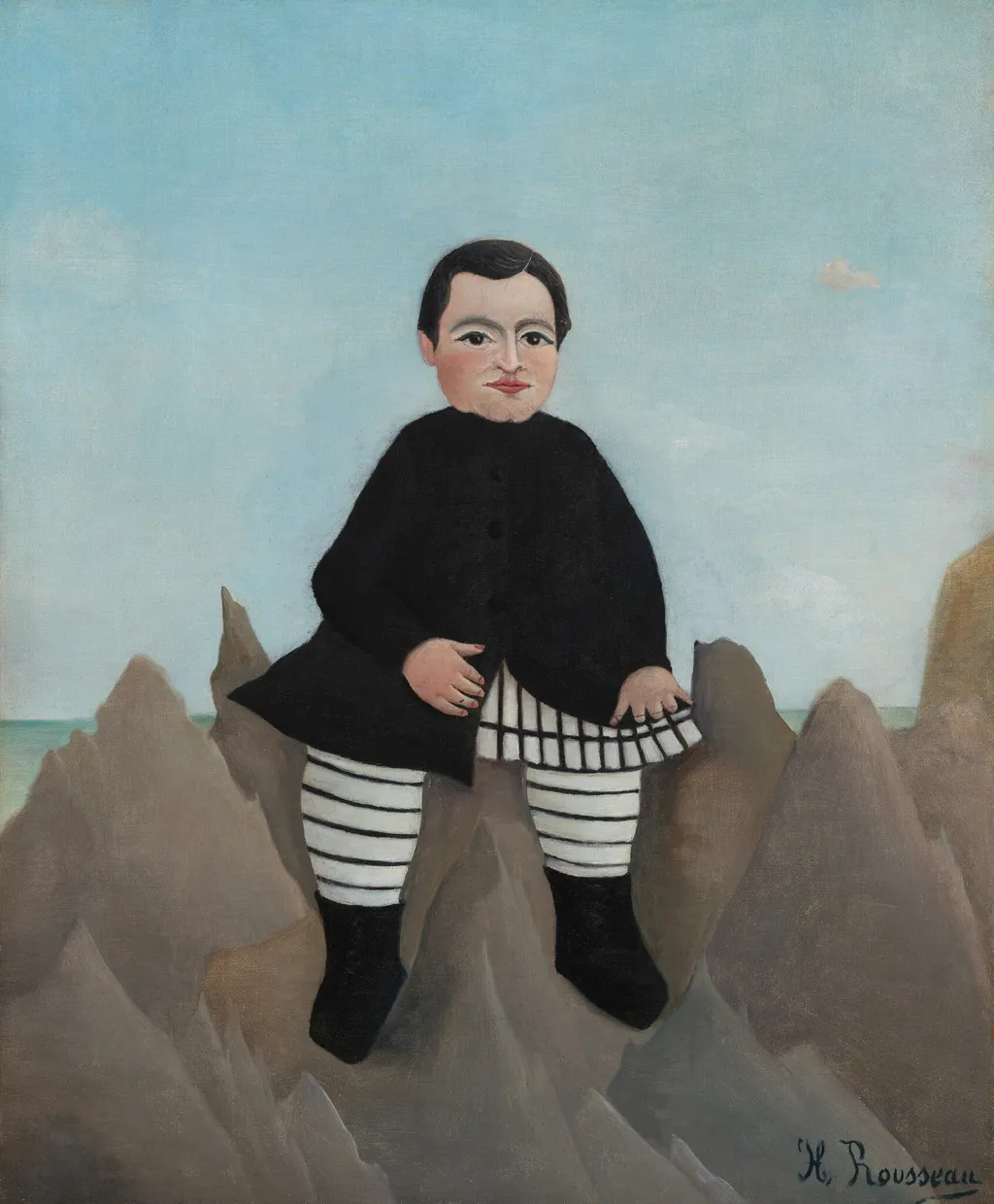
Boy on the Rocks is an oil painting by the Impressionist artist Henri Rousseau. It dates from 1896 and is held in the collection of the National Gallery of Art.
- Inscription
- Inscribed:lower right: H. Rousseau
About this work
Subject & Meaning
Created by Henri Rousseau between 1895 and 1897, the work is executed in oil on canvas and belongs to the naïve art movement.
The painting titled Boy on the Rocks portrays a young boy seated on a cluster of sharp rocks, a composition described as a naïve portrait of a child set against a landscape that evokes rugged mountains. Created by Henri Rousseau between 1895 and 1897, the work is executed in oil on canvas and belongs to the naïve art movement. Rousseau's rendering is noted for its mysterious poetry and dreamlike force, suggesting a symbolic elevation of childhood innocence and a childlike mastery over an imposing natural scene.
Technique & Style
The work is executed in oil on linen, a medium characteristic of Rousseau's late-19th-century practice, and measures 55.4 cm in height by 45.7 cm in width. Its handling emphasizes flat, even color fields and sharply defined contours, aligning with the artist's naïve manner rather than academic naturalism. The composition presents a frontal, seated boy against jagged rock forms that dissolve spatial illusion, flattening the pictorial field and foregrounding the figure's monumental simplicity.
The stylistic qualities, deliberate naivety, rhythmic outlines, and subdued palette, reinforce Rousseau's rejection of conventional perspective in favor of a dreamlike, childlike vision.
History & Provenance
Henri Rousseau created the oil painting Boy on the Rocks between 1895 and 1897. The work entered the art market at a sale held at the Hôtel Drouot in Paris on April 29, 1927, where it was listed as lot number 74. American collector Chester Dale purchased the canvas at this auction.
Upon Dale's death in 1962, the painting remained in his estate until it was bequeathed to the National Gallery of Art in Washington, D.C., in 1963, where it has remained in the collection since.
Context
Created between 1895 and 1897, Boy on the Rocks is categorized within the naïve art movement, reflecting Henri Rousseau's distinctive simple vision. Critics have characterized the artist's broader oeuvre as possessing a "mysterious poetry" and a "dreamlike force." Commentary by Nicolas Pioch suggests that only a childlike artist could capture such an effortless elevation of the subject, rendering the scene both accessible and dauntingly true.
The painting depicts a young boy seated on sharp, mountain-like rocks, embodying the genre of the naïve portrait. Its inclusion on the cover of the May 19, 1999, issue of the Journal of the American Medical Association further underscores its recognition beyond traditional art historical circles.
Legacy
Boy on the Rocks has been described as possessing a "mysterious poetry" and a "dreamlike force," qualities that have shaped its critical reception as a touchstone of Rousseau's naïve art. A commentary by Nicolas Pioch praised the painting's ability to convey a child's confident vantage on the world, reflecting the lasting impression Rousseau's unschooled vision made on later viewers. The work reached a wider public audience when it was featured on the cover of the May 19, 1999, issue of the Journal of the American Medical Association.
Held since 1963 in the National Gallery of Art in Washington, D.C., the painting remains part of the museum's permanent collection and continues to be cited as an example of Rousseau's distinctive contribution to late nineteenth-century portraiture.
Overview
Henri Rousseau's painting, Boy on the Rocks (French: Garçon sur les rochers), was created between 1895 and 1897. Executed in oil on linen, this work presents a solitary young boy seated amidst a rocky landscape. The composition places the child as the central focus, inviting contemplation of his quiet presence and the artist's distinctive approach to portraiture and natural settings.
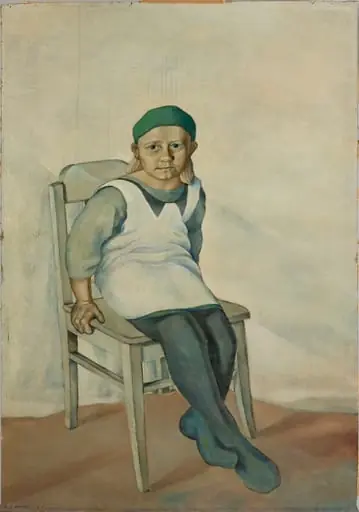
![Child Portrait (Peter in Sicily) (Knabenbildnis [Peter in Sizilien])](https://artifactworldgallery.com/img/georg-schrimpf--child-portrait-peter-in-sicily-knabenbildnis-peter-in-sizili--69ab378ddf389e3e-w320.webp)
Own this work as a print
Artist & collection

Artist
Henri Julien Félix Rousseau (French: ; 21 May 1844 – 2 September 1910) was a French post-Impressionist painter in the Naïve or Primitive manner.