Artwork
The Merry Jesters
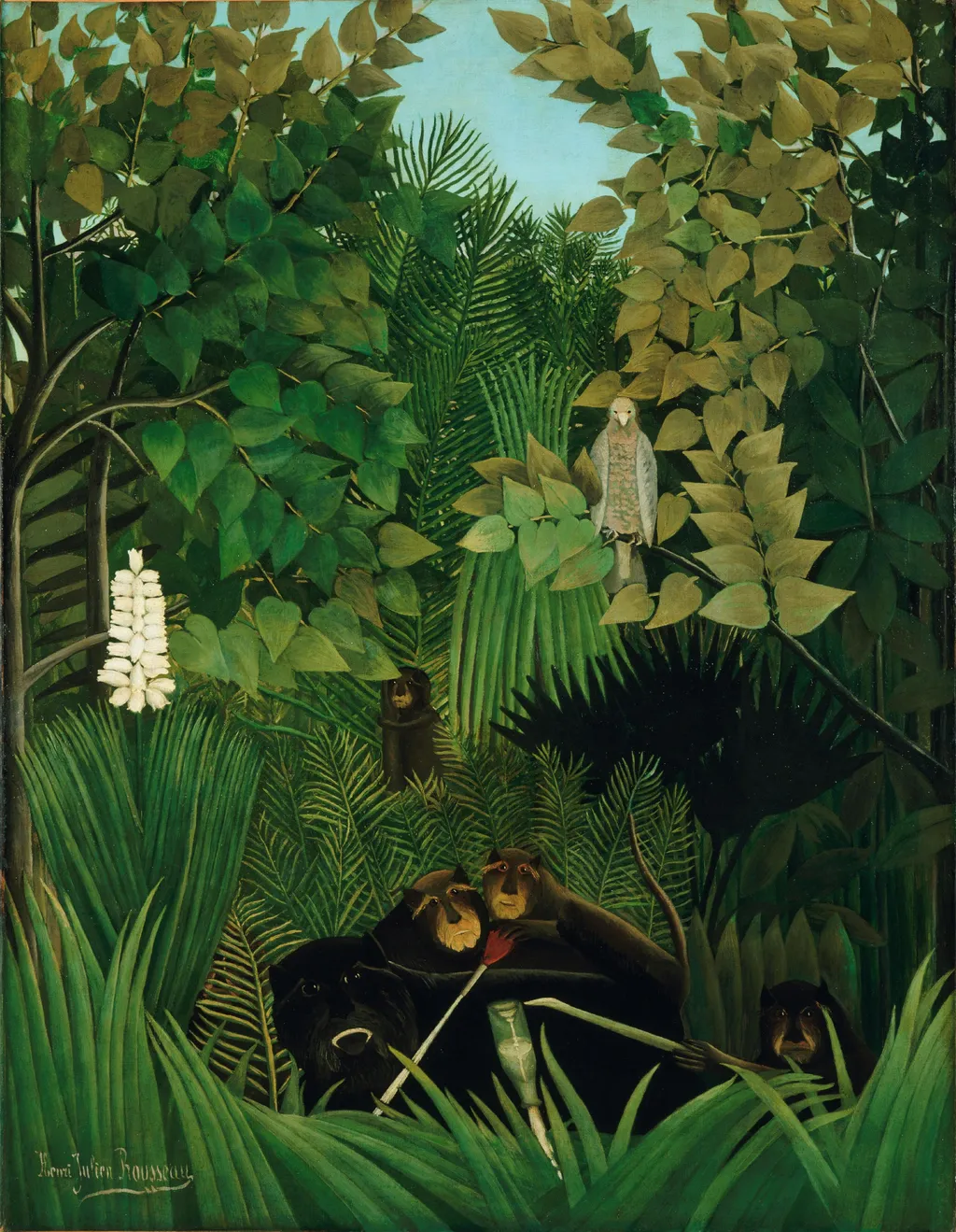
The Merry Jesters is an oil painting by the Naïve art artist Henri Rousseau. It dates from 1906 and is held in the collection of the Philadelphia Museum of Art.
About this work
Overview
The Merry Jesters (French: Les Joyeux Farceurs) is a 1906 oil-on-canvas painting by the French post-impressionist artist Henri Rousseau.
The Merry Jesters (French: Les Joyeux Farceurs) is a 1906 oil-on-canvas painting by the French post-impressionist artist Henri Rousseau. Measuring 145.7 by 113.3 centimeters, the vertical composition depicts monkeys and a bird in a stylized jungle setting, exemplifying the naive-art movement with which Rousseau is associated. The work is held in the Philadelphia Museum of Art as part of the Louise and Walter Arensberg Collection, having been owned by the modernist painter Robert Delaunay before its acquisition by the museum. Painted during the most celebrated phase of Rousseau's career, when he produced his famed jungle scenes, The Merry Jesters stands as a characteristic example of the artist's imaginative tropical visions, created without his ever having left France.
Subject & Meaning
The painting presents a group of five dark-furred monkeys and a single bird within a dense jungle environment. Four monkeys cluster in the lower third of the composition, their faces rendered in frontal view. The largest monkey, positioned with his back parallel to the lower edge, partially obscures two smaller ones whose bodies are arranged in near-mirror symmetry along the central vertical axis. The rightmost small monkey grasps a white staff that terminates in a bright red swelling near his hand. A fourth monkey in this group is largely hidden by light green grasses covering the lower edge, with only his face and one arm visible; he holds a tapering stick with a bottle at its end, from which liquid pours downward. A fifth monkey appears left of center, his torso frontal, his gaze directed toward the group, part of his face concealed by overhanging foliage. Above them, a bird with beige-modeled breast plumage and white wings pressed close to its body perches on a sparsely leaved diagonal branch. A tall white cylindrical flower with stacked petals and a small patch of pale blue sky appear near the upper center. The monkeys are notably anthropomorphized: they possess beard-like facial hair, with longer fur around the eyes, and the smaller ones show beige coloring in beard and eyebrow regions. Their human-like activities, particularly the pouring of liquid from a bottle, suggest a playful, almost theatrical scene of animal mimicry. The title itself implies jest and performance, reinforced by the stage-like, flattened arrangement of the foliage.
Technique & Style
Rousseau executed The Merry Jesters in oil paint on canvas, employing a smooth, flat brushwork that renders leaves as simplified, patterned shapes rather than naturalistic detail. The palette is dominated by deep greens, with touches of pale blue sky visible through gaps in the canopy. Shadows are minimal, and light appears evenly distributed across the scene, eliminating traditional chiaroscuro modeling. The foliage is arranged in a scissor-cut, silhouette-like manner that recalls theater sliding scenery rather than perspectival depth; different layers of leaves, grasses, and fern-like forms overlap without creating convincing spatial recession. This decorative, frontal approach is characteristic of Rousseau's self-taught, naive style, which operated outside academic conventions. The composition is notably vertical, with the dense tropical filling the frame and figures pressed toward the picture plane. A signature appears in the lower left corner. The overall effect is one of deliberate artificiality, a constructed paradise that announces itself as imaginative invention rather than observed reality.
History & Provenance
The Merry Jesters was painted in 1906, during the mature period of Rousseau's jungle paintings. The work was owned by Robert Delaunay, the French modernist painter associated with Orphism, before entering the collection of Louise and Walter Arensberg. It is now held by the Philadelphia Museum of Art as part of their Arensberg Collection. The painting has been discussed in significant Rousseau scholarship, including publications by Götz Adriani and Christopher Green, and was featured in a 2022 Washington Post article by Sebastian Smee examining the artist's monkey paintings.
Context
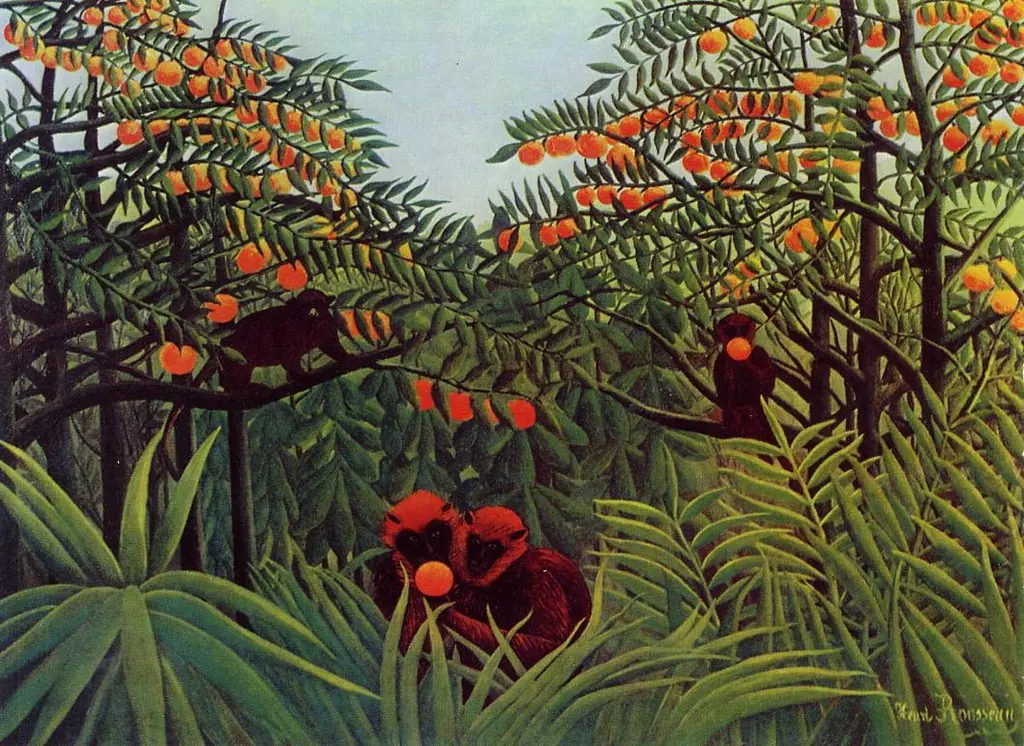
Henri Rousseau, a customs officer by profession and entirely self-taught as an artist, never left France, yet he produced some of the most enduring imaginary jungle scenes in Western art. For The Merry Jesters, as with his other tropical compositions, Rousseau drew botanical inspiration from studies made at the Jardin des Plantes in Paris, while his animal depictions derived from postcards and popular illustrated publications such as Bêtes sauvages. Significantly, rather than depicting the monkeys in the cages of Parisian zoos as he knew them, Rousseau liberated them into an artificial greenhouse-like environment, transferring them from captivity to a constructed wilderness. The work belongs to Rousseau's celebrated jungle series, which cemented his reputation as a pioneer of naive art and attracted the admiration of avant-garde circles including the Delaunays, Picasso, and later the Surrealists. The painting's ownership by Robert Delaunay signals its importance within modernist circles that championed Rousseau's untutored vision as an alternative to academic naturalism.
Legacy
The Merry Jesters occupies a significant place within Rousseau's oeuvre as a representative jungle scene that demonstrates the artist's distinctive fusion of observed detail and imaginative fabrication. The work has contributed to ongoing scholarly interest in how Rousseau constructed his exotic subjects from secondhand sources, transforming popular imagery into something uniquely his own. Its place in the Arensberg Collection at the Philadelphia Museum of Art ensures its visibility within one of the most important assemblies of modern art in the United States. The painting continues to attract critical attention, as evidenced by recent journalistic engagement, and serves as a touchstone for discussions of primitivism, naive art, and the construction of the exotic in early twentieth-century French painting. Rousseau's jungle scenes, including The Merry Jesters, influenced subsequent generations of artists who found in his work a liberating alternative to conventional perspective and naturalistic representation.
Own this work as a print
Artist & collection

Artist
Henri Julien Félix Rousseau (French: ; 21 May 1844 – 2 September 1910) was a French post-Impressionist painter in the Naïve or Primitive manner.