Artwork
The Dream
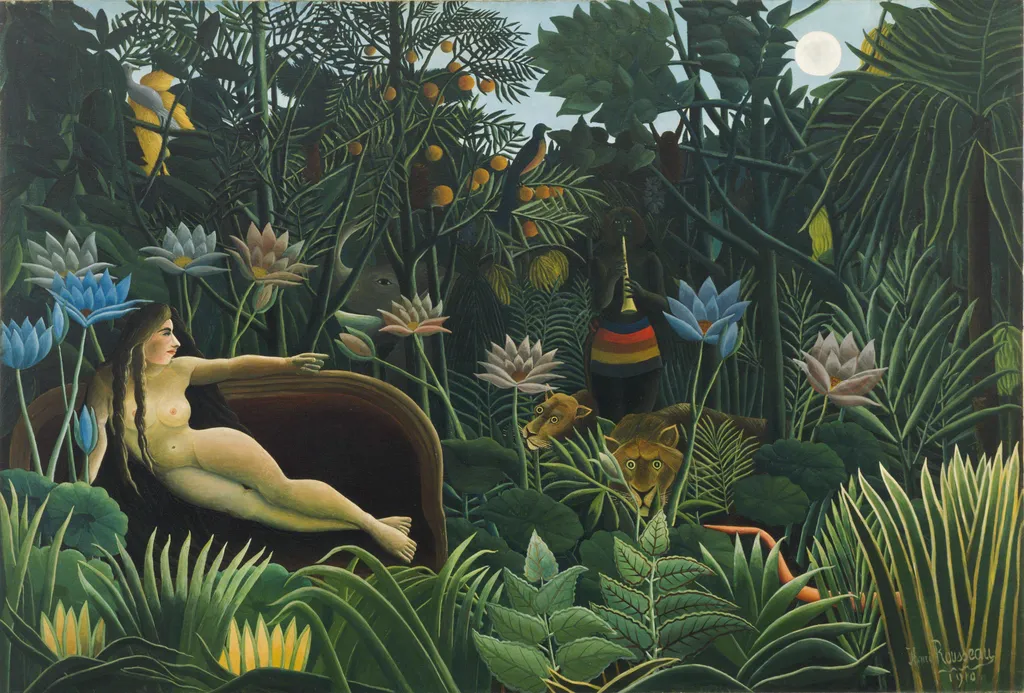
The Dream is an oil painting by the Naïve art artist Henri Rousseau. It dates from 1910 and is held in the collection of the Museum of Modern Art.
About this work
Subject & Meaning
Rousseau may also have drawn inspiration from Émile Zola's novel Le Rêve, which concerns the love between a painter and an embroideress.
The painting depicts a nude woman, identified as Yadwigha, Rousseau's Polish mistress from his youth, reclining on a couch amid a lush jungle populated by birds, monkeys, an elephant, a lion and lioness, a snake, and a flute-playing snake charmer. Stylized lotus flowers and other tropical plants surround her, while a full moon illuminates the scene. The reclining nude places the work within a classical tradition stretching from Titian's Venus of Urbino to Manet's Olympia.
Rousseau himself clarified the subject in a letter to critic André Dupont: the woman is lying on a couch in Paris, dreaming she hears a flute player in the jungle. To forestall misinterpretation, he composed an accompanying poem, Inscription pour Le Rêve, in which Yadwigha falls asleep and listens to a snake charmer's pipe while wild serpents lend their ears to the music. Rousseau may also have drawn inspiration from Émile Zola's novel Le Rêve, which concerns the love between a painter and an embroideress.
Technique & Style
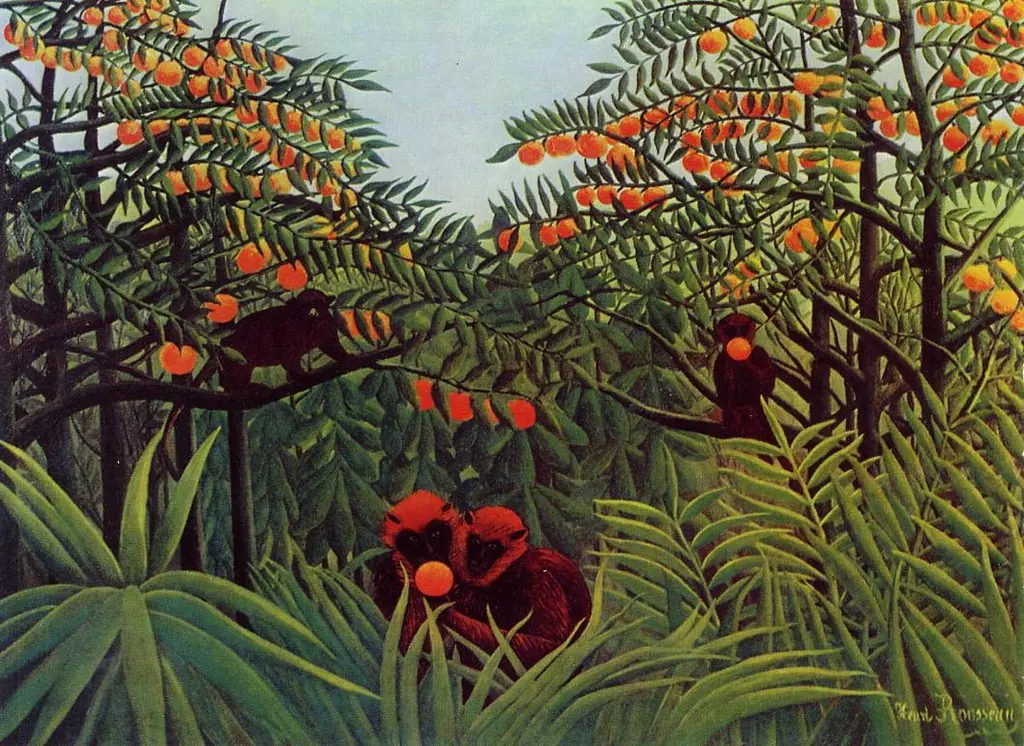
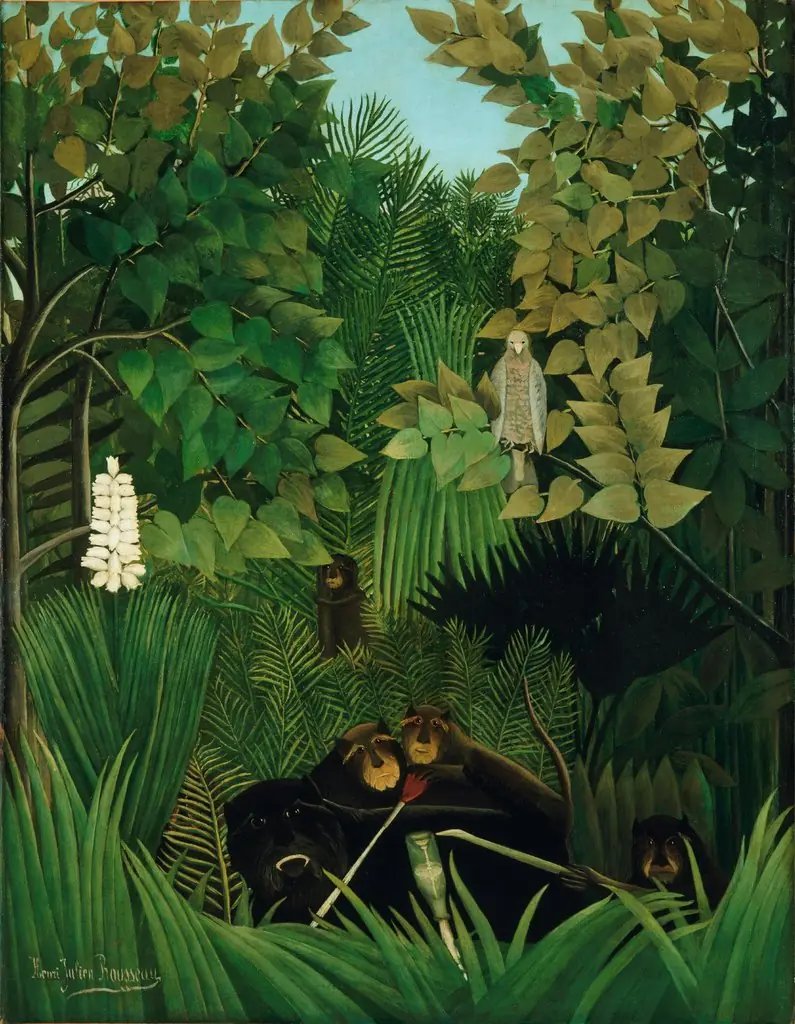
The Dream is an oil-on-canvas painting measuring 204.5 × 298.5 cm, making it the largest of Henri Rousseau's more than 25 jungle-themed works. Executed in 1910, it is classified within the naïve art movement and belongs to the genre of the nude. The composition features a reclining nude, Yadwigha, on a red divan, surrounded by stylised lotus flowers, an elephant, a lion and lioness, monkeys, birds, an orange snake, and a black snake charmer playing a flute under moonlight. The flat, decorative treatment of the jungle foliage derives from Rousseau's observations at the Paris Museum of Natural History and its Jardin des Plantes rather than from direct contact with tropical environments. Stylised plant forms and the dreamlike juxtaposition of the nude with wild fauna give the work its characteristically naïve, almost surreal quality.
History & Provenance
The Dream was painted by Henri Rousseau in 1910, his last completed work, and first shown at the Salon des Indépendants from 18 March to 1 May 1910, a few months before his death on 2 September 1910. Rousseau sold the canvas to dealer Ambroise Vollard in February 1910. Vollard then consigned it to Knoedler Galleries in New York, which sold it to collector Sidney Janis in January 1934. Janis retained the painting until 1954, when he sold it to Nelson A. Rockefeller; Rockefeller donated the work to the Museum of Modern Art, New York, to mark the institution’s 25th anniversary, where it remains on view.
The Dream is held by the Museum of Modern Art, New York, where it remains on display.
It was first exhibited at the Salon des Indépendants in Paris from 18 March to 1 May 1910. Ambroise Vollard purchased the work directly from the artist in February 1910. It was later sold via Knoedler Galleries, New York, to Sidney Janis in January 1934, then to Nelson A. Rockefeller in 1954, who donated it to MoMA in 1954 to mark the museum’s 25th anniversary.
Context
Completed in 1910 as Henri Rousseau's final work, *The Dream* marked a critical turning point for the artist, who had previously faced negative reception. Upon its debut at the Salon des Indépendants, poet Guillaume Apollinaire defended the piece, declaring its beauty indisputable and predicting it would not be mocked. The painting stands as the largest of Rousseau's more than twenty-five jungle-themed canvases and is a defining example of the naïve art movement. Art historically, the composition engages with the classical tradition of the reclining nude, echoing works by Titian and Manet, while its dreamlike narrative anticipates Surrealism. Rousseau, who never traveled beyond France, synthesized observations from the Paris Museum of Natural History and botanical gardens to construct this imaginary landscape, blending a Polish mistress, Yadwigha, with exotic fauna and a snake charmer.
Legacy
The Dream entered the Museum of Modern Art in 1954 when Nelson A. Rockefeller donated it to mark the institution’s twenty‑fifth anniversary, and it has remained on view there ever since. As Rousseau’s largest and final jungle canvas, the work is regarded as a touchstone of naïve art and continues to be referenced in broader culture. A detail of the painting served as the cover for the Dutch edition of Gabriel García Márquez’s Love in the Time of Cholera, while Andrea Camilleri’s novel Un covo di vipere cites the canvas. More recently, the painting was reproduced as wallpaper in Laurent Lafitte’s 2021 film L’Origine du monde.
Own this work as a print
Artist & collection

Artist
Henri Julien Félix Rousseau (French: ; 21 May 1844 – 2 September 1910) was a French post-Impressionist painter in the Naïve or Primitive manner.