Artwork
Tropical Forest with Monkeys
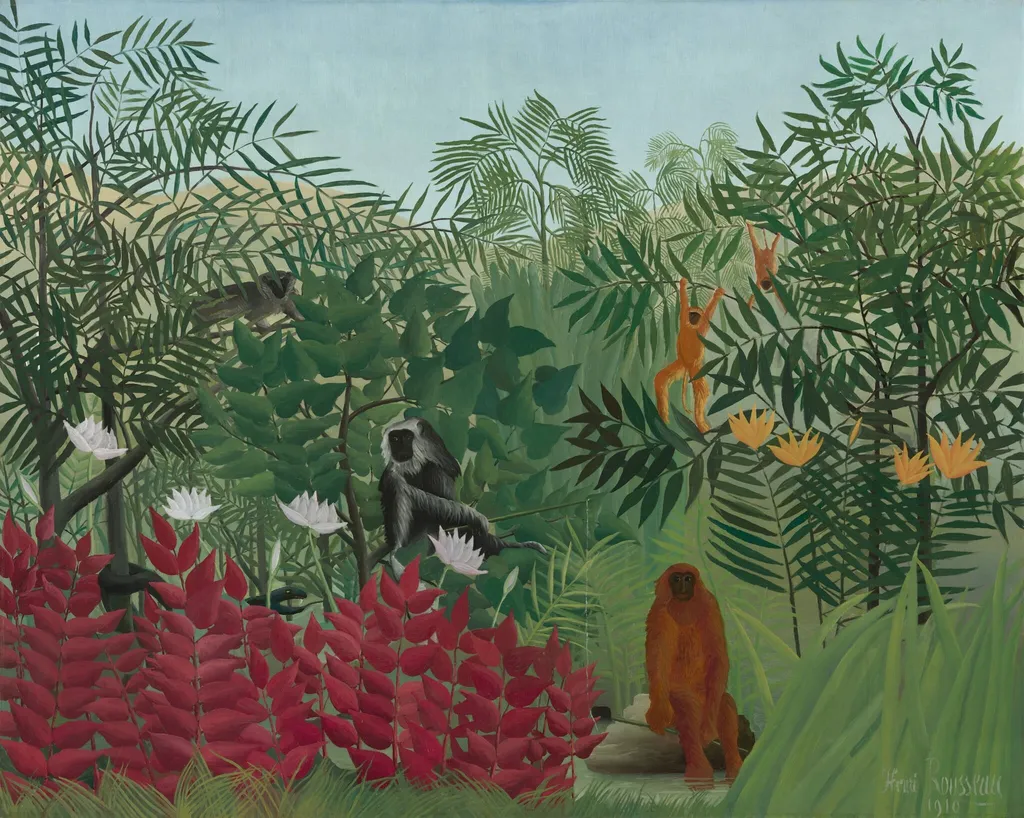
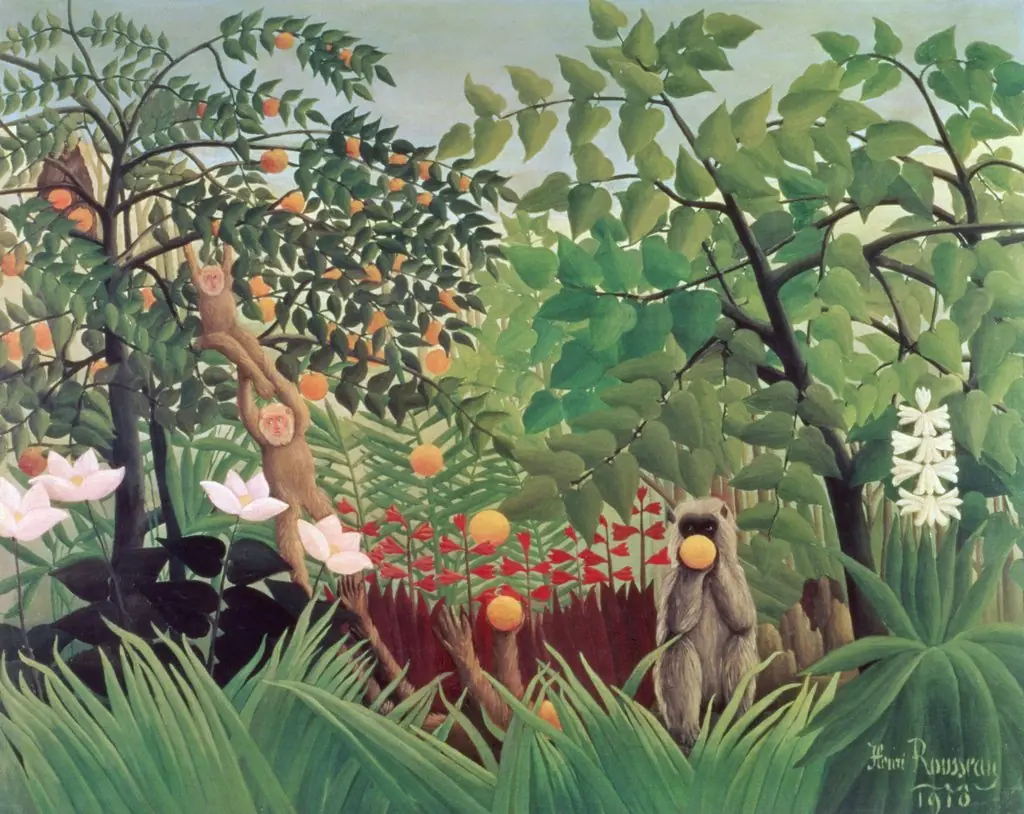
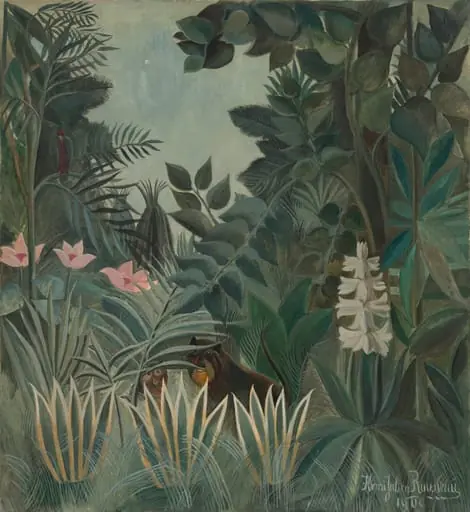
Tropical Forest with Monkeys is a watercolor painting by the Naïve art artist Henri Rousseau. It dates from 1910 and is held in the collection of the National Gallery of Art.
- Inscription
- Inscribed:lower right: Henri Rousseau / 1910
About this work
Subject & Meaning
As a hallmark of Rousseau's naïve style, the work's iconography challenges viewers to question the distinction between the domestic and the untamed.
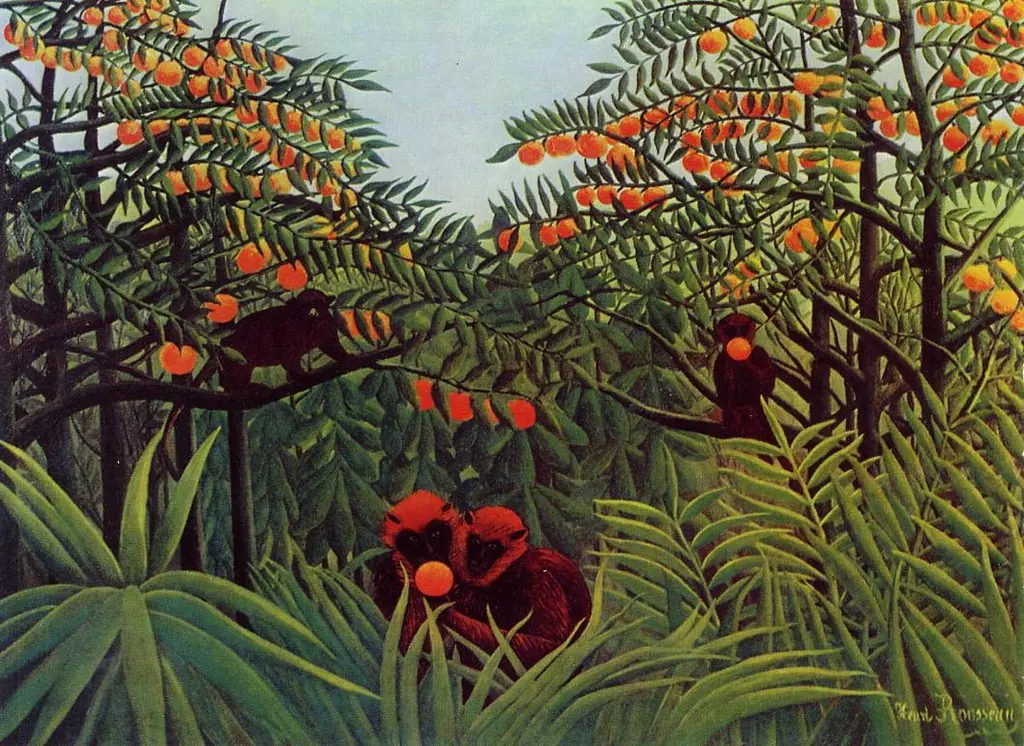
The painting depicts a lush jungle inhabited by two monkeys, a snake, and a fishing rod, a human tool wielded by one of the primates. This anthropomorphic detail introduces a symbolic tension between the natural and the artificial, suggesting a playful or ironic commentary on the boundary between animal instinct and human culture. Rousseau, who never visited a real jungle, constructed an imagined, Edenic landscape that blends exotic flora with narrative enigma.
The snake adds a traditional element of threat or temptation, while the monkeys’ use of the fishing rod humanizes them, prompting reflection on the relationship between civilization and the wild. As a hallmark of Rousseau's naïve style, the work's iconography challenges viewers to question the distinction between the domestic and the untamed.
Technique & Style
Created in 1910, this oil-on-canvas painting belongs to Henri Rousseau's signature series of jungles. Its medium is oil on canvas, typical of the artist's mature work. The support measures 129.5 by 162.5 cm. Stylistically, the work is a prime example of naïve art, characterized by simplified forms, vivid colors, and a flattened sense of space.
The composition depicts a dense jungle inhabited by primates, a snake, and a human fishing rod, elements that combine exotic nature with incongruous human tools. Rousseau's handling is meticulous in its rendering of foliage and animals, yet retains the unschooled charm that defines his approach. The painting is classified as a landscape and is housed at the National Gallery of Art in Washington, D.C.
History & Provenance
Henri Rousseau painted Tropical Forest with Monkeys in 1910, as confirmed by multiple references. The work was first owned by Paul von Mendelssohn Bartholdy in Berlin. After his death, it passed to his wife, Elsa Gräfin Kesselstadt, who held it in Berlin and later in Vaduz.
In 1950, the painting was consigned to the Swiss dealer Walter Feilchenfeldt, who sold it that same year to American collector John Hay Whitney of Manhasset, New York. Whitney deeded the painting to the John Hay Whitney Charitable Trust in 1982, and in the same year the trust gifted it to the National Gallery of Art, Washington, where it remains. The painting was not commissioned; its creation history directly parallels Rousseau's late-career jungle scenes.
Context
Henri Rousseau, a self-taught French painter associated with the Naïve art movement, is best known for his imaginative jungle scenes, of which Tropical Forest with Monkeys (1910) is a late example. Scholars have noted that the painting complicates the exotic genre by portraying primates wielding human tools, specifically a fishing rod, introducing a layer of ambiguity between the natural and the artificial. This detail underscores Rousseau's idiosyncratic vision, which blends childlike directness with subtle strangeness.
The work now resides in the National Gallery of Art in Washington, D.C., and is considered a key piece within Rousseau's celebrated jungle series, illustrating his distinctive place in early modern art as an outsider who influenced later avant-garde movements.
Overview
Tropical Forest with Monkeys, painted by Henri Rousseau in 1910, is a quintessential example of the artist's mature jungle fantasy. Executed in oil on canvas, the work depicts a dense, verdant rainforest teeming with life. The composition is characterized by flat, rhythmic patterns of foliage, where thick vines and broad leaves create a layered, tapestry-like effect.
Brightly colored birds and monkeys emerge from the dense greenery, while a coiled snake adds a sense of latent danger. A solitary figure, a man holding a fishing rod, sits incongruously in the lower corner, a recurring motif in Rousseau's work that introduces a human element into the wild setting. Created shortly before the artist's death, this painting reflects his unique vision of the tropics, derived entirely from botanical illustrations and dioramas at the Paris Natural History Museum, as he never traveled beyond France.
The work stands as a significant contribution to the Naïve art movement, celebrated for its dreamlike atmosphere and meticulous, decorative detail that challenges traditional perspectives on depth and realism.
Own this work as a print
Artist & collection

Artist
Henri Julien Félix Rousseau (French: ; 21 May 1844 – 2 September 1910) was a French post-Impressionist painter in the Naïve or Primitive manner.