Artwork
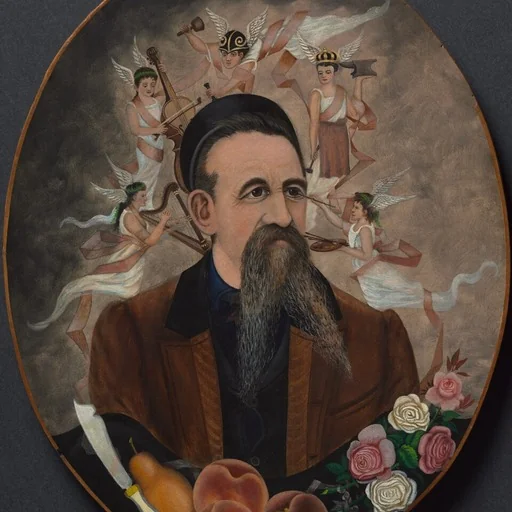
Self-Portrait with Five Muses
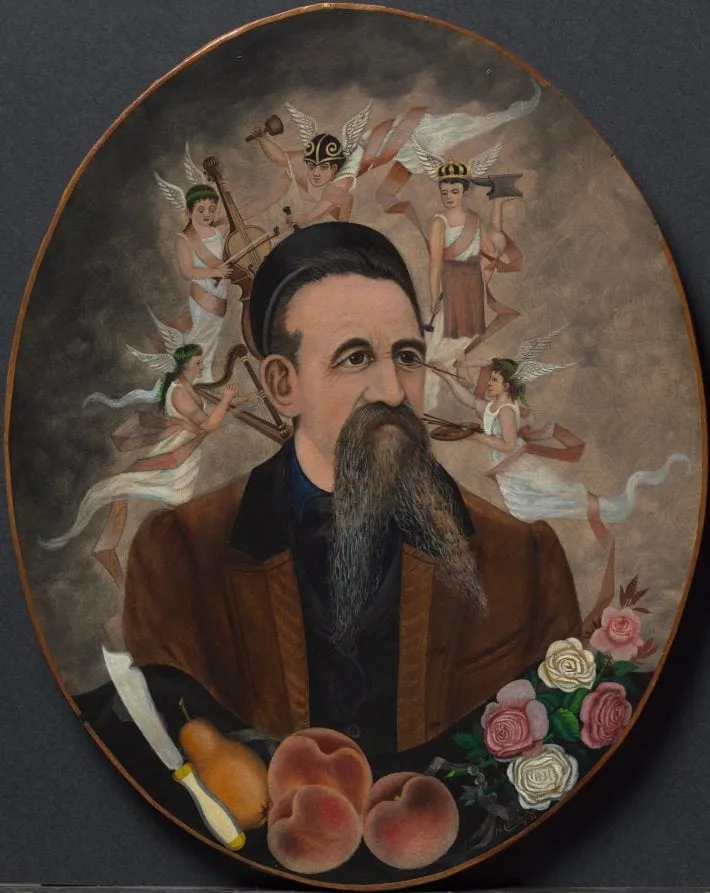
Self-Portrait with Five Muses is an unspecified painting by the American Impressionist artist Henry Church. It dates from 1880 and is held in the collection of the Cleveland Museum of Art.
- Accession no.
- 2012.30
- Credit line
- Delia E. Holden Fund
About this work
If you like this mix of skill and imagination, look up artist: Henry Church (American, 1836–1908) for more of his self-taught scenes.
Here’s a man standing in the middle of five tiny winged women. Each one holds a different tool, paintbrush, hammer, chisel, lyre.
Church was a blacksmith by trade, not a trained artist. He painted himself as the center of creativity, even giving a muse a blacksmith’s crown. It’s rare to see everyday work celebrated like this in 19th-century art.
If you like this mix of skill and imagination, look up artist: Henry Church (American, 1836–1908) for more of his self-taught scenes.
Overview
Henry Church, a self-taught artist from Chagrin Falls, Ohio, created this unusual self-portrait as a declaration of personal identity and creative authority. Though trained as a blacksmith, he embraced painting, sculpture, and music as lifelong passions. The painting presents him surrounded by five winged figures, each embodying a form of artistic expression he valued, blending folk imagination with symbolic tradition.
Subject & Meaning
The five muses in the painting represent not only classical arts, painting, sculpture, and music, but also Church’s trade as a blacksmith, depicted as a crowned figure wielding a hammer and anvil. This reimagining elevates manual labor to the level of artistic inspiration. By placing himself at the center, Church asserts his role not as a mere craftsman but as a holistic creator, merging utility and artistry in a single vision.
Technique & Style
Church’s technique reflects the untrained hand of a folk artist: simplified forms, flat perspective, and bold outlines characterize the figures and setting. The muses are rendered in miniature, hovering around the central figure with a dreamlike logic. Color is restrained but deliberate, drawing attention to the symbolic tools each muse holds. The composition prioritizes narrative clarity over naturalism, emphasizing meaning over realism.
History & Provenance
Painted around the time of his gallery’s founding in 1888, the work likely served as both personal statement and promotional artifact. Church’s Art Museum at Geauga Lake displayed only his own creations, making this portrait a cornerstone of his self-curated legacy. The painting remained in his possession until his death in 1908, after which it passed through private hands before entering institutional collections.
Context
In an era when professional academies dominated American art, Church’s work stood apart. His fusion of artisanal identity with mythic symbolism challenged norms that separated fine art from craft. While contemporaries sought European validation, Church rooted his vision in local experience, offering a rare example of a working-class man asserting creative sovereignty through visual allegory.
Legacy
Church’s self-portrait endures as a testament to independent artistic expression outside institutional frameworks. His decision to celebrate blacksmithing as a muse-like calling influenced later folk and outsider art narratives. Though little known during his lifetime beyond northeast Ohio, his work now contributes to broader understandings of 19th-century American creativity beyond academic traditions.
Artist & collection