Artwork
A Gentleman of the Wilkes Family

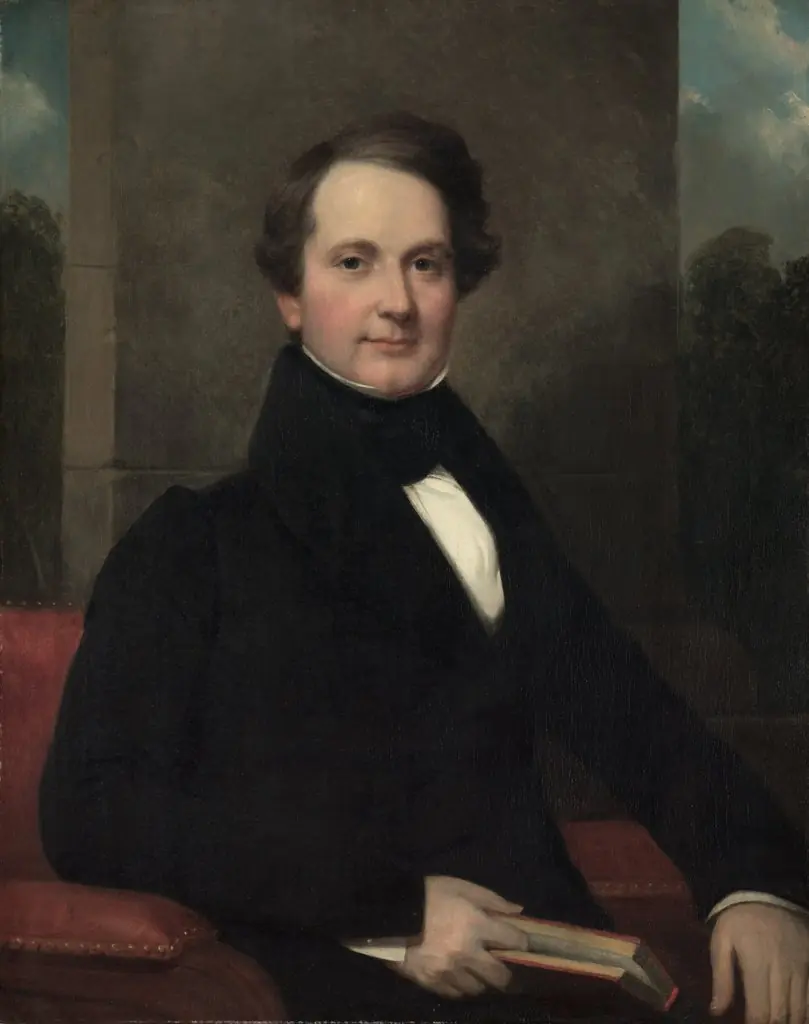
A Gentleman of the Wilkes Family is an oil painting by the American Folk Art artist Henry Inman. It dates from 1839 and is held in the collection of the Metropolitan Museum of Art.
About this work
If you like this, look up other portraits from the same time at The Metropolitan Museum of Art.
Here’s a man in a dark coat, crisp white shirt, and black bow tie, staring straight at you. His face is lit softly, like sunlight through a window.
Inman painted this around 1840, when American portraits were often stiff and formal. But this one feels different, less like a statue, more like someone you might meet at a party. The loose brushstrokes on his coat add life, not polish.
If you like this, look up other portraits from the same time at The Metropolitan Museum of Art.
Subject & Meaning
The portrait A Gentleman of the Wilkes Family (1838) by Henry Inman depicts an unidentified male member of the Wilkes family, rendered in oil on canvas. As a genre work, it adheres to the conventions of 19th-century American portraiture, emphasizing the subject’s individuality and social status through direct gaze and formal attire. The iconography is restrained, focusing on the sitter’s likeness rather than overt symbolic attributes, though the choice of dark, understated clothing may subtly signal the subject’s refinement and professional or mercantile standing.
The work primarily represents a personal and familial record, preserving the likeness of a specific individual within a prominent family context, rather than conveying broader allegorical or moral themes.
Technique & Style
The portrait is painted in oil on a plain-weave linen canvas using a precisely modeled, smoothly blended handling typical of early American academic portraiture. The sitter is rendered with sharp focus and even illumination, avoiding visible brush-textured impasto. The palette is restrained, relying on subdued earth tones and cool highlights to articulate form.
The 30.5 × 25.4 cm format suggests a bust-length, three-quarter view composition designed for intimate display. No abrasions or flaking are reported, indicating the support remains taut and the paint layer intact under stable conditions.
History & Provenance
Created in 1838, the oil-on-canvas portrait titled A Gentleman of the Wilkes Family was executed by the American artist Henry Inman. The work depicts a male subject and is classified within the genre of portraiture. While the specific circumstances of its commission and the detailed chain of ownership prior to its current location are not detailed in the available records, the painting is firmly dated to 1838 based on its inception.
It is currently held in the collection of the Metropolitan Museum of Art, where it resides within The American Wing. The artwork measures 30.5 by 25.4 inches and remains a significant example of Inman's portraiture from that period.
A Gentleman of the Wilkes Family is housed in the Metropolitan Museum of Art in New York, where it is listed as part of the museum’s collection in the American Wing. The work is catalogued as an oil on canvas portrait painted by Henry Inman in 1838, measuring 30.5 × 25.4 cm. The sources do not provide a specific accession or inventory number for the piece, nor do they record any documented exhibition history prior to its inclusion in the museum’s holdings. Consequently, its provenance is limited to the museum’s collection records.
Overview
A Gentleman of the Wilkes Family is an oil on canvas portrait by Henry Inman, completed around 1839. This work depicts an unidentified male figure, rendered with a direct gaze toward the viewer. The painting is held within The American Wing, representing a notable example of American portraiture from the early 19th century. It captures a sense of immediacy, distinguishing it from some contemporary works.
Context
Created around 1839, this portrait by Henry Inman emerged during a period when American portraiture frequently favored a formal and somewhat rigid presentation. "A Gentleman of the Wilkes Family" offers a contrast to this prevailing style, presenting a more relaxed and immediate depiction of its subject. Rather than an idealized or monumental figure, the sitter appears as an individual one might encounter in everyday life, reflecting a subtle shift in artistic sensibility.

Artist & collection