Artwork
The Lackawanna Valley
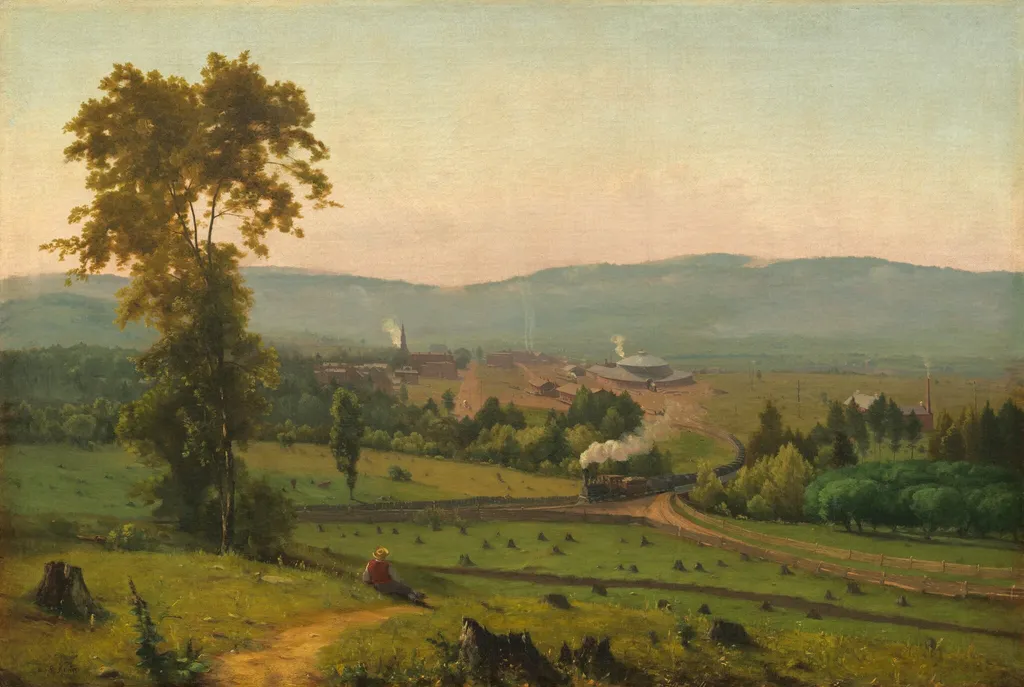
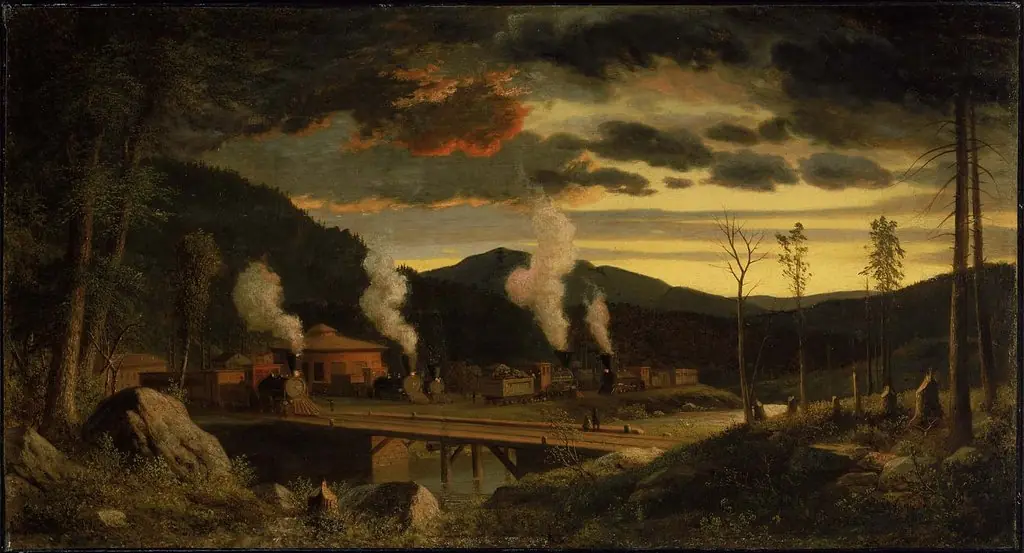
The Lackawanna Valley is an oil painting by the Hudson River School artist George Inness. It dates from 1856 and is held in the collection of the National Gallery of Art.
- Inscription
- Inscribed:lower left: G. Inness
About this work
Subject & Meaning
This imagery was originally commissioned as an advertisement for the railroad, emphasizing its role in regional development and progress.
The work portrays the Lackawanna Valley at the location of the railroad's inaugural roundhouse, a scene that symbolizes the emerging industrial presence of the Delaware, Lackawanna and Western Railroad; the composition centers on a prominent tree, underscoring both natural scenery and the railroad's integration into the landscape. This imagery was originally commissioned as an advertisement for the railroad, emphasizing its role in regional development and progress. The painting thus conveys themes of technological advancement and the harmonious yet dominant relationship between nature and industry.
Technique & Style
Created circa 1855 to 1856, The Lackawanna Valley is executed in oil paint on a canvas support. The work measures 86 cm in height and 127.5 cm in width. Classified as a landscape painting, the piece features a composition that prominently depicts trees alongside the industrial subject of the railroad roundhouse.
The medium of oil on canvas was the standard technique employed by the American artist George Inness for this commission, which served as an advertisement for the Delaware, Lackawanna and Western Railroad.
History & Provenance
George Inness created The Lackawanna Valley, an oil-on-canvas painting dated to approximately 1855–1856, following a commission from the Delaware, Lackawanna, and Western Railroad. The work was specifically requested by railroad president John Jay Phelps to serve as an advertisement depicting the company's first roundhouse in Scranton, Pennsylvania. After its creation, the painting passed through several private owners; it appeared at an American Art Association sale in New York in March 1927 and a Parke-Bernet auction in February 1938.
It was acquired by dealer Henry Schultheis Co. before being sold to M. Knoedler & Co. in May 1944. Millicent Rogers purchased the painting in February 1945 and gifted it to the National Gallery of Art later that same year, where it remains in the permanent collection.
Legacy
The Lackawanna Valley became a reference point for 19th-century American landscape painting, noted for its industrial subject matter and precise atmospheric rendering. Commissioned by the Delaware, Lackawanna and Western Railroad, the work exemplified early corporate patronage of art and introduced a genre that merged topography with emerging railway infrastructure. After passing through several private owners, the canvas entered the National Gallery of Art in 1945, where its inclusion reinforced George Inness's standing as a pioneer of visionary scenery. Scholars have highlighted the painting's role in shaping later landscape artists' treatment of technology and nature.
Overview
George Inness's painting, The Lackawanna Valley, created around 1855, is an oil on canvas recognized as one of the artist's notable works. Currently housed at the National Gallery of Art in Washington, D.C., this landscape depicts a specific industrial site within a broader natural setting. The composition subtly integrates elements of human development into a seemingly tranquil scene, reflecting a period of significant change in the American landscape.
Own this work as a print
Artist & collection

Artist
George Inness (May 1, 1825 – August 3, 1894) was an American landscape painter. Now recognized as one of the most influential American artists of the nineteenth century, Inness was influenced by the Hudson River School…