Artwork
View of Richmond Hill and Bridge
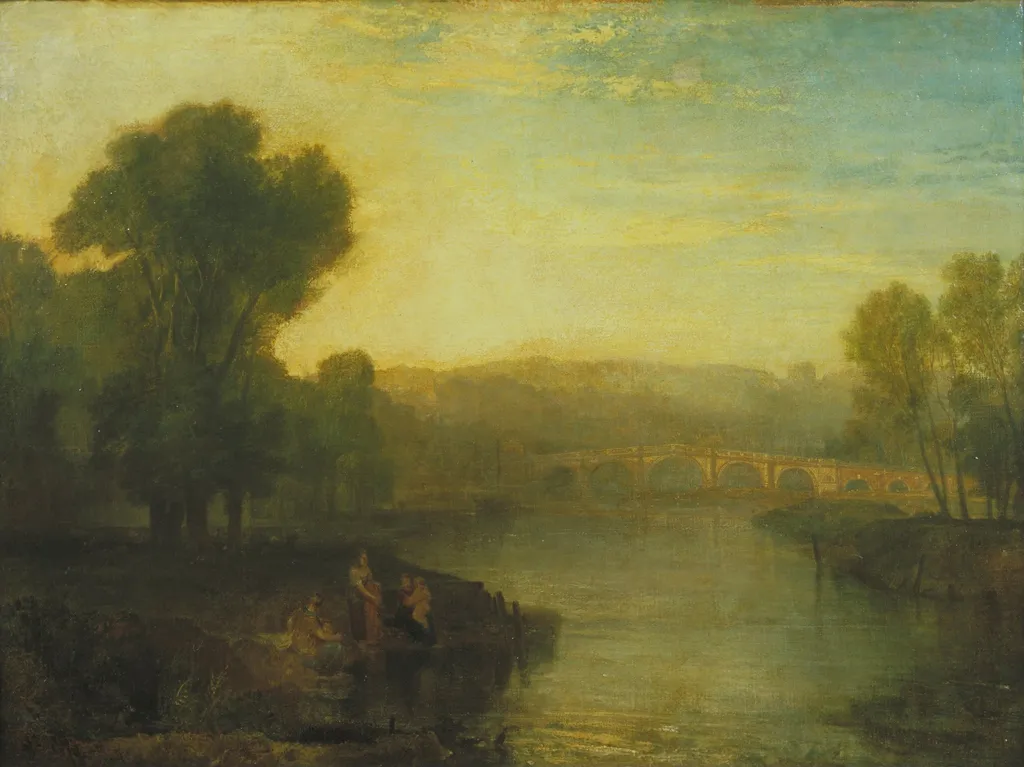
View of Richmond Hill and Bridge is an oil painting by Joseph Mallord William Turner. It dates from 1808 and is held in the collection of the National Gallery.
About this work
Overview
9 cm, the work is now held at Tate Britain in London, where it entered as part of the Turner Bequest in 1856.
View of Richmond Hill and Bridge is an oil on canvas landscape painted by Joseph Mallord William Turner in 1808, depicting a Thames riverside scene at Richmond in Surrey. Measuring 91.4 by 121.9 cm, the work is now held at Tate Britain in London, where it entered as part of the Turner Bequest in 1856. The painting exemplifies Turner's early engagement with the pastoral English countryside at a moment when his reputation as Britain's foremost landscape painter was rapidly ascending.
Subject & Meaning
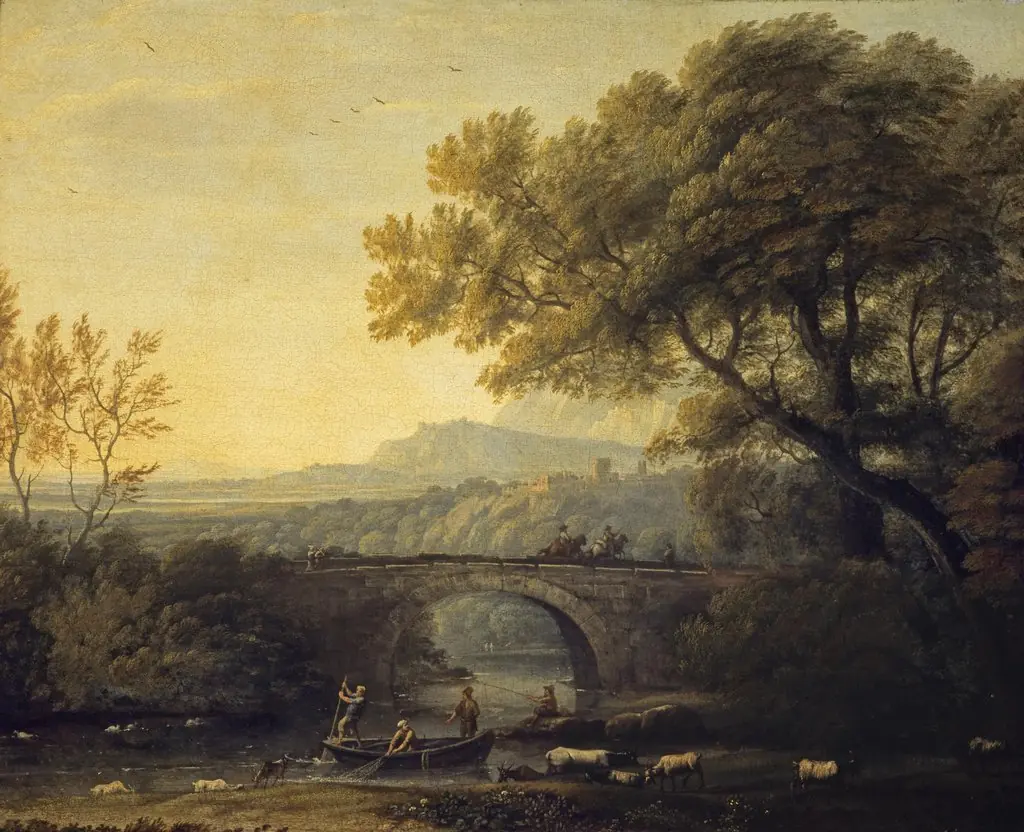
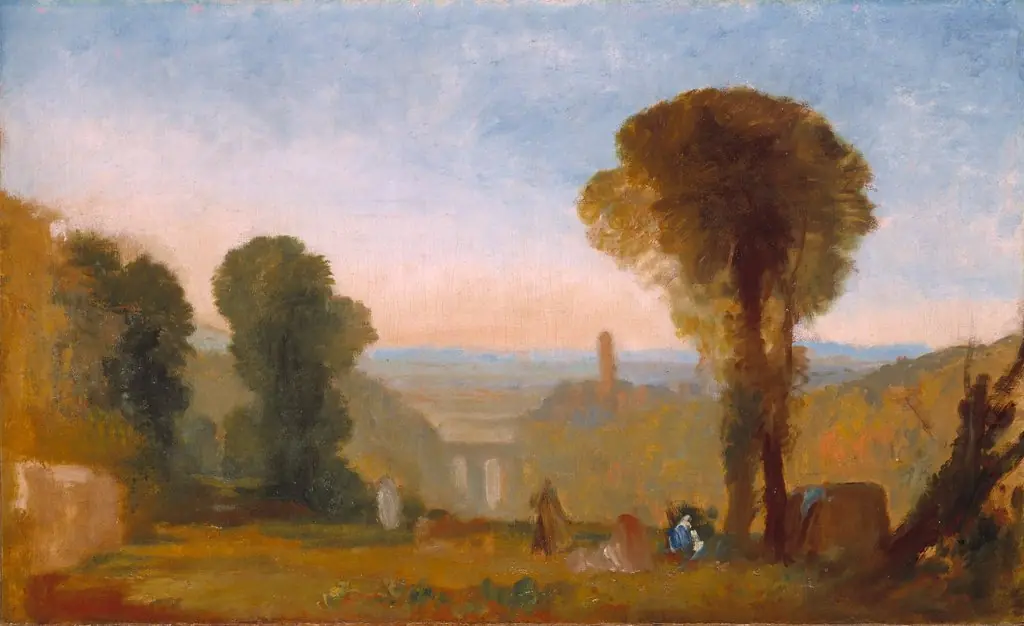
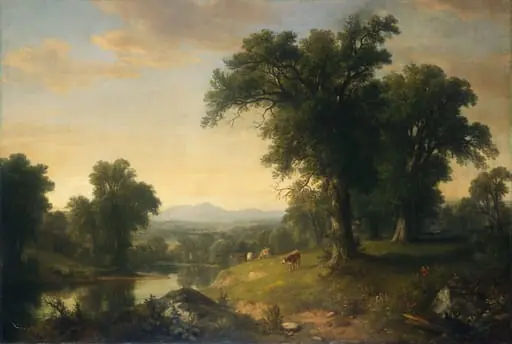
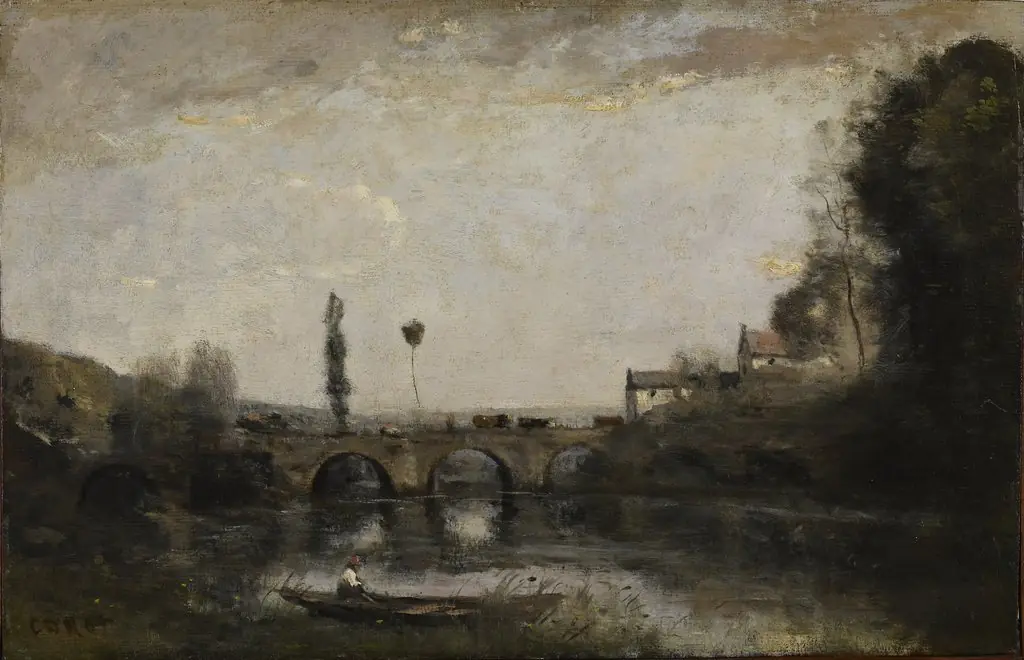
The painting depicts Richmond Bridge spanning the River Thames, with Richmond Hill visible in the distance. The composition presents a deliberately idealized pastoral vision: despite the substantial settlement of Richmond nearby, Turner shows the scene as a tranquil rural retreat suffused with bright sunshine, where bathers and grazing sheep occupy the riverbank. Three small figures gather near a wooden fence or structure in the foreground left, though no individual features are discernible. This selective naturalism, which edits out urban development in favor of an Arcadian fantasy, reflects the Romantic era's nostalgic investment in an unspoiled English countryside. The bridge itself, a substantial five-arched stone structure completed in 1777, serves as both a real topographical marker and a compositional device that mediates between the human and natural worlds.
Technique & Style
Turner executed the work in oil on canvas, employing a horizontal format that accords equal dramatic weight to sky and land. The upper half of the canvas is occupied by a luminous, expansive sky rendered in muted yellows and warm golden tones, while the lower half contains darker land and water in cooler greens and blues. The brushwork is characteristically smooth and blended, producing a misty, unified atmospheric effect with minimal detail. Shadows remain soft and indistinct rather than sharply defined, and the distant background dissolves into hazy, indistinct vegetation. The water reflects the sky through subtle horizontal strokes. A large, dark, rounded tree dominates the left foreground, balanced by slimmer trees on the right, creating a natural frame for the central bridge motif. The paint surface now shows some age-related texture and discoloration.
History & Provenance
The painting was exhibited in 1808, the same year of its creation. Edwin Landseer, then a young artist, saw the work in Turner's studio that year and reviewed it, offering early contemporary testimony to its reception. The painting remained in Turner's possession until his death. It was accepted by the nation as part of the Turner Bequest in 1856, the comprehensive gift that transferred the bulk of the artist's studio collection to public ownership. It is now held at Tate Britain under accession number N00557. The work is available for non-commercial sharing through Art UK under a Creative Commons Attribution-NonCommercial-NoDerivatives licence.
Context
Turner's choice of Richmond as subject carried personal as well as artistic significance. A few years after painting this work, he designed and lived in Sandycombe Lodge in nearby Twickenham, embedding himself in the Thames Valley landscape that would preoccupy him throughout his career. The 1808 date places the painting in a pivotal period: Turner had been elected a full Royal Academician in 1802 and was increasingly consolidating his position as the leading British landscape painter of his generation. The pastoral mode here, with its bathing figures and grazing sheep, engages with a long tradition of English landscape painting stretching back to Claude Lorrain and the Dutch Italianates, yet Turner's atmospheric dissolution of form already signals his departure from topographical precision toward the more subjective, light-drenched vocabulary that would define his later work. Critical attention to the painting has been sustained by the scholarly literature on Turner, including studies by Graham Reynolds, David Blayney Brown, and James Hamilton.
Legacy
View of Richmond Hill and Bridge occupies a significant place within Turner's oeuvre as an early statement of his lifelong engagement with the Thames and its environs. The painting demonstrates how Turner could transform a specific, identifiable location into a vehicle for broader Romantic idealization, a strategy that would prove enormously influential on subsequent generations of British landscape painters. Its afterlife has been shaped by its inclusion in the Turner Bequest, ensuring continuous public access and scholarly attention. The work now circulates as a key example of Turner's early maturity, available for study and reproduction through Tate Britain and Art UK. Its composition, with its dramatic sky and atmospheric recession, anticipates the ever more radical experiments with light and space that would characterize Turner's later career, even as it preserves a more conventional picturesque structure.
Own this work as a print
Artist & collection
Artist
Joseph Mallord William Turner was born in 1775 at Maiden Lane, Covent Garden, where his father kept a barber and wig-making shop.