Artwork
Winter Landscape
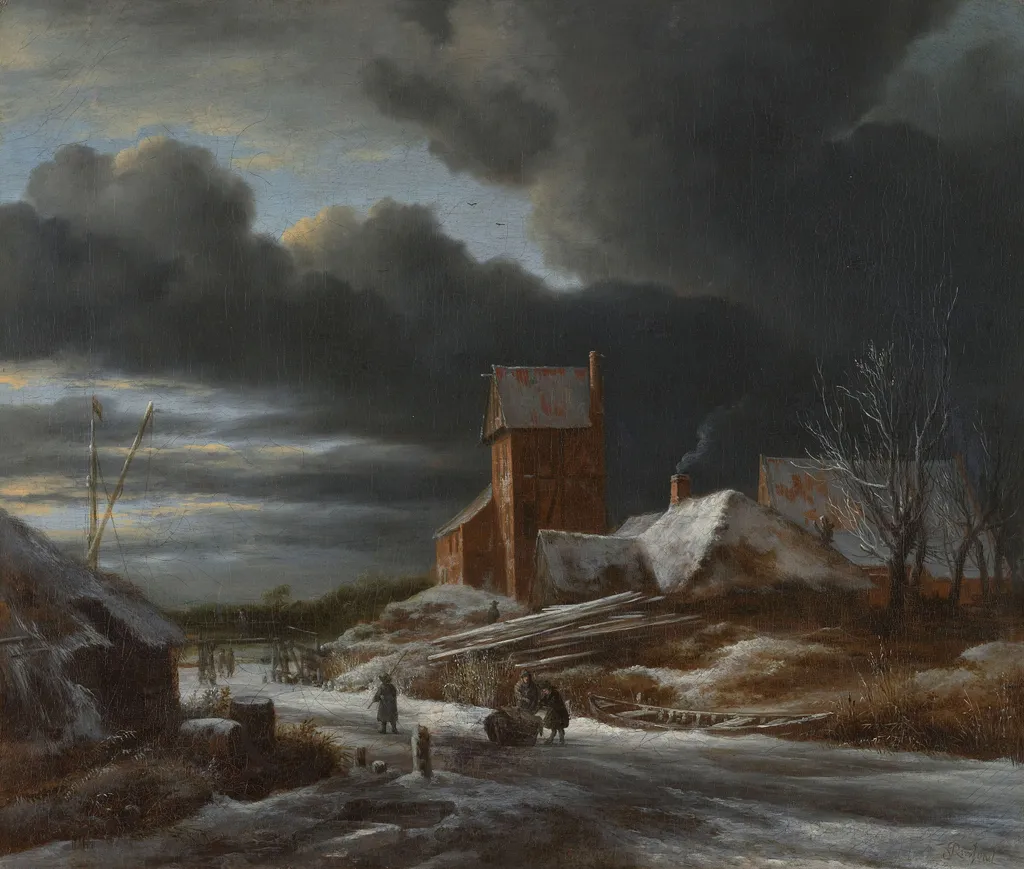
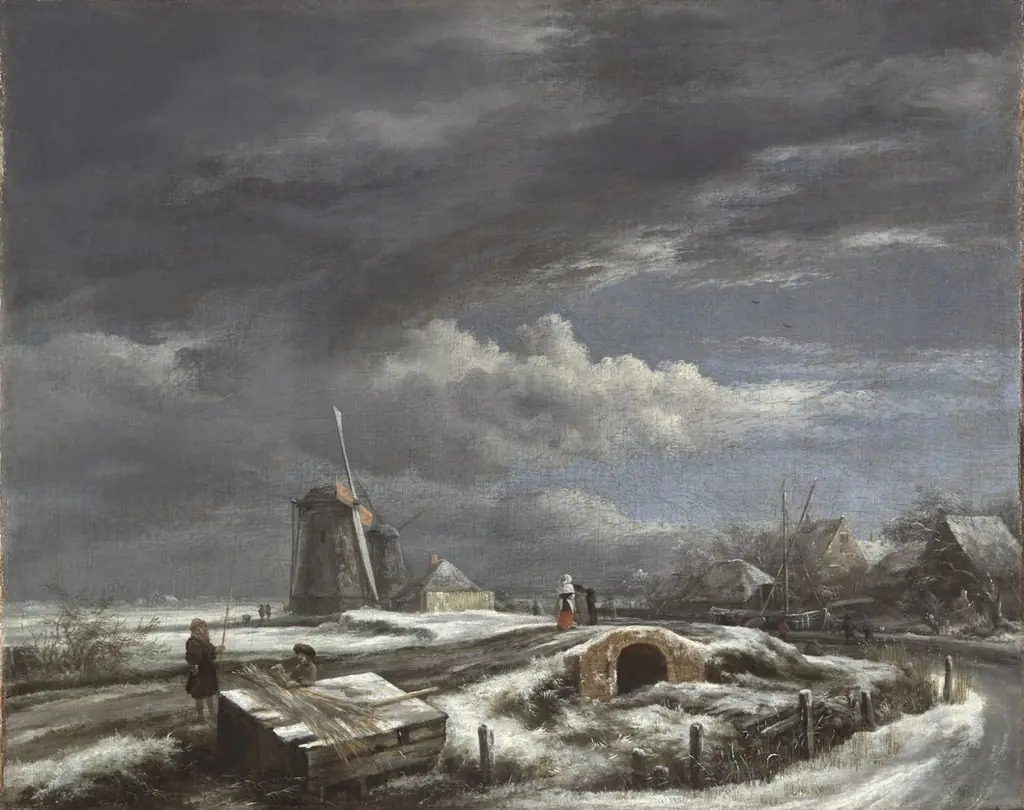
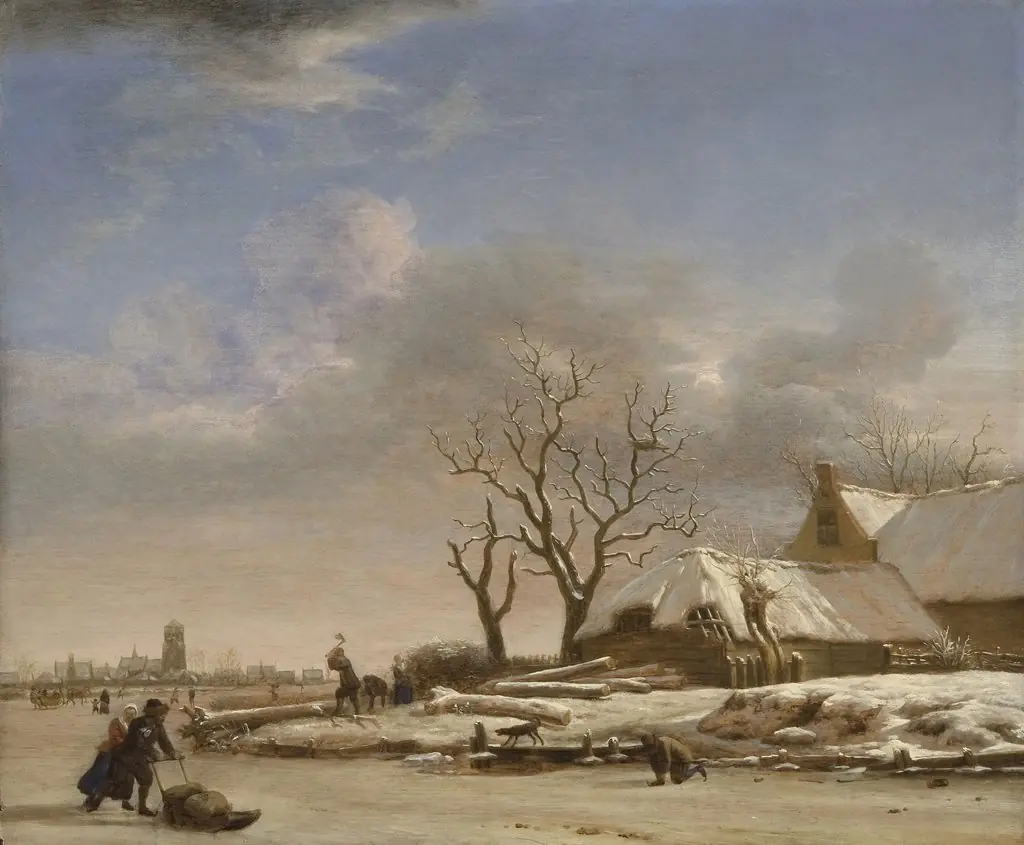
Winter Landscape is an oil painting by the Dutch Golden Age artist Jacob van Ruisdael. It dates from 1665 and is held in the collection of the Rijksmuseum.
About this work
Subject & Meaning
The composition centers on a tall warehouse rendered in characteristic Dutch timber framing, with a prominent chimney emitting smoke that indicates still air.
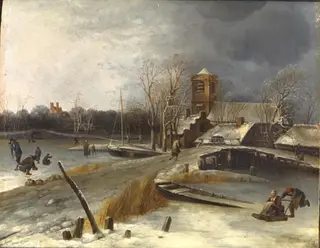
Winter Landscape by Jacob van Ruisdael, painted in 1665, portrays a frozen canal under a dramatic sky filled with gathering storm clouds that suggest an imminent snow shower. The composition centers on a tall warehouse rendered in characteristic Dutch timber framing, with a prominent chimney emitting smoke that indicates still air. Small figures on the ice engage in activities such as ice fishing, while two ship masts bearing Dutch flags balance the right-hand side of the scene.
The work also includes detailed elements like a thatched house, a shed, and wooden poles used for setting nets, reflecting Ruisdael’s interest in both realistic weather effects and the architectural details of eastern Dutch landscapes he studied after 1650.
The painting’s symbolism lies in its blend of natural observation and subtle narrative: the looming warehouse and weather hints convey a sense of impending change, while the scattered human activity on the ice provides a quiet, everyday moment frozen in time. This balance of realism and atmospheric tension exemplifies Ruisdael’s mastery of winter scenes, a recurring theme in roughly twenty-five works he produced on the subject.
Technique & Style
The painting Winter Landscape by Jacob van Ruisdael (1665) is executed in oil on canvas, measuring 42 by 49.7 centimeters in a horizontal format. It depicts a frozen canal before a dark, realistic cloud formation, a characteristic feature of Ruisdael's winter scenes. The composition centers on a high horizon with a prominent warehouse rendered as a timber-framed building, alongside a thatched house and outbuilding sheltering from the dramatic weather, while a large barn rises at the right edge.
Smoke from the house chimney indicates minimal wind, and figures on the ice engage in activities such as ice fishing. Two ship masts with Dutch flags balance the composition on the left, and birds appear in a blue gap in the clouds. The work reflects Ruisdael's later style, combining realistic detail with romanticized atmospheric effects, and demonstrates his use of Dutch architectural elements learned during travels after 1650.
The technique emphasizes meticulous handling of light and weather, with layered oil application creating depth in the sky and frozen surface. The support is canvas, typical of Dutch landscape painting of the period, and the medium allows for fine detail in architectural elements and subtle tonal variations in the snow and ice. Formal qualities include a strong vertical emphasis through the warehouse and masts, contrasting with horizontal water and sky, and a compositional balance achieved through opposing visual elements.
History & Provenance
Jacob van Ruisdael created the oil-on-canvas painting Winter Landscape in 1665. The work entered the documented ownership chain with John Rombouts of Dordrecht, who held the piece until his death in 1850. Following Rombouts's passing, the painting was inherited by his nephew, the Dordrecht collector Leendert Dupper (1799–1870).
Upon Dupper's death in 1870, the artwork was bequeathed to the Rijksmuseum in Amsterdam, where it has remained part of the permanent collection since that year. Prior to these documented owners, the painting was located in Noordwijk and was offered for sale at a Rotterdam auction on August 3, 1811, listed as item number 38.
Winter Landscape is held by the Rijksmuseum in Amsterdam under inventory number SK-A-349. Its provenance begins with Leendert Dupper, who owned it by 1811 and bequeathed it to the Rijksmuseum in 1870. The work has been exhibited in several venues, including the 1956–1957 exhibition Le XVIIe siècle européen in Rome, the 1981 Mauritshuis display in The Hague, the 1982 showing at the Fogg Art Museum in Cambridge, Massachusetts, and recent exhibitions Wintermärchen at the Kunsthistorisches Museum Wien (2011–2012) and Kunsthaus Zürich (2012).
Context
Winter Landscape is considered one of Jacob van Ruisdael's most famous works and belongs to a group of approximately 25 winter scenes painted by the artist. Created in 1665, the painting emerged during a period of high market demand for idyllic landscape motifs following Dutch independence from Spain. The work exemplifies Ruisdael's characteristic compositional strategy of combining a deep horizon with dramatic, realistic cloud formations and towering landmarks, here a half-timbered warehouse, often placed in the right half of his canvases. The depiction of half-timbered architecture reflects the artist's travels through Bentheim and western Westfalen after 1650.
The painting's historical significance is underscored by its inclusion in major international exhibitions, including shows in Rome (1956–57), The Hague (1981), Cambridge (1982), Stockholm (2005–06), and the major survey "Wintermärchen" in Vienna (2011–12) and Zurich (2012). It has been cataloged in Seymour Slive's comprehensive 2001 monograph on the artist.
Legacy
Jacob van Ruisdael's Winter Landscape (1665) is regarded as one of the artist's most celebrated works and a significant example of Dutch winter landscape painting. It belongs to a group of approximately 25 winter scenes he produced. The painting has been featured in major international exhibitions, including "Le XVIIe siècle européen" in Rome (1956–1957), shows at the Mauritshuis (1981) and the Fogg Art Museum (1982), and the touring exhibition "Wintermärchen" at the Kunsthistorisches Museum Wien and Kunsthaus Zürich (2011–2012). Its inclusion in these prominent displays underscores its enduring stature in the canon of European landscape art.
Overview
Jacob van Ruisdael’s Winter Landscape, executed in oil in 1665, presents a quiet, snow‑covered village scene. The composition centers on a modest wooden house perched on a gentle rise, its chimney releasing a thin curl of smoke. In the foreground, two figures traverse a snowy path, one pulling a sled, while leafless trees and a brooding sky frame the setting. The work is part of the Rijksmuseum’s collection.
Own this work as a print
Artist & collection
Artist
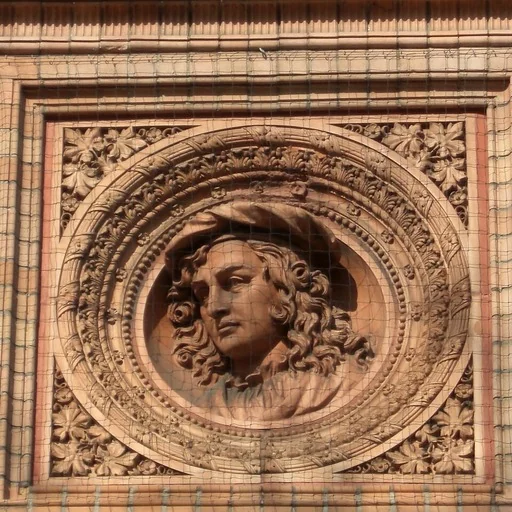
Jacob Isaackszoon van Ruisdael was a Dutch painter, draughtsman, and etcher. He is generally considered the pre-eminent landscape painter of the Dutch Golden Age, a period of great wealth and cultural achievement when…