Artwork
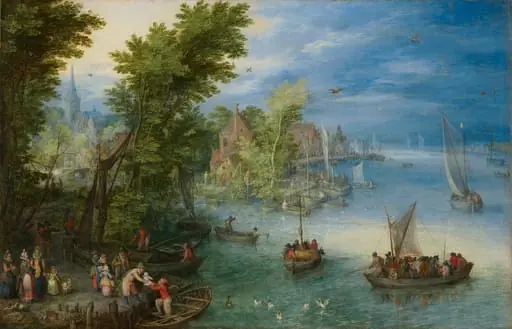
View of a Village along a River
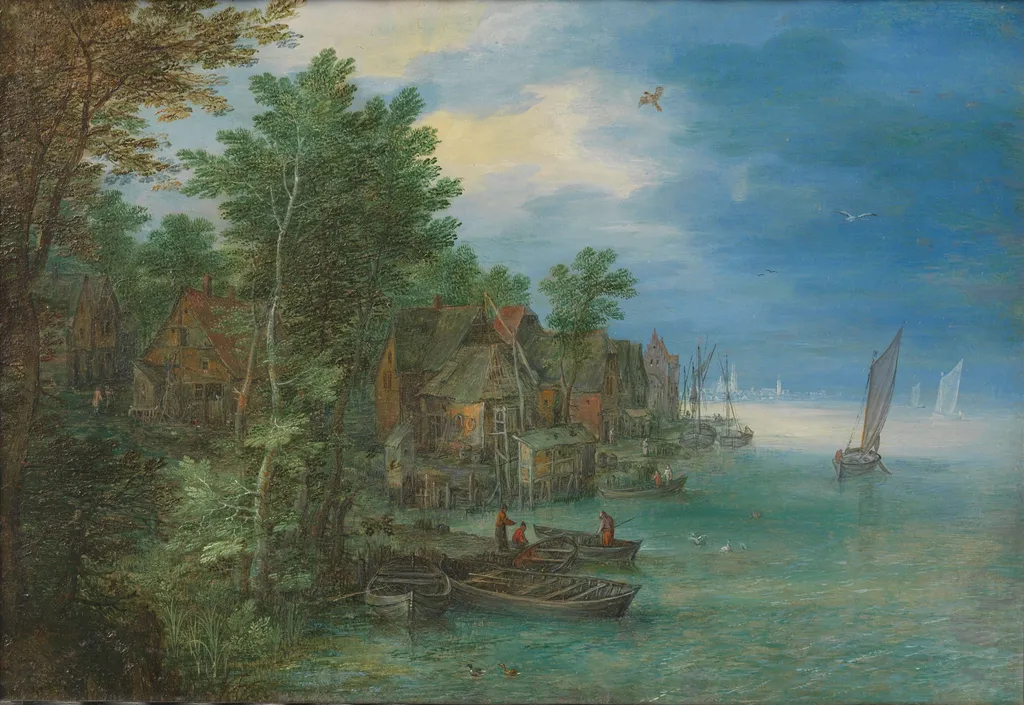
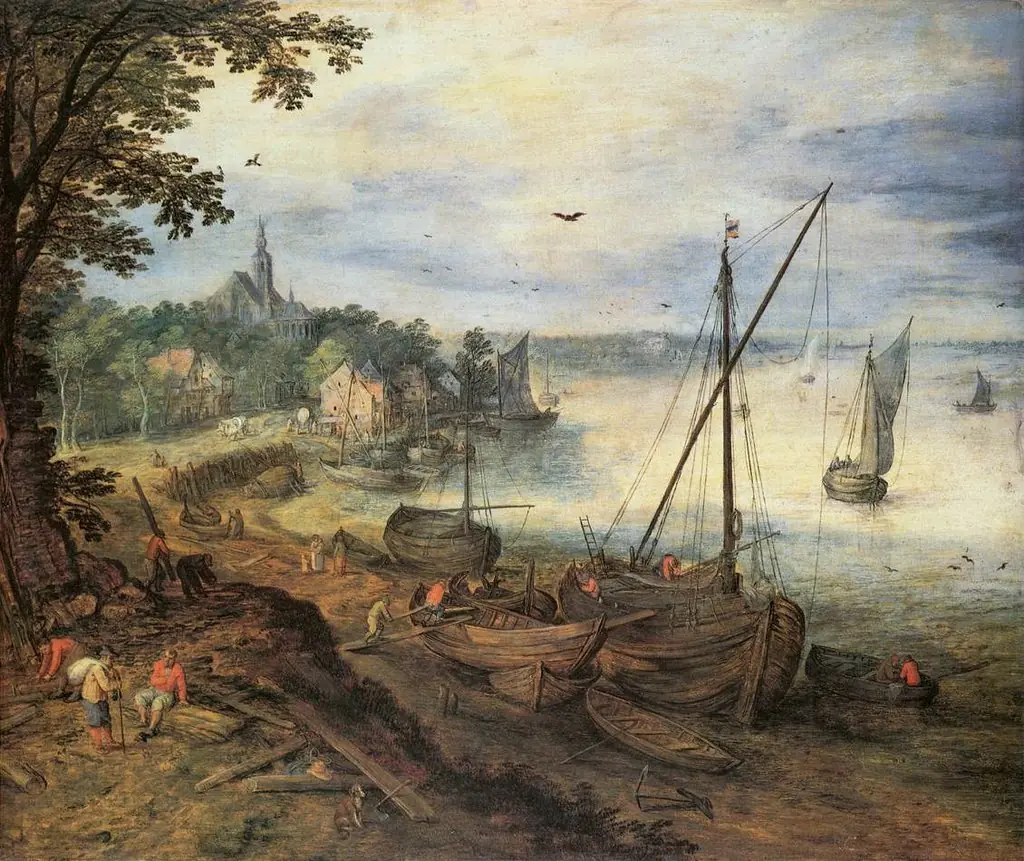
View of a Village along a River is an oil painting by the Flemish Baroque painting artist Jan Brueghel, the elder. It dates from 1604 and is held in the collection of the Rijksmuseum.
About this work
Subject & Meaning
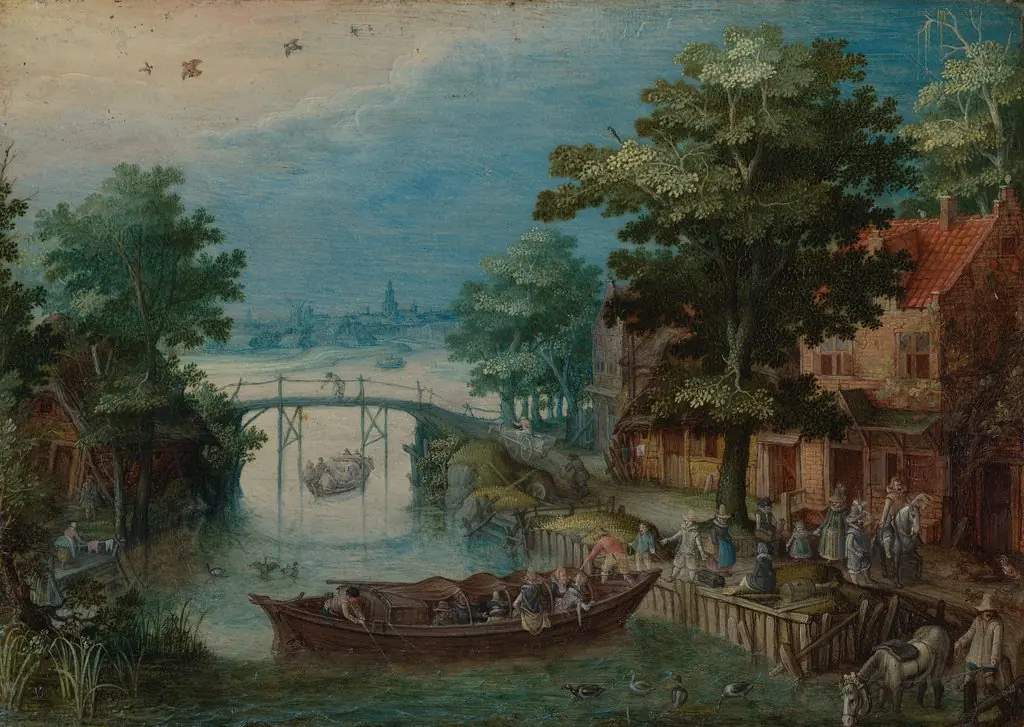
The painting depicts a riverside village framed by tall trees on the left and a series of modest houses along the bank, with small boats moored at the water’s edge and the silhouetted outlines of a distant city on the horizon.
The composition belongs to a known group of early seventeenth-century panel paintings by Jan Brueghel the Elder that recur around the same motifs, trees, boats, and a village with a fortified skyline, intended for the open market. There is no evidence of disguised religious or political symbolism; rather, the work exemplifies the contemporary vogue for topographical landscape as a pleasurable, saleable subject.
Technique & Style
Several small boats are moored along the water's edge, while the faint outlines of a city appear in the background.
Executed in 1604, View of a Village along a River is an oil painting on a copper support. The work measures 14.5 cm in height and 20.5 cm in width. Signed and dated 'Brveghel / 1604' in the lower left corner, the piece exemplifies Jan Brueghel the Elder's landscape style, depicting a river scene with tall trees and houses on the left bank.
Several small boats are moored along the water's edge, while the faint outlines of a city appear in the background. These landscape variations were produced for the open market, often serving as pendants to similar compositions.
History & Provenance
View of a Village along a River is a 1604 oil painting on copper by Jan Brueghel the Elder, created as a market-oriented landscape work and later linked to a pendant depicting a cityscape. The painting bears Jan Brueghel's signature and date 'Brveghel / 1604' in the lower left. Provenance begins with an anonymous 1783 sale at Amsterdam's Philippus van der Schley auction, where it was bought for 300 guilders by Rotterdam collector Gerrit van der Pot alongside its pendant.
In 1808, the pair were sold as a single lot at Van der Pot's Rotterdam estate auction and acquired for 180 guilders by J.J. de Wit for the Koninklijk Museum, the precursor to Amsterdam's Rijksmuseum.
The painting is held by the Rijksmuseum in Amsterdam, where it forms part of the Kabinet van Heteren Gevers collection. Its provenance can be traced back to an anonymous sale on 9 April 1783 at auction house Philippus van der Schley in Amsterdam, where it was offered together with its pendant, Gezicht op een stad aan een rivier, by consigner Cornelis Ploos van Amstel. The Rotterdam collector Gerrit van der Pot acquired both works for 300 guilders.
On 6 June 1808, the pair was again sold as a single lot at the Van der Pot estate auction in Rotterdam, where J.J. de Wit purchased them for 180 guilders on behalf of the Koninklijk Museum, the predecessor of the Rijksmuseum.
No specific exhibition history beyond this institutional acquisition is documented in the available sources.
Context
View of a Village along a River exemplifies Jan Brueghel the Elder’s prolific output of small-scale copper landscapes produced for the open market. Scholarship notes that these works are variations on a recurring theme and were often conceived as pendants; this painting was historically regarded as the companion piece to his View of a City on a River. Its early provenance records joint sales with that pendant in 1783 and 1808, eventually entering the Rijksmuseum’s collection, where it remains today as a representative example of early‑17th‑century Flemish landscape painting.
Legacy
The painting is representative of Jan Brueghel the Elder’s prolific output of small river‑landscapes, which were produced as variations on a single theme for the open market. In contemporary assessments it has been regarded as the pendant to his companion view of a town on a river, a pairing noted already in the late eighteenth‑century sales. After being bought together with its pendant for 300 gulden in 1783, the pair resurfaced in 1808 when they were acquired for 180 gulden by J.J. de Wit for the Koninklijk Museum, the predecessor of today’s Rijksmuseum, where the work remains part of the collection.
Overview
Jan Brueghel the Elder painted View of a Village along a River in 1604. Executed on a copper plate, the work measures only a few inches, indicating it was meant for intimate viewing rather than public display. The composition captures a quiet riverside settlement, with a modest boat and a solitary, dominant tree anchoring the scene.
Own this work as a print
Artist & collection
Artist
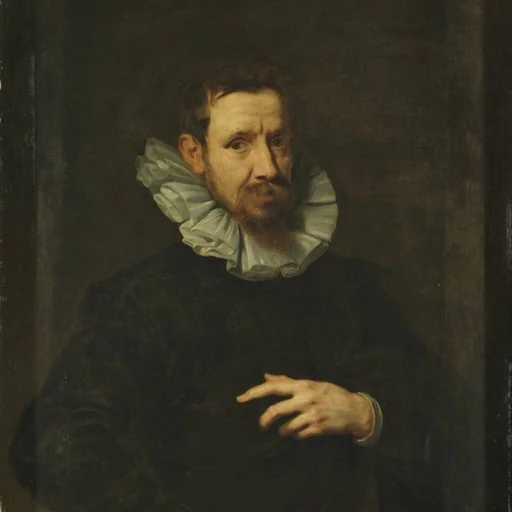
Jan Brueghel the Elder ( BROY-gəl, US also BROO-gəl; Dutch:; 1568 – 13 January 1625) was a Flemish painter and draughtsman.