Artwork
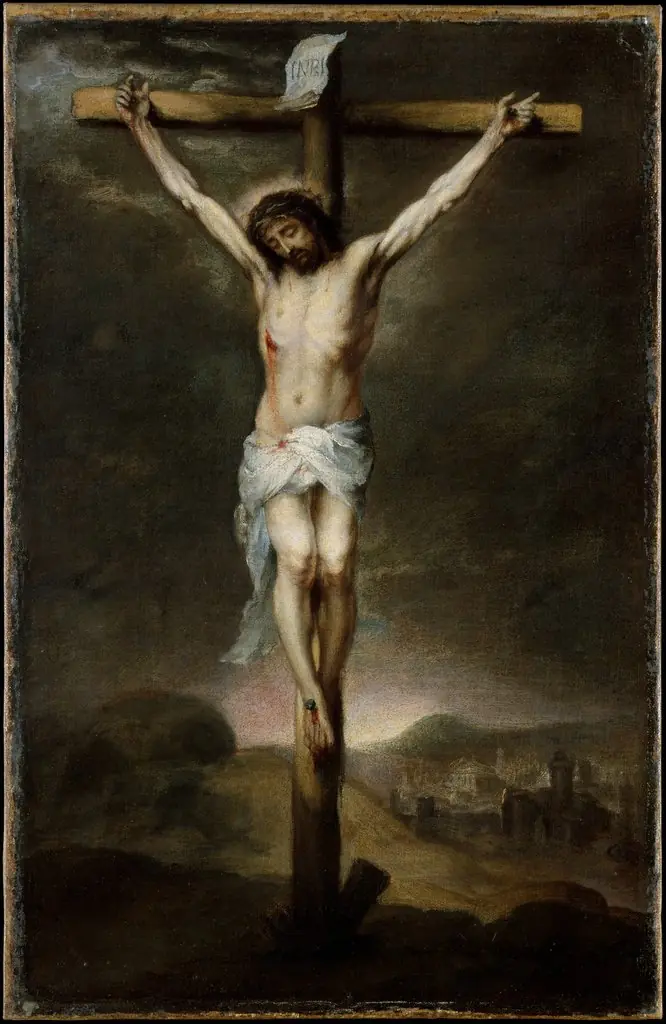
The Crucifixion of Christ
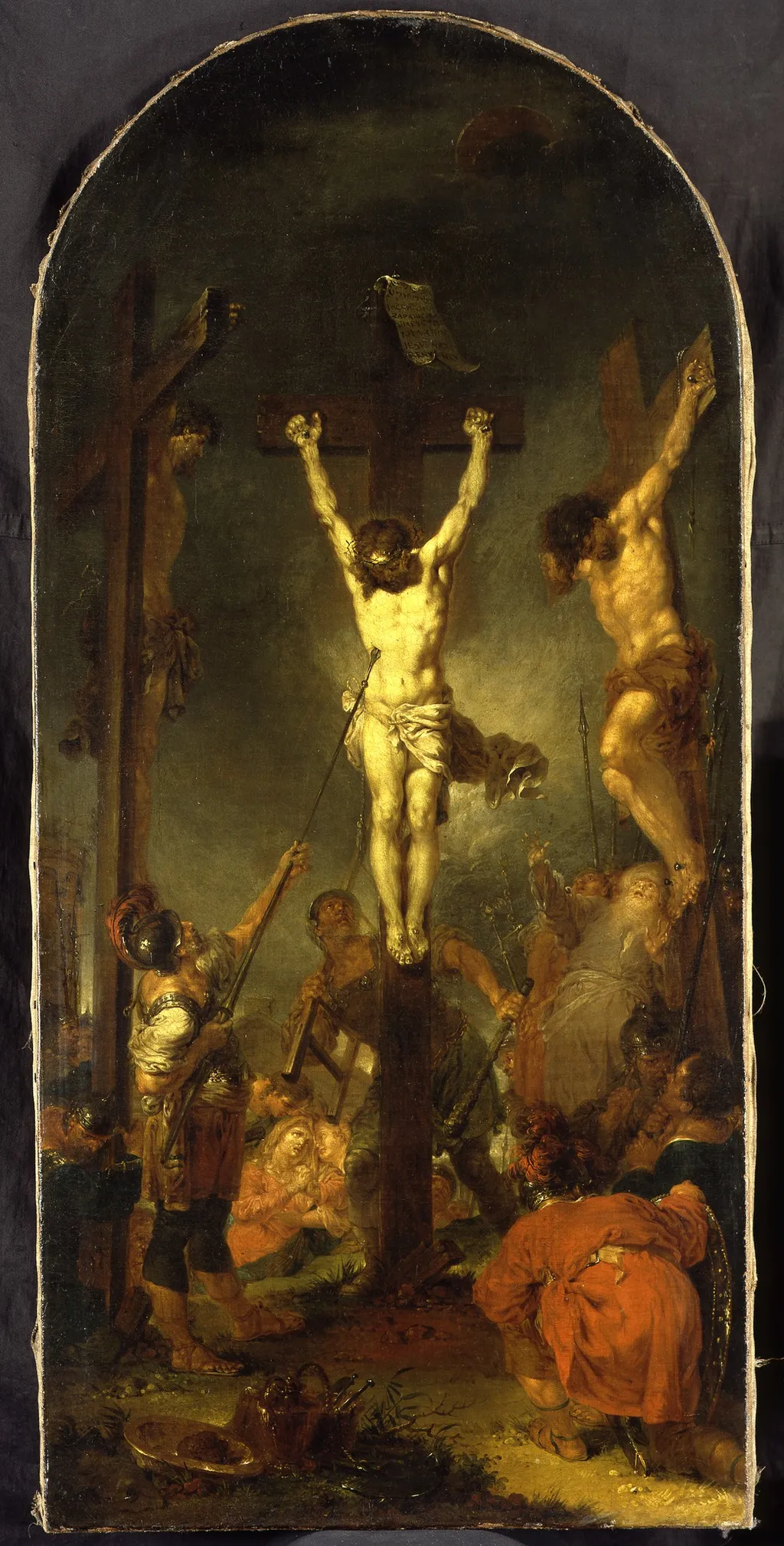
The Crucifixion of Christ is an oil painting by the Rococo painting artist Januarius Zick. It dates from 1790 and is held in the collection of the Gemäldegalerie Berlin.
About this work
Overview
The work is held in the collection of the Gemäldegalerie Berlin, where it is classified as a religious painting.
The Crucifixion of Christ is an oil on canvas painting by the German artist Januarius Zick, dated 1778. The work is held in the collection of the Gemäldegalerie Berlin, where it is classified as a religious painting. Zick, who lived from 1732 to 1797, was a prominent figure in late eighteenth-century German painting, known for synthesizing diverse European influences into a distinctive personal style. This particular canvas matters as both an independent artistic statement and a preparatory model for a major altarpiece commission, illustrating the intersection of devotional function and painterly ambition in the period. The painting depicts the crucified Christ flanked by the two thieves, with attendant figures gathered below, rendered in the dramatic chiaroscuro that characterizes Zick's mature religious works.
Subject & Meaning
The painting presents the biblical scene of Christ's crucifixion at Golgotha, with three crosses arranged across a vertical arched composition. The central cross bears the pale figure of Christ, head tilted forward, wearing the crown of thorns and a white cloth about his lower body. Above him hangs a scroll bearing visible text, likely the inscription INRI. To either side, the two darker figures of the thieves hang on their crosses, their bodies twisted in death, one with a cloth at the hips. Below the crosses, a complex grouping of figures enacts the various episodes associated with the Passion narrative. To the left, a soldier in a plumed helmet raises a long spear toward Christ, identifying the moment of the piercing of Christ's side by Longinus, while another figure holds up a sponge on a pole, the offer of vinegar. Several figures kneel or recline at the base, including a figure in a vivid orange robe with back turned to the viewer, traditionally interpretable as one of the mourning women or possibly the Virgin Mary in grief. To the right, an older bearded figure in pale robes looks upward, perhaps representing one of the disciples or a sympathetic onlooker. The iconography draws upon established Northern European traditions of Crucifixion imagery, with particular attention to the emotional responses of the attendant figures. The palette of deep browns, olive greens, and muted golds, punctuated by the pale body at center and the orange robe, reinforces the somber dignity of the subject. The overall meaning emphasizes Christ's sacrifice and the range of human responses to divine suffering, from active torment to contemplative sorrow.
Technique & Style
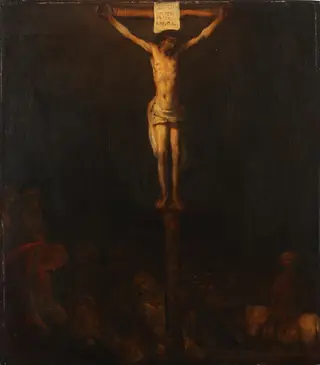
The work is executed in oil on canvas, a medium that allowed Zick the flexibility to achieve both detailed rendering and expressive painterly effects. The brushwork is loose and visible, with thicker paint application in the highlights and thinner, darker passages in the background, a handling that reveals the influence of Rembrandt's technique on Zick's practice. Light falls strongly on the central figure from the upper left, casting deep shadows elsewhere and creating the dramatic chiaroscuro that defines the composition's emotional impact. The surface shows fine craquelure throughout, consistent with its age and medium. The setting appears as an open, dim landscape with no distinct horizon, focusing attention on the human drama rather than topographical specificity. At the bottom, metal plates and vessels rest on the ground, details that add material specificity to the scene. The composition is organized around a strong central vertical axis formed by the cross, immediately drawing the viewer's eye to the suspended figure. Some sources describe a shallow architectural niche framing the event, contributing to a sense of theatricality, though the primary visual evidence emphasizes the open landscape setting. The artist's treatment of anatomy suggests a deliberate realism within a heightened emotional context, with musculature rendered to convey physicality and presence. The overall effect conveys profound empathy for the suffering depicted, achieved through the interplay of dramatic lighting, expressive brushwork, and concentrated compositional focus.
History & Provenance
The painting was created in 1778, a date confirmed by multiple sources, with one source suggesting a possible range extending into 1779. It served as a model, or preparatory study, for the high altarpiece completed in 1781 for the Benedictine monastery church in Wiblingen near Ulm. In 1778, Januarius Zick was entrusted with the leadership of the artistic decoration of this building complex, a significant commission that testifies to his professional standing. Zick's activity for the Wiblingen commission formed part of his broader engagement with ecclesiastical decoration during this period. The work entered the collection of the Staatliche Museen zu Berlin, specifically the Gemäldegalerie, where it remains today. The painting is now in the public domain, with photographic reproductions distributed by the museum. Its accession history and specific exhibition record are not detailed in the available sources, though its presence in one of Germany's premier painting collections ensures its visibility to scholars and the public.
Context
Januarius Zick operated within a rich artistic environment shaped by multiple European traditions. Born in 1732 and active until his death in 1797, he was initially taught by his father Johann Zick, who had himself absorbed Italian influences, particularly from Giambattista Piazzetta, and the dramatic lighting of Rembrandt. Januarius furthered his training in Paris in 1757 and then in Rome with Raphael Mengs, gaining exposure to both French academic and Italian classical currents. From 1760 he settled in Ehrenbreitstein, flourishing as a court painter in Trier. The broader Zick family enterprise extended across Würzburg, Mainz, and Trier, with Januarius contributing designs for various media including marquetry for the cabinetmaker David Roentgen in Neuwied. In his cabinet paintings, Januarius Zick developed a style that drew upon early Rembrandt and the works of Rembrandt's pupils or imitators, particularly Leonaert Bramer and Adriaen Verdoel, whose green-grey color preferences he adopted. He delighted in Rembrandt-like, spooky chiaroscuro that cuts across concentrated beams of light, and he dressed his figures with preference in fanciful, Oriental costumes to strengthen the uncanny impression. Scholarly attention has noted how a Crucifixion by Zick unites Rubens's Coup de Lance with Rembrandt's light and painterly technique, suggesting that this Berlin canvas participates in a broader compositional strategy within his oeuvre. The work thus occupies a significant position in the study of eighteenth-century German Rembrandt reception and the persistence of Baroque emotional intensity into the period of Neoclassicism.
Legacy
The Crucifixion of Christ occupies a dual position in Januarius Zick's legacy: as a preparatory model for the Wiblingen altarpiece, it documents the working methods of an artist who combined design and execution across large-scale commissions, and as an independent painting in the Gemäldegalerie Berlin, it preserves evidence of Zick's painterly powers at their height. The work's afterlife is intertwined with the broader reassessment of eighteenth-century German painting, a field in which Zick's synthesis of Rembrandtesque drama, French decorative sensibility, and Italian compositional learning has attracted increasing scholarly interest. The painting's presence in a major public collection has facilitated its study and reproduction, including digital dissemination through museum databases and Wikimedia Commons. Its public domain status ensures continued accessibility for researchers and educators. While specific later influence on individual artists is not documented in the available sources, the work exemplifies the enduring vitality of religious narrative painting in an age of secularization and the capacity of the Crucifixion theme to sustain artistic reinvention across centuries. The canvas stands as a testament, in the documentary sense, to the ambitions of the Wiblingen decorative program and to Zick's particular achievement in maintaining the emotional immediacy of Baroque religious art within the evolving stylistic frameworks of the later eighteenth century.
Artist & collection
Artist
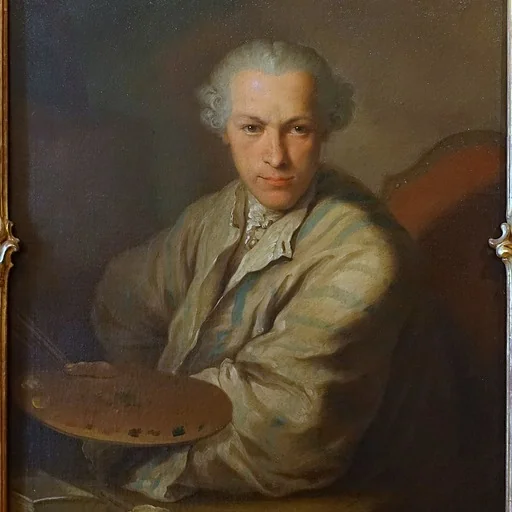
Johann Rasso Januarius Zick (6 February 1730 – 14 November 1797) was a German painter and architect. He is considered to be one of the main masters of the Late-Baroque.