Artwork
Ubu Roi
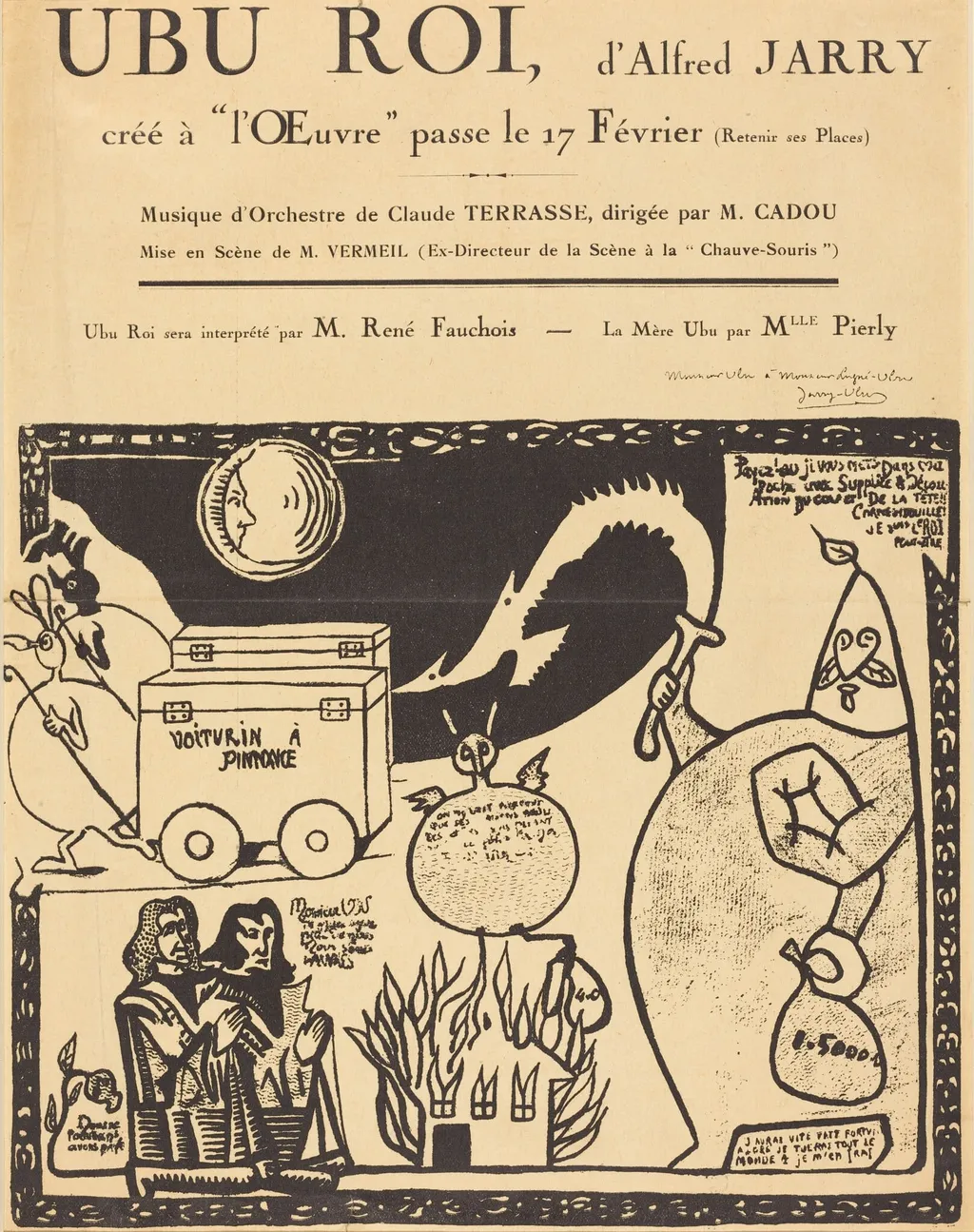
Ubu Roi is a print by Alfred Jarry. It dates from 1922 and is held in the collection of the National Gallery of Art.
- Inscription
- Inscribed:across top printed: UBU ROI, d'Alfred JARRY / créé à "l'OEuvre" passe le 17 Février (Retenir ses Places) / Musique d'Orchestre de Claude TERRASSE, dirigée par M. CADOU / Mise en Scène de M. VERMEIL (Ex-Directeur de la Scène à la "Chauve-Souris") / Ubu Roi sera interprété par M. René Fauchois --- La Mère Ubu par MLLE Pierly...
About this work
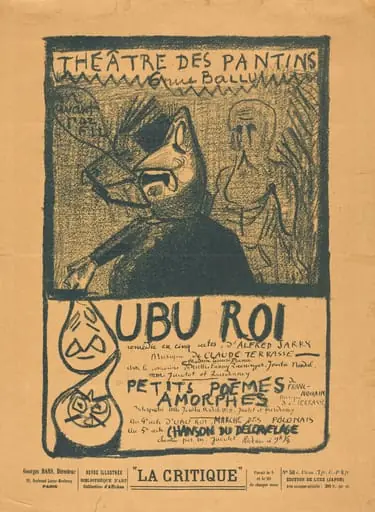
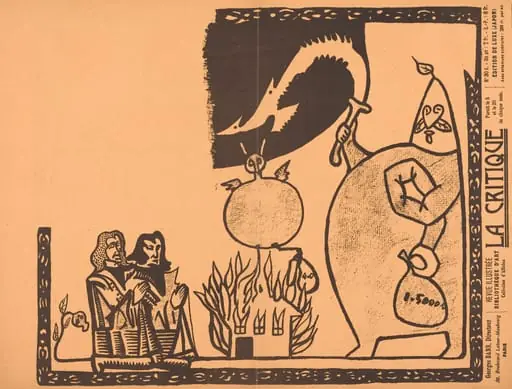
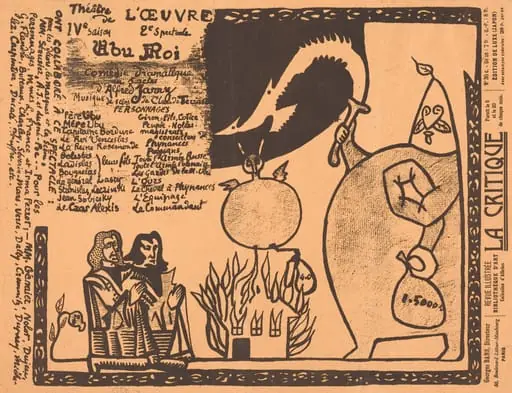
Odd shapes float around, like a suitcase, a lamp, and a giant hand holding a coin.
This poster is all black and white with bold, rough lines. A big, strange face with a crown looms over a small stage. Two people stand there, looking like kings.
Odd shapes float around, like a suitcase, a lamp, and a giant hand holding a coin. Words are scribbled everywhere, some in circles, some in speech bubbles.
The title at the top reads Ubu Roi, which means "King Ubu." The artist, Alfred Jarry, made this in 1922. It’s not a painting but a printed poster, full of sharp, uneven lines.
Look up Jarry, Alfred to see more of his wild, funny work.
Overview
Ubu Roi is a 1922 print created by Alfred Jarry using a photomechanical process on wove paper in a stark black and white palette.
Subject & Meaning
The print depicts a dominant, crowned face looming over a diminutive stage with two regal figures. Surrounding oddities, a suitcase, lamp, and a giant coin-bearing hand, convey the absurdity of 'King Ubu,' reflecting Jarry's trademark blend of humor and surrealism.
Technique & Style
Characterized by bold, rough lines and sharp, uneven edges, the work showcases Jarry's embrace of photomechanical printing's capabilities, contrasting with traditional fine art techniques.
History & Provenance
Produced in 1922, Ubu Roi is a late work by Jarry, originally designed as a poster, indicating its intended use for public dissemination.
Context
Emerging from the early 20th-century avant-garde, Ubu Roi aligns with the era's experimental spirit, Jarry's contribution to the absurd and surreal movements evident in its bizarre, dreamlike imagery.
Artist & collection