Artwork
A Roman Slave Market
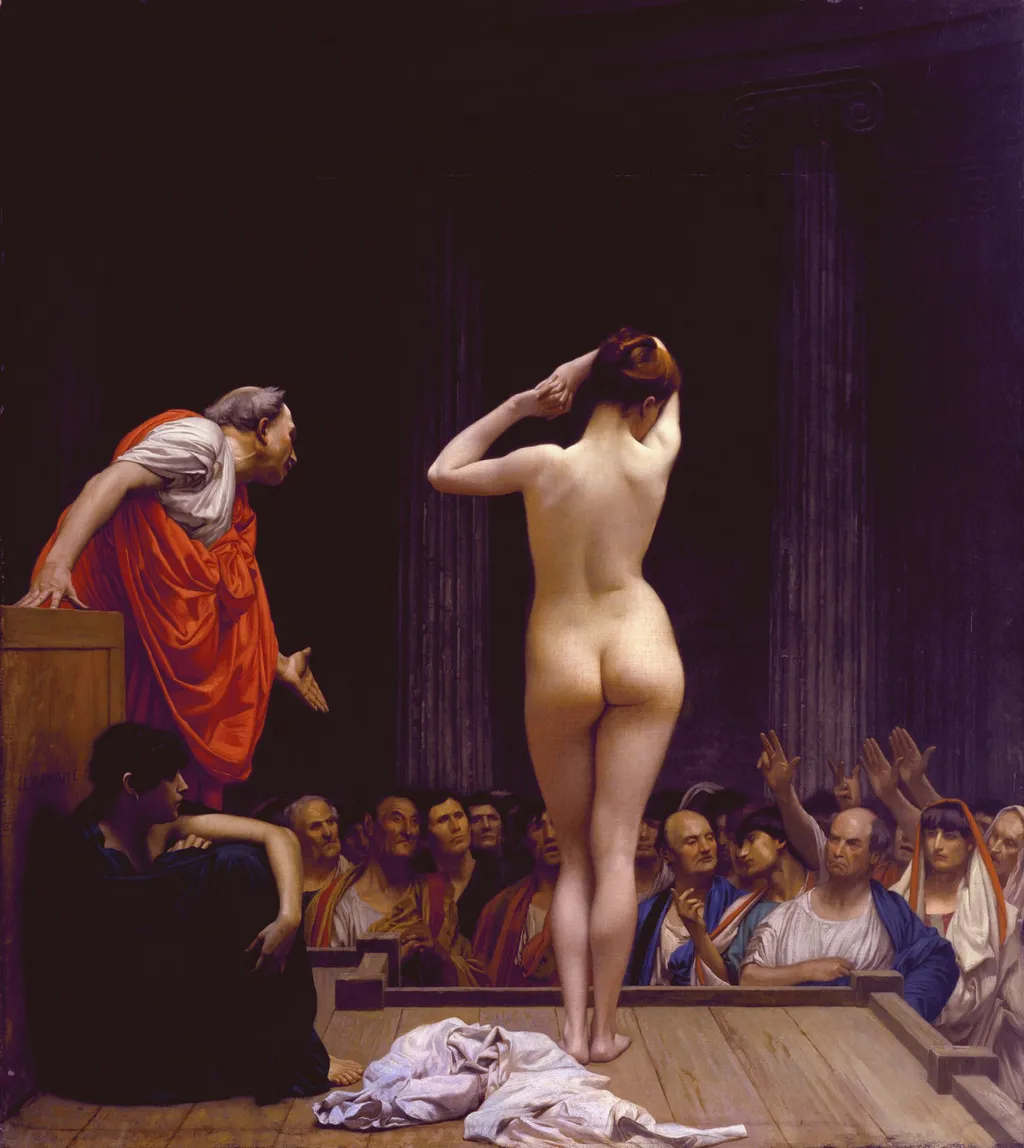
A Roman Slave Market is an oil painting by the Academic Art artist Jean Léon Gérôme. It dates from 1892 and is held in the collection of the Walters Art Museum.
About this work
Subject & Meaning
Her pose, shielding her eyes with one arm, references the ancient Greek courtesan Phryne, aligning the scene with classical ideals of beauty and vulnerability.
Gérôme’s A Roman Slave Market (1884) depicts a slave auction in ancient Rome, centering on a nude young woman displayed on a platform to prospective buyers. Her pose, shielding her eyes with one arm, references the ancient Greek courtesan Phryne, aligning the scene with classical ideals of beauty and vulnerability. The composition contrasts the exposed, idealized female body with the clothed male merchants and bidders, emphasizing the commodification of human life within the slave system.
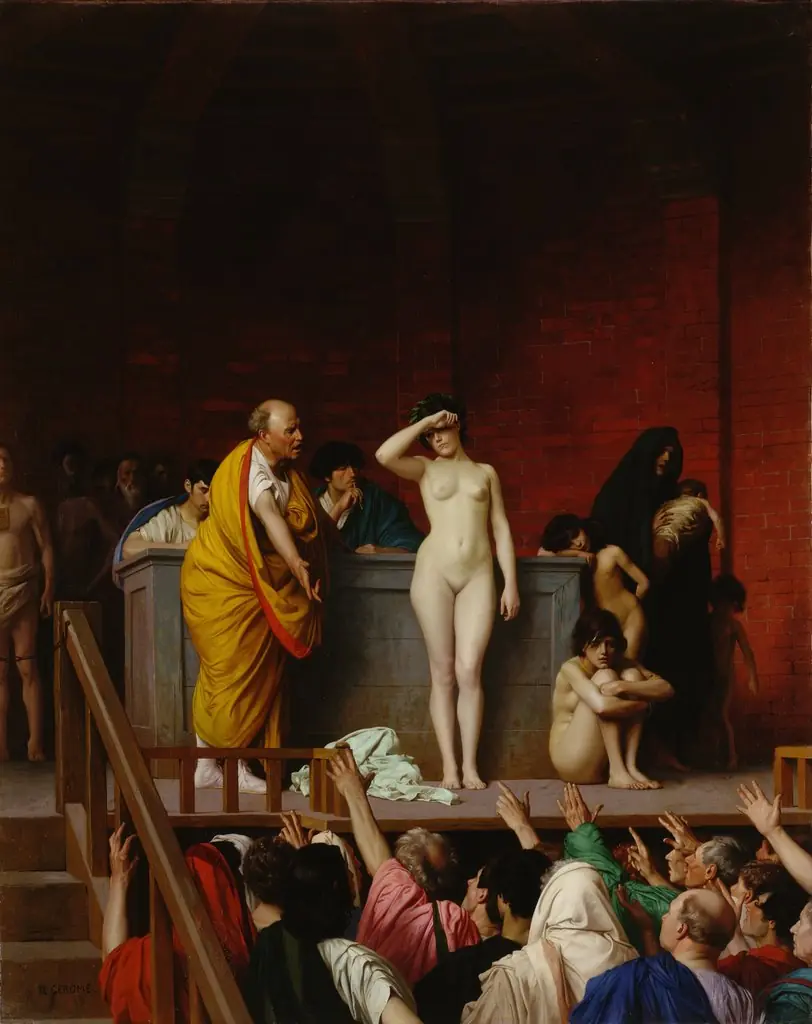
Gérôme’s repeated use of this subject, including related works like Slave Market in Rome (Hermitage), reflects nineteenth-century fascination with the eroticism and brutality of slavery, blending historical reconstruction with contemporary Orientalist and academic conventions. The painting’s dramatic lighting and composition frame the nude figure as both victim and aesthetic object, underscoring the moral contradictions of slavery under the guise of classical antiquity.
Technique & Style
Executed in 1884, this work is an oil painting on canvas measuring approximately 64.1 by 56.9 centimeters. Gérôme employs a high-finish academic style, utilizing a stark contrast between the dark, shadowed background and the illuminated foreground figures to emphasize the subject. The central female figure is rendered with a pinkish carnation that stands out against the black-violet tones behind her, highlighting her nude form.
Her pose, viewed from the back with arms shielding her face, recalls the artist's earlier depiction of the courtesan Phryne. The composition focuses on the dramatic tension of the auction, with detailed attention paid to the textures of the wooden platform and the varied reactions of the surrounding crowd.
History & Provenance
Created around 1884 in Rome, A Roman Slave Market is an oil-on-canvas history painting by Jean-Léon Gérôme. The work was first exhibited at the Salon of 1884 in Paris, where it was displayed alongside La Nuit au désert and Vente d'esclaves à Rome. In 1917, the American philanthropist Henry Walters acquired the painting, which was then cataloged under the title Sale of Circassian Slave.
Following Walters' death, the artwork entered the collection of the Walters Art Museum in Baltimore through inheritance in 1931. The piece is frequently associated with a companion work, Venta de esclavos en Roma (now in the Hermitage, Saint Petersburg), which Gérôme painted in the same year with a reversed composition.
The work is held by the Walters Art Museum in Baltimore, where it entered the collection in 1917 and was formally accessioned following Henry Walters' bequest in 1931. Its accession number is not publicly disclosed, but the museum records it as part of the 1917 acquisition.
It was first exhibited at the Salon of 1884 in Paris, where it appeared alongside other Gérôme works, and has remained in the museum's permanent holdings without further major exhibition.
Context
Jean-Léon Gérôme, a leading figure of the Academic movement, exhibited A Roman Slave Market at the Paris Salon of 1884 alongside related works on the same theme. The painting is frequently analyzed for its dual nature as a historical genre scene and a vehicle for Orientalist fantasy, often linked to the nineteenth-century fascination with the Circassian woman. Art historians note that Gérôme specialized in such depictions, having produced at least six paintings addressing slavery in ancient Rome or the Ottoman world.
The composition draws on classical precedents, specifically echoing the artist's own earlier portrayal of the courtesan Phryne, thereby merging antiquarian detail with a sensationalized nude aesthetic. This work exemplifies the tension in Gérôme's scholarship between dramatic narrative and the eroticized gaze, establishing it as a significant, albeit controversial, example of late nineteenth-century academic art.
Legacy
After its Salon debut in 1884, the painting circulated widely as reproductive prints and photographs that amplified its notoriety within academic circles and popular visual culture. Gérôme’s repeated use of the slave‑auction motif, including a related version at the Hermitage, further entrenched the composition’s influence on later Orientalist and history painting. By the early twentieth century, the work’s dramatic staging and idealized female nude had become touchstones for debates about slavery’s aesthetics, shaping discussions in art theory and ethics that persisted into the twenty‑first century.
Overview
Jean-Léon Gérôme's 1884 oil painting, A Roman Slave Market, portrays a scene of human commerce in antiquity. This history painting depicts a young woman, unclothed and vulnerable, being presented for sale on a raised platform. Surrounding her, figures in Roman attire observe and participate in the auction, highlighting the public nature of such transactions. The work exemplifies Gérôme's dedication to historical subjects and his academic approach to art.
Own this work as a print
Artist & collection

Artist
Jean-Léon Gérôme was a French painter and sculptor in the style now known as academicism.