Artwork
Lady Writing a Letter with her Maid
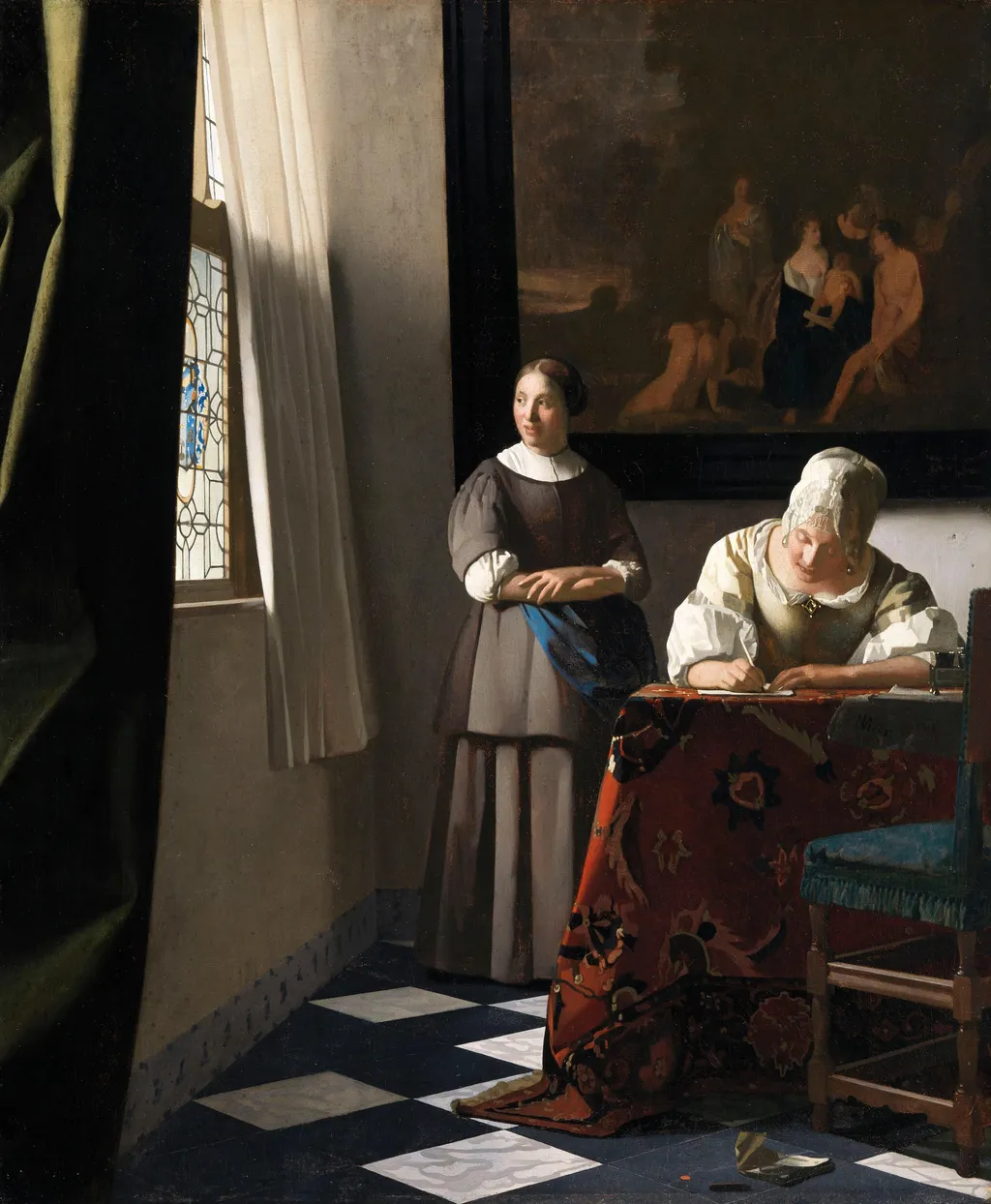
Lady Writing a Letter with her Maid is an oil painting by the Dutch Golden Age artist Johannes Vermeer. It dates from 1670 and is held in the collection of the National Gallery of Ireland.
About this work
Overview
4 centimetres, the work depicts an interior scene with two women: a seated lady composing a letter and a standing maid who appears to serve as messenger.
Lady Writing a Letter with her Maid (Dutch: Schrijvende vrouw met dienstbode) is an oil on canvas painting by the Dutch Golden Age master Johannes Vermeer, dated to 1670. Measuring 71.1 by 58.4 centimetres, the work depicts an interior scene with two women: a seated lady composing a letter and a standing maid who appears to serve as messenger. The painting is held by the National Gallery of Ireland in Dublin, where it has been since 1987. It is notable as one of Vermeer's first experiments with centrifugal composition, in which the dramatic focus extends beyond the centre of the canvas, and as one of his earliest works to distribute narrative tension between two figures rather than concentrating on a single protagonist. The painting also holds an unusual place in art history as one of only two Vermeers remaining in private hands as late as 1974, and it subsequently became one of the most frequently stolen Old Master paintings of the twentieth century.
Subject & Meaning
The painting presents a carefully composed domestic interior in which a young woman, absorbed in writing a letter, is attended by a housemaid standing nearby. The seated lady wears a white cap and yellowish-green bodice over a white blouse, her gaze lowered in concentration as she holds a quill. The maid, dressed in dark clothing with white sleeves and a blue sash, stands with arms crossed, her attention directed toward a window at the left of the composition. A crumpled paper on the floor, perhaps a discarded draft or a received letter, hints at emotional agitation beneath the writer's composed surface. Behind the maid hangs a large framed painting depicting The Finding of Moses, a subject Vermeer had used previously in his Astronomer. The iconography of letter-writing in Dutch genre painting traditionally carried associations of love and courtship, and the maid's presence suggests her role as go-between in an amorous correspondence. Art historians have debated the emotional register of the scene. Some read the maid's averted gaze and folded arms as indicators of detachment and impatience, a psychological distance from her mistress's intimate concerns. Others, notably Pascal Bonafoux, argue that the very presence of the maid during so private an act implies a degree of intimacy and complicity between the two women, even if no explicit gesture confirms it. The painting thus explores the subtle dynamics of class, gender, and emotional labour in the Dutch bourgeois household.
History & Provenance
The painting's documented history begins shortly after Vermeer's death in 1675, when his widow Catharina transferred it, together with The Guitar Player, to the baker Hendrick van Buyten in settlement of a debt of 617 guilders and 6 stuivers, a sum well above market value. Van Buyten subsequently sold it to the Rotterdam merchant Joshua van Belle. The painting remained in various Dutch hands until the end of the nineteenth century, when it was acquired by the South African gold and diamond magnate Alfred Beit. It later passed through the collections of Charles Sedelmeyer, Franz Kleinberger, and other owners including Eugène Secrétan, before returning to the Beit family through Sir Alfred Beit, 2nd Baronet. The painting was stolen twice from Russborough House in County Wicklow, Ireland. On 27 April 1974, armed intruders led by the British heiress Rose Dugdale took it along with eighteen other Old Masters including works by Gainsborough, Rubens, and Goya; the thieves assaulted Sir Alfred and Lady Beit and sought to raise funds for the IRA. All works were recovered within two weeks in a cottage in County Cork. On 21 May 1986, a gang led by Dublin crime boss Martin Cahill stole it again, along with seventeen other paintings. Cahill demanded a ransom of IR£20 million but proved unable to dispose of the work on the international market. The painting was finally recovered in August 1993 at Antwerp airport during a sting operation in which Irish and Belgian police posed as collectors. The Beit family had already donated the painting to the National Gallery of Ireland, and it has been in the museum's collection since 1987.
Context
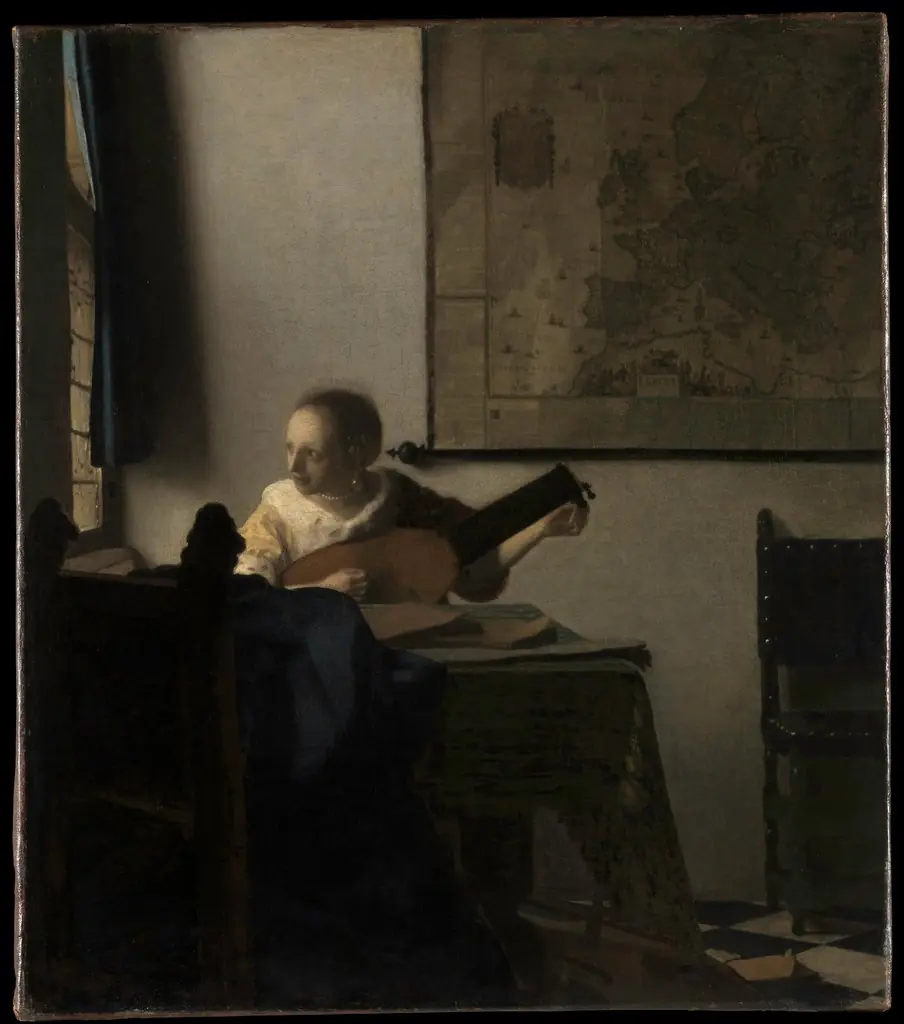
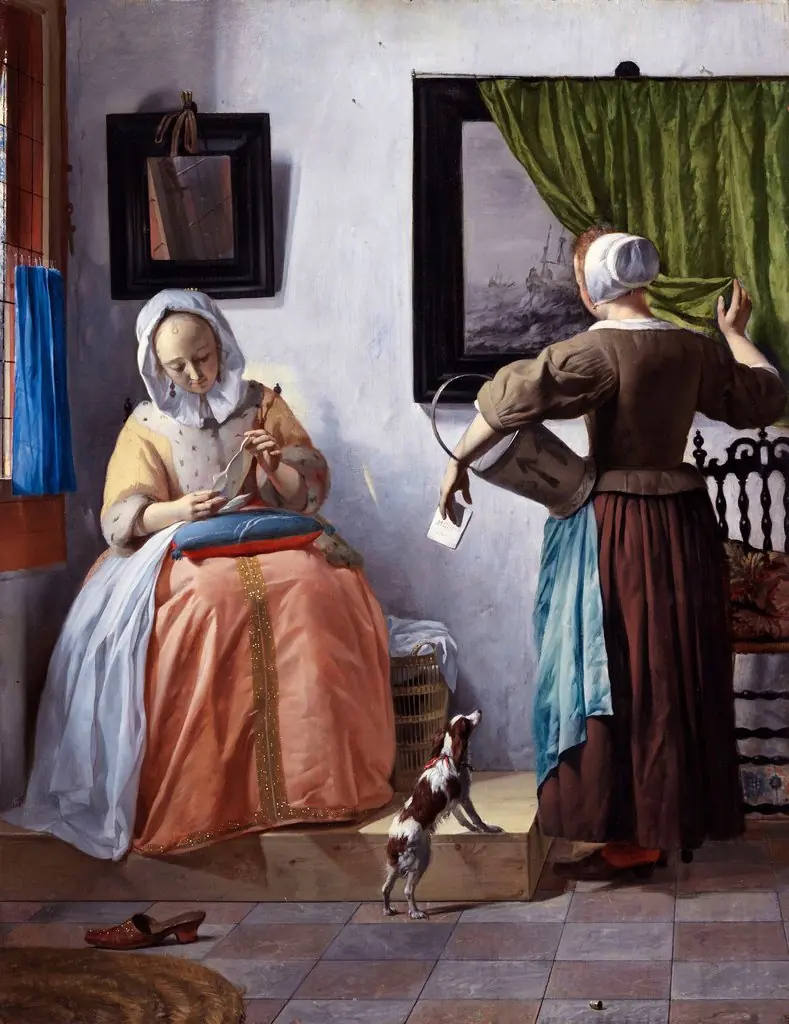
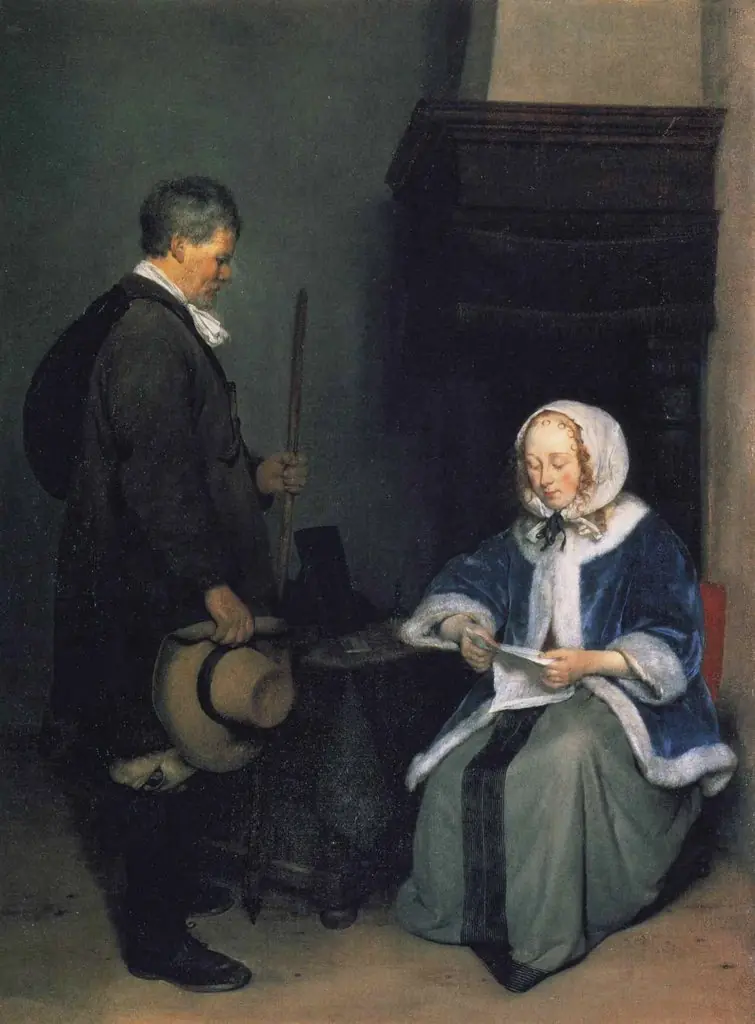
Lady Writing a Letter with her Maid occupies a pivotal position in Vermeer's oeuvre, bridging the quiet restraint and self-containment of his 1660s works and the cooler, more distanced manner of his 1670s output. It has been suggested that the painting was partly inspired by Gerard ter Borch's Woman Sealing a Letter, a precedent in Dutch genre painting for the theme of epistolary intimacy. The canvas was almost certainly cut from the same bolt used for Woman with a Lute, indicating the material economies of Vermeer's late practice. The painting exemplifies Vermeer's enduring fascination with the inside/outside axis of interior spaces, a thematic preoccupation that runs throughout his career from View of Delft to The Art of Painting. The work has attracted significant scholarly attention, particularly regarding its psychological interpretation. Griselda Pollock and others have examined its gendered dynamics, while the formal analysis of its centrifugal composition has contributed to understanding Vermeer's evolving approach to narrative structure. The painting's repeated victimisation by theft has also made it a case study in art crime and the vulnerability of private collections.
Legacy
The painting's cultural afterlife has been shaped less by its influence on subsequent artists than by its dramatic history of theft and recovery, which has made it one of the most famous stolen artworks in modern history. Its repeated misadventure, recounted in works such as Matthew Hart's The Irish Game, has overshadowed its purely art-historical significance in popular imagination. Yet within Vermeer scholarship, the work remains crucial for understanding the artist's late development. As one of his experiments with multi-figure composition and centrifugal design, it anticipates the spatial complexity of his final works. The painting's provenance through the Beit collection and its eventual donation to the National Gallery of Ireland also illustrates the migration of Dutch Golden Age paintings from private European collections to public museums in the twentieth century. Today it stands as a central holding of the National Gallery of Ireland, one of the few Vermeers in public collections outside the major concentrations in Amsterdam, The Hague, New York, and London.
Own this work as a print
Artist & collection
Artist
Johannes Vermeer ( vər-MEER, vər-MAIR, Dutch:; see below; also known as Jan Vermeer; October 1632 – 15 December 1675) was a Dutch painter who specialized in domestic interior scenes of middle-class life.