Artwork
A Lady Writing
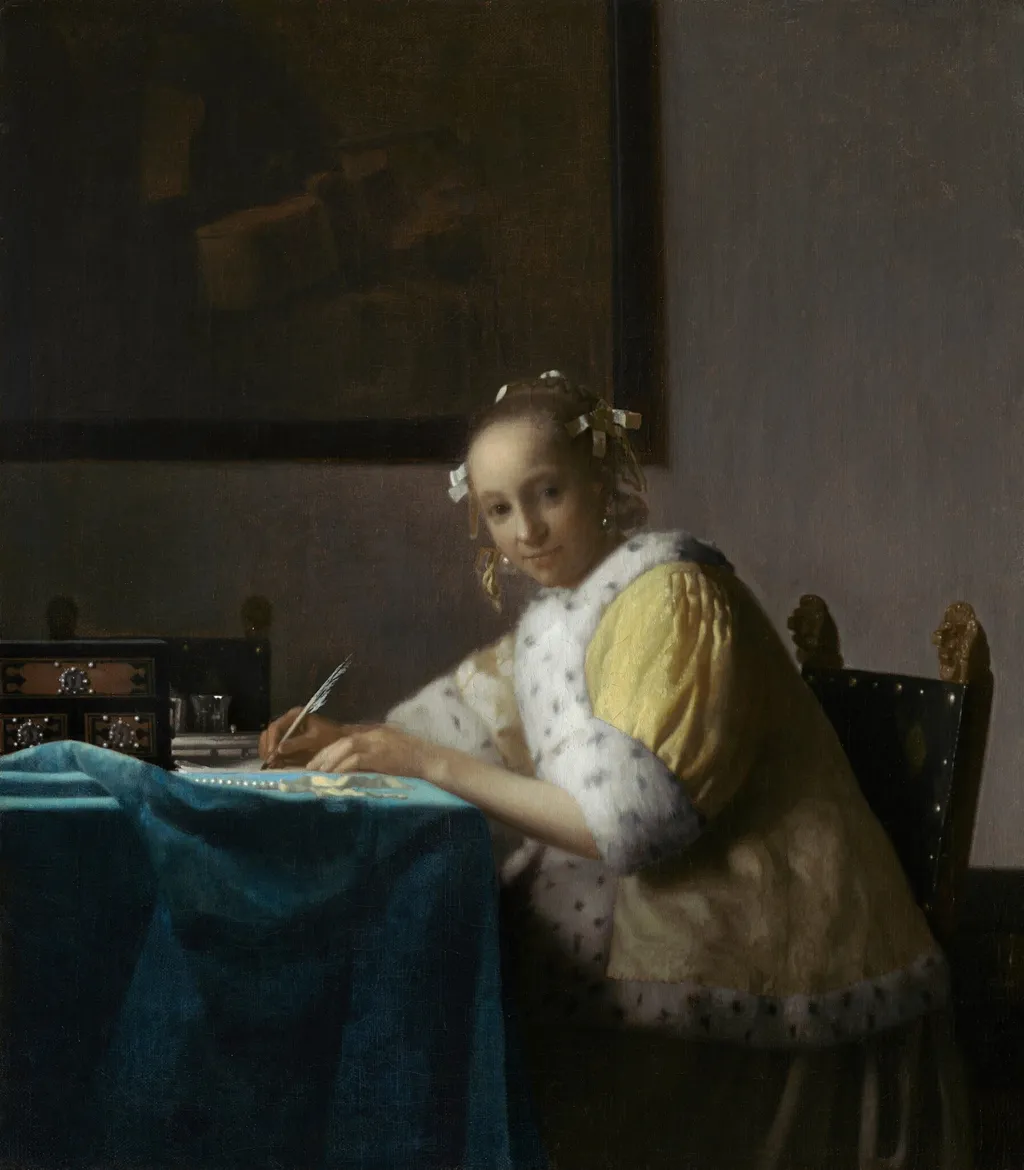
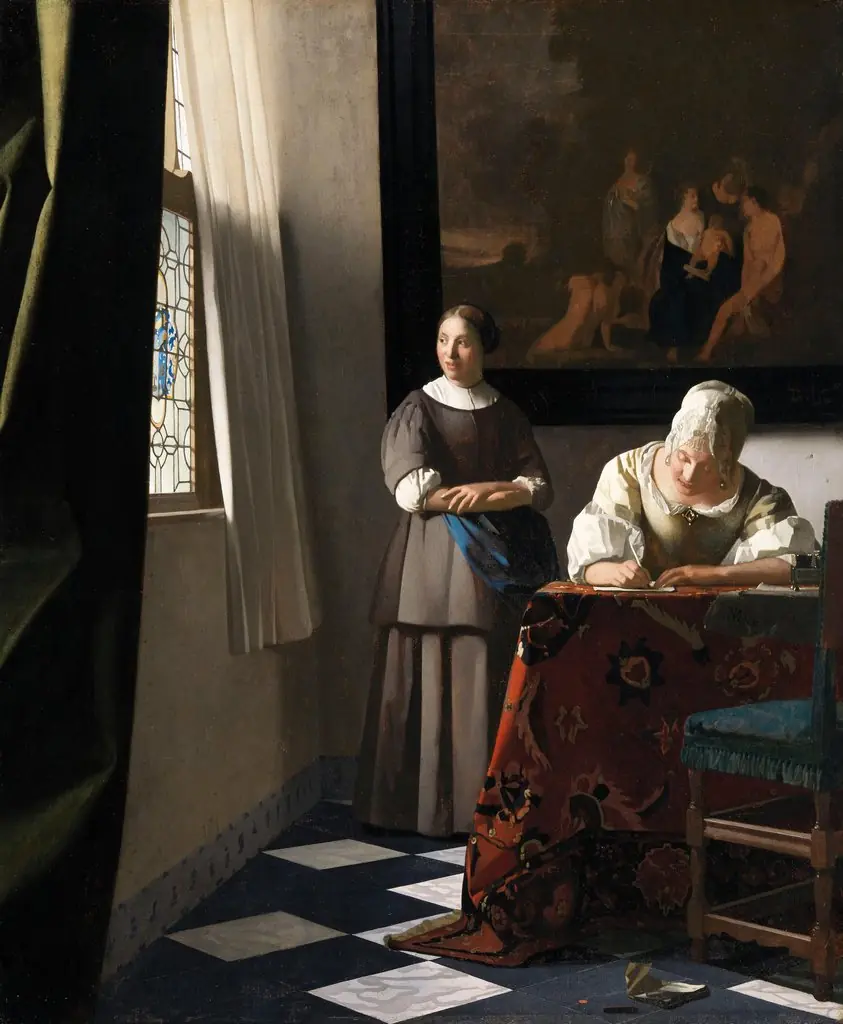
A Lady Writing is an oil painting by the Baroque artist Johannes Vermeer. It dates from 1665 and is held in the collection of the National Gallery of Art.
- Inscription
- Inscribed:center left on frame of picture on back wall: IVMEER (IVM in ligature)
About this work
Subject & Meaning
She wears a lemon-yellow satin morning jacket trimmed with fur, a string of ten pearls, and two pearl earrings, with bows in her hair.
A Lady Writing depicts an elegantly dressed young woman seated at a table, pausing from her writing to gaze directly at the viewer while still holding a quill in her right hand. She wears a lemon-yellow satin morning jacket trimmed with fur, a string of ten pearls, and two pearl earrings, with bows in her hair. The concentration of small, luminous objects on the table, pearls, inkwell, jewelry casket, contrasts with the broader forms of the room, drawing attention to her interrupted act of correspondence.
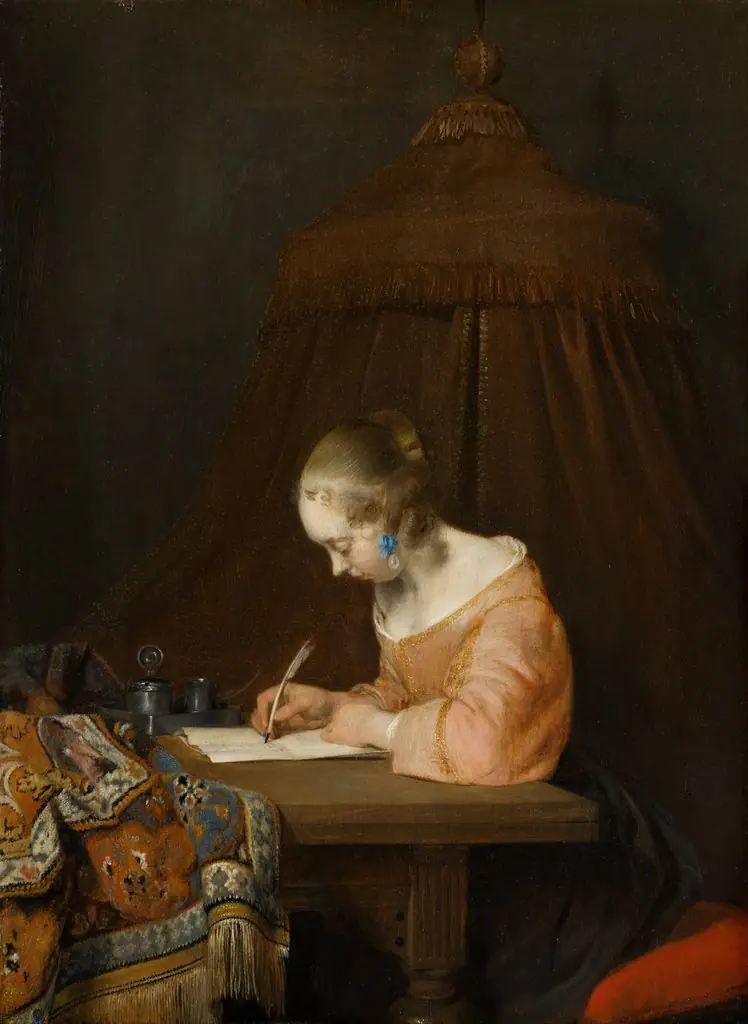
The subject of a woman writing a letter was a popular motif in 17th-century Dutch painting, and Vermeer may have drawn on Gerard ter Borch's 1655 Letter Writer as a compositional model. Many critics have speculated, based on the individualized features of the sitter, that the woman depicted is Vermeer's wife Catharina Bolnes, though this cannot be confirmed. Hanging on the back wall is a vanitas still life, likely by Cornelis van der Meulen, showing a stringed instrument; vanitas imagery traditionally contrasts worldly luxury with the transience of life, suggesting that even amid affluence and refinement, earthly pursuits end in mortality.
The yellow jacket, table cloth, and pearl necklace recur in several other Vermeer paintings, leading scholars to suggest these were objects owned by the artist or his family, and that the painting represents the calm and prosperity Vermeer could not provide to his own household.
Technique & Style
A Lady Writing is executed in oil on canvas, measuring approximately 45 by 39.9–40 cm, a modest scale typical of Vermeer's mature genre scenes. Vermeer concentrates compositional focus on the figure and the few objects clustered on the table, with the woman and table pushed near the picture plane. Foreground and background recede into shadow while the middle ground is brightly lit, producing pronounced spatial depth.
The limited palette is anchored by the lemon-yellow satin jacket trimmed with ermine, a garment that recurs in five other Vermeer paintings. Highlights animate small forms: the pearl necklace, upholstery nails, jewelry casket, and inkwell gleam in the sunlight. Vermeer balances the composition through parallel diagonals, the fold of the rolled blue velvet cloth echoes the resting arm and continues into the chair, while the yellow ribbons of the pearl necklace follow the contour of the outstretched hand.
The face receives more individualized finish than in most of his works, and the wall painting behind the sitter, a vanitas still life with a stringed instrument, forms a large dark counterweight to the illuminated figure.
History & Provenance
Completed circa 1665 during Vermeer's mature phase, this work was likely commissioned by his patron Pieter Claesz van Ruijven. Following Van Ruijven's death in 1674, the painting possibly passed by inheritance to his wife Maria de Knuijt, their daughter Magdalena van Ruijven, and subsequently her husband Jacobus Abrahamsz. Dissius.
It appeared in the Dissius estate sale in Amsterdam on May 16, 1696. The canvas remained with various Dutch owners until 1827, when Belgian politician François-Xavier, comte de Robiano, acquired it. The work stayed within the Robiano family until 1907, when American banker J. Pierpont Morgan purchased it.
Upon Morgan's death, it passed to his son, J. P. Morgan, Jr., before being sold to M. Knoedler & Co. in 1940. Art collector Horace Havemeyer acquired the piece in 1946; his heirs, Harry Waldron Havemeyer and Horace Havemeyer, donated it to the National Gallery of Art in Washington, D.C., in 1962.
The painting is held by the National Gallery of Art in Washington, D.C. Its museum inventory number is 1962.10.1. The work entered the collection through a 1962 donation by Harry Waldron Havemeyer and Horace Havemeyer. Its earlier ownership is documented from Vermeer’s possible patron Pieter van Ruijven through a series of Dutch dealers to Belgian collector François de Robiano, then to J. Pierpont Morgan in 1907, before the museum acquired it.
The canvas has been included in major Vermeer exhibitions, most notably ‘Vermeer and the Masters of Genre Painting. Inspiration and Rivalry.’ at the National Gallery of Art.
Context
Situated within the Dutch Golden Age, A Lady Writing (c. 1665) is frequently analyzed as a mature work where Vermeer refines the genre of the letter-writing woman, a popular motif in the 17th-century Netherlands. Scholars often cite Gerard ter Borch's The Letter Writer (1655) as a likely inspiration for the composition and subject matter. Critical reception has long focused on the painting's vanitas undertones, particularly the background still life of a violone and skull, which contrasts the subject's worldly elegance with themes of mortality.
Art historians also note the recurrence of specific props, such as the yellow satin jacket and pearls, across Vermeer's oeuvre, suggesting they were family possessions. Furthermore, the direct, tender gaze of the sitter has led to persistent speculation that the model was Vermeer's wife, Catharina Bolnes, reflecting a broader scholarly interest in the artist's personal life and the idealized domestic calm he depicted.
Legacy
The painting entered the National Gallery of Art collection through the 1907 acquisition by J. Pierpont Morgan and the 1962 donation by the Havemeyer heirs, a trajectory documented in the provenance records (1). Its prominent display in the Gallery’s Dutch Golden Age exhibitions, notably the exhibition Vermeer and the Masters of Genre Painting, helped cement Vermeer’s reputation as the preeminent painter of intimate interior scenes (2). Scholars repeatedly cite the work when discussing Vermeer’s mastery of light, spatial depth, and the symbolic use of domestic objects, a theme explored in major monographs (3,4).
Consequently, the piece has become a reference point for studies of 17th‑century genre painting and continues to influence contemporary interpretations of Vermeer’s legacy.
Overview
Johannes Vermeer's painting, A Lady Writing, is an oil on canvas work from the mid-to-late 1660s. This piece represents the Dutch artist's mature period in the 17th century. It is currently housed in the collection of the National Gallery of Art in Washington, D.C., and is recognized for its intimate portrayal of domestic life.
Own this work as a print
Artist & collection
Artist
Johannes Vermeer ( vər-MEER, vər-MAIR, Dutch:; see below; also known as Jan Vermeer; October 1632 – 15 December 1675) was a Dutch painter who specialized in domestic interior scenes of middle-class life.