Artwork
Sweet Melancholy
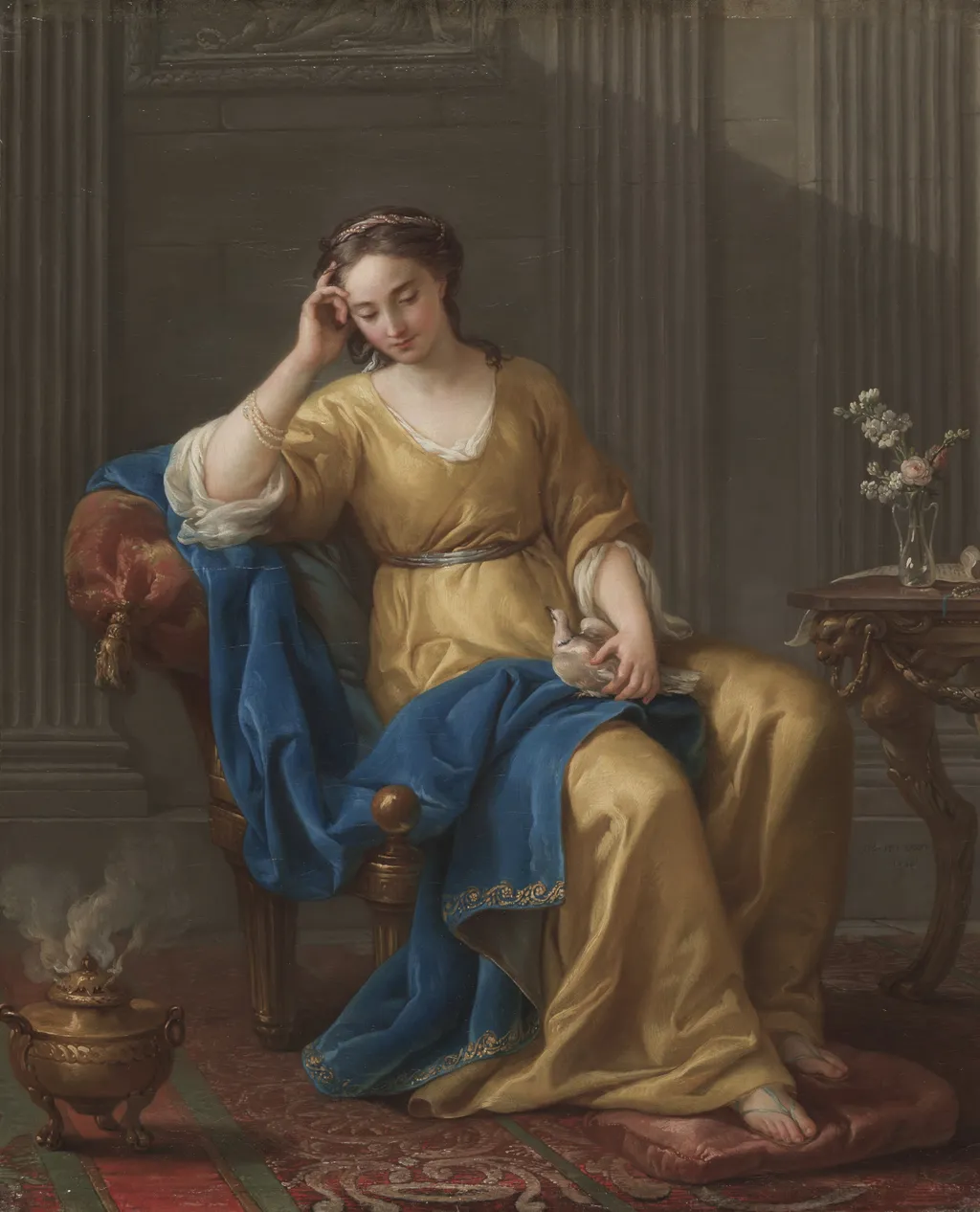
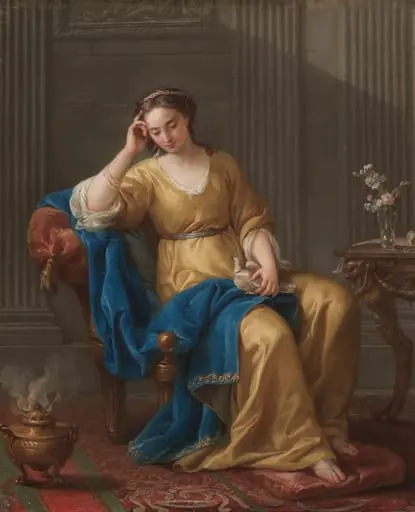
Sweet Melancholy is an oil painting by the Rococo painting artist Joseph-Marie Vien. It dates from 1756 and is held in the collection of the Cleveland Museum of Art.
About this work
Joseph-Marie Vien painted Sweet Melancholy in 1756. This oil on canvas hangs in the Cleveland Museum of Art today. It showed at the Louvre’s 1757 Salon, so people could see it right away.
Vien liked soft feelings over dramatic scenes. He chose a quiet mood for this work. Melancholy, the opposite of happiness, feels gentle here.
Look up the technique of glazing next.
Subject & Meaning
Its intimate symbolism influenced Jacques‑Louis David, who later adopted a restrained, classical mode in his own compositions.
The painting presents an allegorical figure of Melancholy, a young woman in a draped antique-style gown seated on a red velvet chair, her posture suggesting quiet contemplation rather than historical narrative. She holds a dove, a symbol of fidelity, and a discarded letter, hinting at unrequited love; an incense burner alludes to oracular prophecy, while a richly patterned carpet and floral vase reference contemporary exotic décor. The work challenges the dominance of grand historical subjects, embodying the mid‑18th‑century shift toward sentimental genre scenes that Winckelmann praised for 'noble simplicity'. Its intimate symbolism influenced Jacques‑Louis David, who later adopted a restrained, classical mode in his own compositions.
Technique & Style
Executed in 1756, Sweet Melancholy is an oil painting on canvas measuring 68 by 55 centimeters. The work exemplifies a shift toward neoclassical restraint, replacing extroverted movement with silent introspection reminiscent of Poussin. The composition features a solitary female figure in a languid pose, dressed in a golden silk robe resembling an antique toga, accented by a brown belt and an azure blue shawl.
She sits upon a red velvet armchair, holding a dove that symbolizes fidelity and romantic longing. The setting includes a carved wooden table with a glass vase of flowers and an abandoned letter, alongside an incense burner emitting smoke. The background consists of a wall featuring semi-relief colonnades, utilizing chiaroscuro to emphasize the subject's meditative state through contrasting shadows.
History & Provenance
Sweet Melancholy (La Douce Mélancolie) is an oil on canvas painted by Joseph-Marie Vien in 1756 in France. The work was publicly presented at the Salon of 1757, held at the Louvre in Paris. Its earliest recorded owner was the chevalier de Damery, a military officer and collector of prints, drawings, and paintings, in whose cabinet the allegory was held.
After Damery suffered financial ruin, he was compelled to sell his collection and ultimately ended his days at Les Invalides. The painting subsequently entered the Cleveland Museum of Art, where it is held under accession reference 1996.1. Its exhibition history begins with the showing at the Salon of 1757 in Paris.
Context
The painting Sweet Melancholy (1756) by Joseph-Marie Vien was shown at the 1757 Salon, marking a shift toward sentimental genre scenes within French academic art. Contemporary commentary highlighted its challenge to the dominance of historical subjects, echoing Winckelmann's call for noble simplicity and quiet grandeur. Its provenance in the cabinet of the Chevalier de Damery and subsequent acquisition by the Cleveland Museum of Art document its early reception.
Scholarship emphasizes the work's influence on Jacques‑Louis David, who adapted Vien's restrained compositional language in his own neoclassical canvases of the 1780s, reinforcing a transition from Rococo ornament to introspective antiquarian classicism.
Legacy
Sweet Melancholy is regarded as a turning point in French painting of the 1750s, embodying the qualities of "noble simplicity" and "quiet grandeur" that Johann Joachim Winckelmann had recommended the previous year in his Reflections on the imitation of Greek works in painting and sculpture. Its introspective mood marked a shift away from the extroverted compositions of earlier canvases, aligning Vien's work with the silent introspection of the academic tradition exemplified by Nicolas Poussin. The painting exerted a notable influence on Jacques-Louis David, then a pupil of Vien.
Nearly three decades later, in the 1780s, David revived his master's approach, placing female figures in antique togas arranging garlands, offering doves to Venus, or burning incense, drawing on codes inspired by new archaeological scholarship from Pompeii and Herculaneum to substitute a vision of heroism and virile sacrifice.
Overview
Joseph-Marie Vien completed Sweet Melancholy, an oil on canvas, in 1756. This painting, now housed at the Cleveland Museum of Art, was first presented to the public at the prestigious Salon exhibition held in the Louvre in Paris the following year. It embodies a subdued emotional tone, reflecting the artist's inclination towards gentle sentiments rather than overt drama.
Own this work as a print
Artist & collection
Artist
Joseph-Marie Vien (18 June 1716 – 27 March 1809) was a French painter. He was the last holder of the post of Premier peintre du Roi, serving from 1789 to 1791, before it was abolished during the French Revolution.