Artwork
The Quarrel of Oberon and Titania
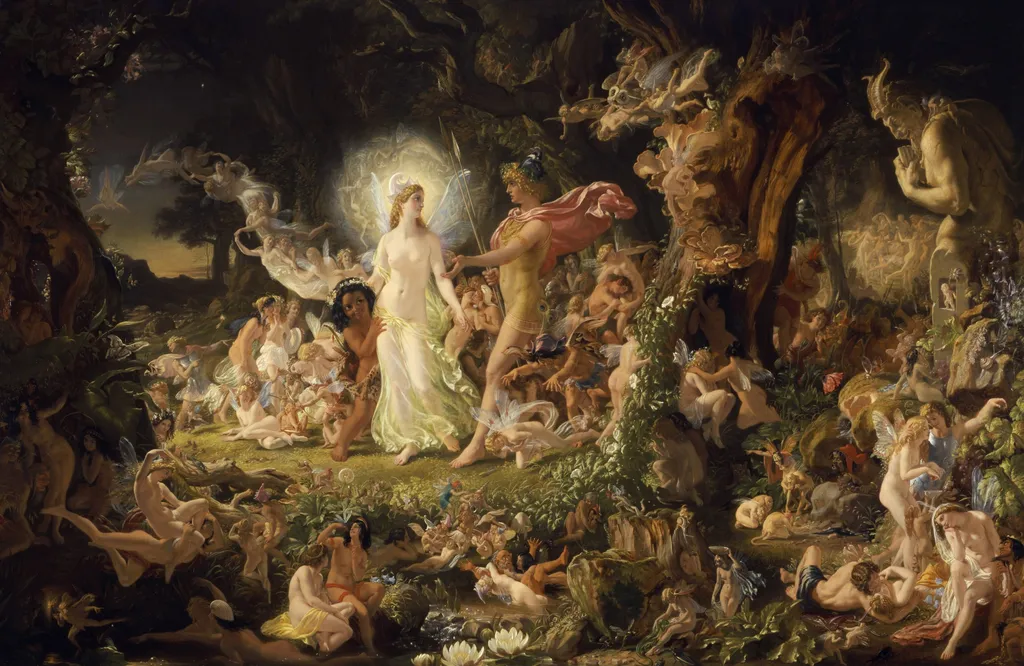
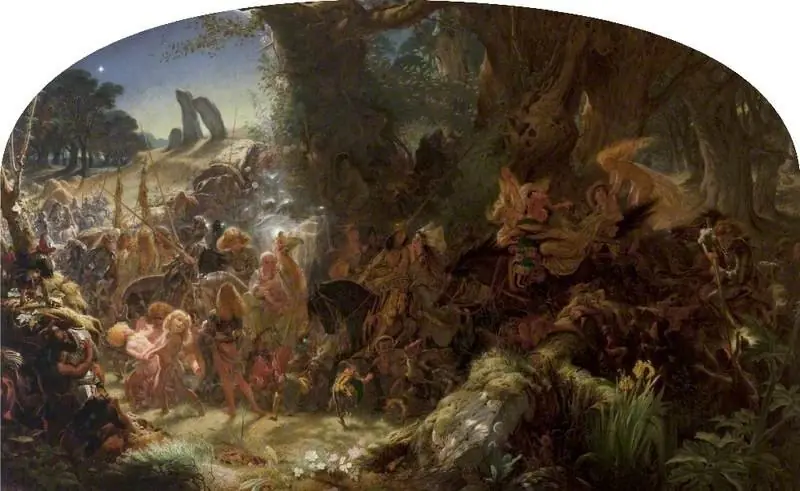
The Quarrel of Oberon and Titania is an oil painting by the British Romanticist artist Joseph Noel Paton. It dates from 1849 and is held in the collection of the National Galleries Scotland.
About this work
Overview
The painting was an immediate success when first exhibited in Edinburgh in 1850, earning the acclaim of being declared the painting of the season.
The Quarrel of Oberon and Titania is an oil on canvas painting by the Scottish artist Sir Joseph Noel Paton, completed in 1849. Measuring 99 by 152 centimeters, the work belongs to the mythological genre and visualizes a pivotal confrontation from William Shakespeare's play A Midsummer Night's Dream. The painting was an immediate success when first exhibited in Edinburgh in 1850, earning the acclaim of being declared the painting of the season. It subsequently entered the collection of the National Galleries of Scotland, where it remains on display at the Scottish National Gallery in Edinburgh under accession number NG 293.
Subject & Meaning
The painting illustrates Act II, scene i of Shakespeare's comedy, set in the fairy rulers' woodland home outside Athens as nightfall descends. At the center of the composition, Oberon, the fairy king dressed in gold armor with a red cape and helmet, reaches toward the fairy queen, Titania, who is luminous and draped in flowing white fabric. Their quarrel concerns the custody of a changeling boy, a human child carried off to the fairy realm, who hides behind Titania. The royal couple is surrounded by a teeming host of 165 fairies, sprites, goblins, and imps, a count famously tallied by author Lewis Carroll. Beautiful, nude fairies engage in leisurely activities like swimming and reclining, contrasting with grotesque, ugly figures scattered among moths, beetles, spiders, and snails. A statue of Pan with pipes appears to the right, under which couples in a state of undress are positioned. The supernatural nature of these creatures excused their sensual appearance and behavior within the Victorian context, while the broader dispute symbolizes a disruption of the natural order.
Technique & Style
Executed in oil on canvas, the painting is characterized by a highly detailed and smooth finish, with meticulous rendering of flesh, fabric, and botanical elements throughout the crowded composition. Paton contrasts the central glowing light radiating from behind Titania, which creates a halo effect and a bright crown of fairies around her head, against the deep browns and greens of the surrounding woods. The woodland setting is constructed from aged twisted trees, leaves, flowers, and a lily pond in the foreground. A massive tree trunk on the right hosts clustered fairy forms and a large, pale, mask-like face emerging from the bark. The work exemplifies Victorian fairy painting, blending detailed realism with mythological fantasy. Scholars such as Richard Schindler and Carole Silver note the distinct influence of the Swiss-born Romantic painter Henry Fuseli on Paton's style, particularly in the fantastical and haunting elements of the composition.
History & Provenance
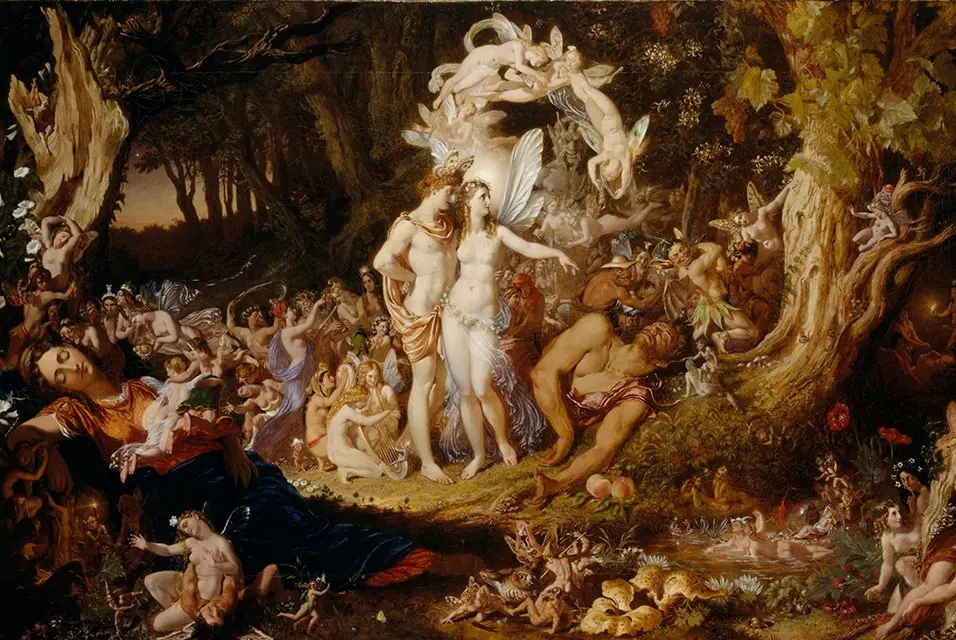
Paton first explored this subject in an earlier study completed in 1846, which he submitted as his diploma picture to the Royal Scottish Academy. The Academy purchased that earlier version for 700 pounds. The 1849 canvas was first exhibited at the Royal Scottish Academy in 1850. Following its acclaim as the painting of the season, the Royal Association for Promoting the Fine Arts in Scotland purchased the work that same year. The painting was later displayed at the 1855 Paris Exhibition, where it was listed as Representative of British Art. Ownership transferred from the Royal Association to the National Gallery of Scotland in 1897, where it has since resided.
Context
Paton created this work during the peak of Victorian fairy painting, a genre that flourished between the 1840s and 1870s as an escapist response to rapid industrialization and urbanization. The movement provided sentimental and poetic alternatives rooted in Romanticism's emphasis on nature, imagination, and the supernatural. Paton, who was elected a full Academician at the Royal Scottish Academy in 1850, emerged as a key figure in this genre alongside contemporaries like John Anster Fitzgerald. His fascination with Shakespearean subjects and the paranormal aligned with broader Victorian preoccupations. The 1849 painting was considered by Paton to be related yet self-contained from his 1847 work, The Reconciliation of Oberon and Titania. Christopher Wood, an expert in Victorian art, described Paton's fairy paintings as some of the most remarkable in the genre.
Legacy
The painting's most notable cultural afterlife stems from its profound impact on Lewis Carroll, who was so captivated by the work that he meticulously counted the 165 fairies populating the canvas. This engagement by the future author of Alice's Adventures in Wonderland underscores the painting's resonance within the literary and visual culture of the Victorian era. Today, the work is recognized as a major example of Victorian fairy painting, continuing to engage visitors at the Scottish National Gallery who search the dense foliage for hidden creatures.
Own this work as a print
Artist & collection
Artist
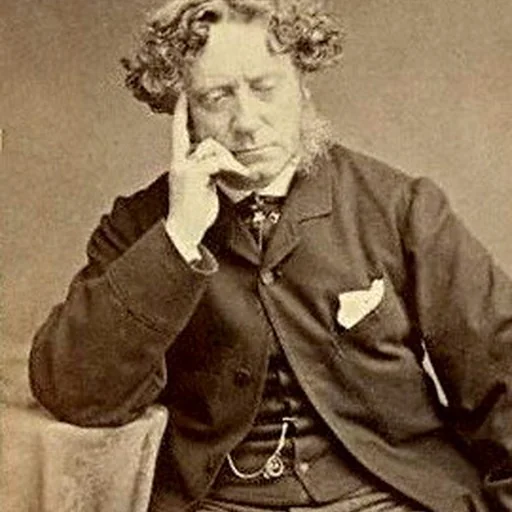
Sir Joseph Noel Paton (13 December 1821 – 26 December 1901) was a Scottish artist, illustrator and sculptor. He was also a poet and had an interest in, and knowledge of, Scottish folklore and Celtic legends.