Artwork
Edward and Sarah Rutter
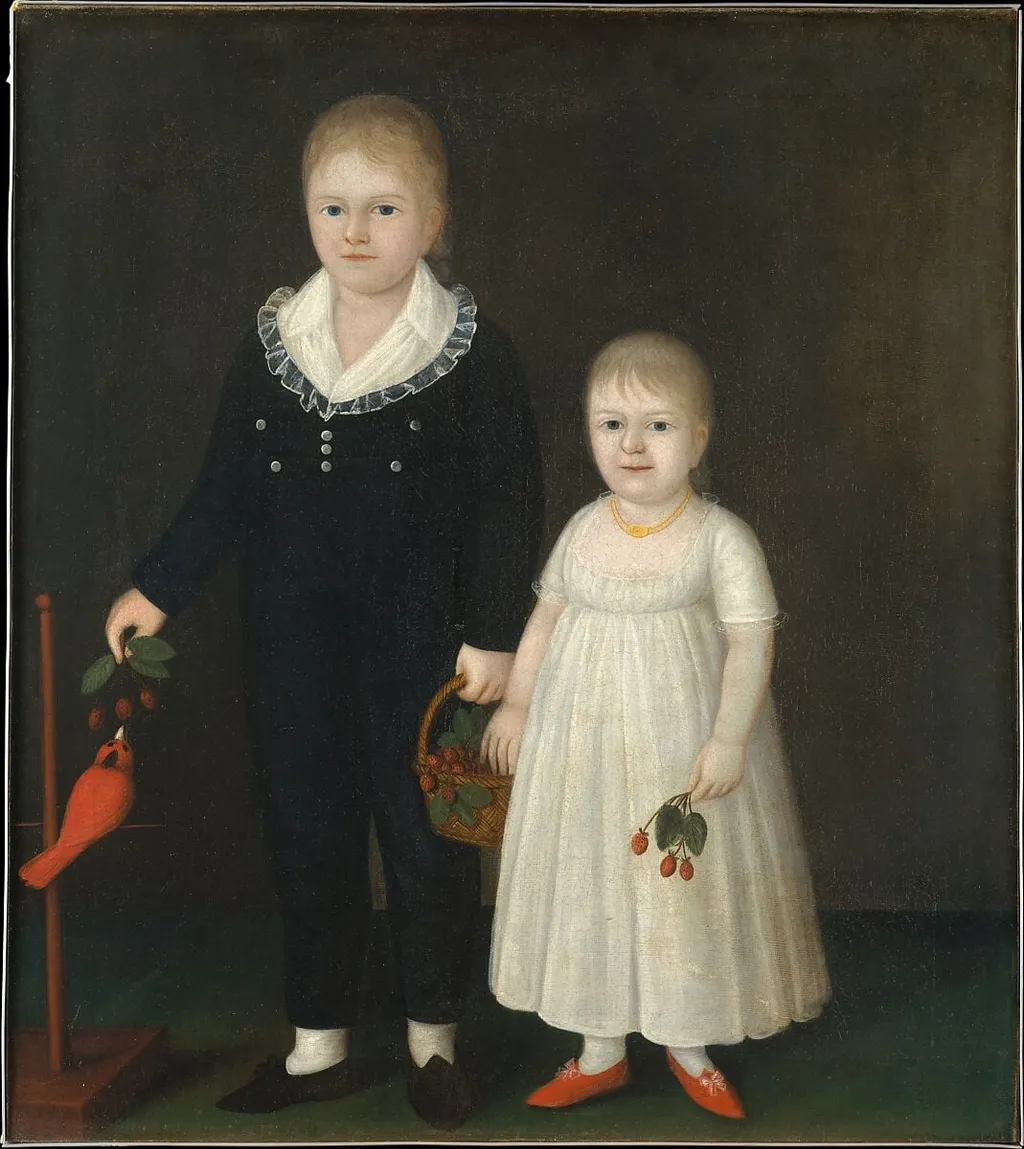
Edward and Sarah Rutter is an oil painting by the Naïve art artist Joshua Johnson. It dates from 1805 and is held in the collection of the Metropolitan Museum of Art.
About this work
Edward Pennington Rutter grips a bright red bird while his sister Sarah Ann holds a spray of strawberries in this portrait of about 1805 by Joshua Johnson, the first known African American to earn a living as a professional painter. The children of a Baltimore sea captain face out against a dark, plain ground in Johnson's characteristic stillness.
Subject & Meaning
The strawberry and bird are recurring objects in naive portraiture, often suggesting innocence, natural abundance, or the brevity of youth.
The painting depicts siblings Edward and Sarah Rutter, shown with a bird and strawberries (Fragaria). The strawberry and bird are recurring objects in naive portraiture, often suggesting innocence, natural abundance, or the brevity of youth. The work's primary subject is the sibling relationship, rendered in the direct, unpretentious style of Joshua Johnson's naive art, emphasizing the plain likenesses and familial bond over elaborate symbolism.
Technique & Style
The portrait is executed in oil on canvas, a standard medium for early American portraiture. The painting aligns with the naïve art movement, evident in its simplified forms, flat spatial treatment, and direct, unmodulated handling. The support measures 91.4 by 81.3 cm.
Overview
This circa 1805 oil on canvas by Joshua Johnson portrays Edward Pennington Rutter and his sister Sarah Ann, children of a prominent Baltimore mercantile family. Johnson, recognized as the first African American artist to establish a professional painting career, captures the siblings with a distinct stillness. Edward holds a vibrant red cardinal, while Sarah presents a cluster of strawberries, elements that add symbolic depth to their formal presentation. The work exemplifies Johnson's direct approach to portraiture.
History & Provenance
This portrait remained in private collections for over a century and a half before entering public ownership. In 1965, Edgar William and Bernice Chrysler Garbisch generously donated the canvas to The Metropolitan Museum of Art, where it is now housed within The American Wing. Since its acquisition, the painting has been featured in significant exhibitions focusing on American folk art, including a major survey at the Met in 1999.
Context
Joshua Johnson's life began around 1763 in Baltimore County, Maryland, born to an enslaved Black woman and a white man. He gained his freedom in 1782 and subsequently established a successful thirty-five-year career as a portraitist in Federal-era Baltimore. Johnson promoted himself as a "self-taught genius" who overcame "many insuperable obstacles," a testament to his determination as the first documented African American artist to sustain himself professionally through painting.
Legacy
Johnson's distinctive and unembellished style garnered renewed appreciation in the early twentieth century. His direct approach to portraiture resonated with both modernists, who valued its departure from academic conventions, and collectors interested in American folk art. This later recognition solidified his place within the broader narrative of American art history, highlighting the enduring appeal of his unique artistic vision.
Artist & collection


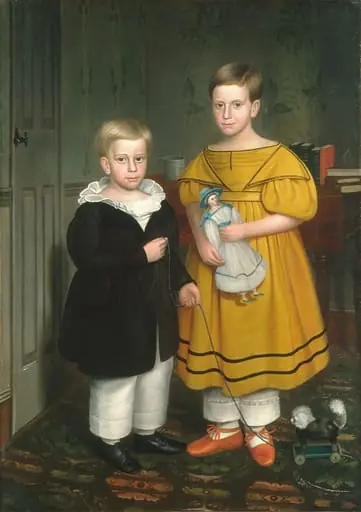
- The Raymond Children
 Two Children
 Sisters in Black Aprons
 Child with a Peach
 The Strawberry Girl
 Kirkkoherra Crohnsin perheen lapset hoitajansa kanssa
 Mrs. Noah Smith and Her Children
 Portrait of Charles Joseph, Archduke of Austria (1745-1761)
 The Duke and Duchess of Osuna and their Children
 Everard Benjamin