Artwork
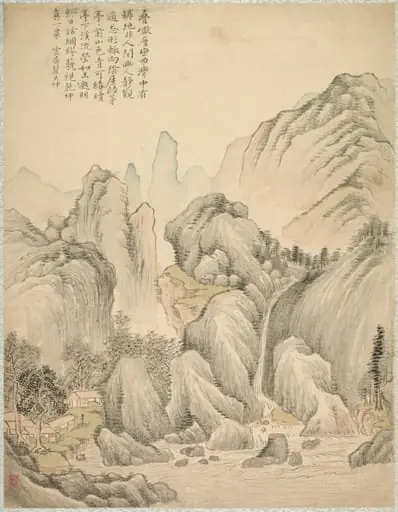
Landscape with Gentle Peaks
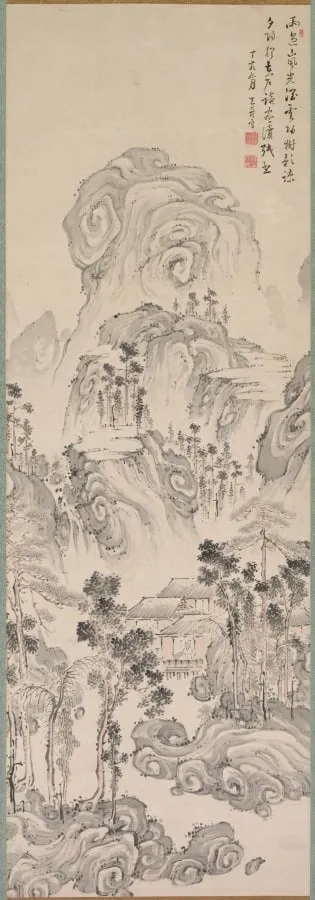
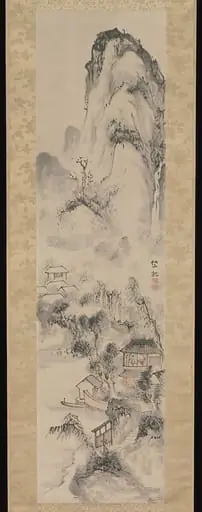
Landscape with Gentle Peaks is an unspecified painting by the Rinpa school artist Kan Tenju. It dates from 1767 and is held in the collection of the Cleveland Museum of Art.
- Accession no.
- 1978.7
- Credit line
- Andrew R. and Martha Holden Jennings Fund
About this work
If you like this quiet mood, look up sfumato, it’s the way artists blur edges so things feel like they’re fading into air.
You see soft blue mountains, a tiny hut, and a waterfall that almost disappears into mist.
Kan Tenju wasn’t just a painter, he was a calligrapher and seal carver too. The poem at the top isn’t decoration; it’s part of the scene, like the mountains and mist are words he wrote. He painted this in 1767, but the quiet feels older, like the view hasn’t changed in centuries.
If you like this quiet mood, look up sfumato, it’s the way artists blur edges so things feel like they’re fading into air.
Overview
Landscape with Gentle Peaks is a 1767 painting by Kan Tenju, showcasing a serene mountain retreat with a figure, waterfall, and misty landscape, accompanied by a Chinese-style poem integrated into the composition.
Subject & Meaning
The painting depicts a contemplative scene of solitude, where a figure sits in a mountainous hideaway near a waterfall, evoking a sense of timeless tranquility. The included poem enhances the serene atmosphere, describing natural phenomena and the figure's peaceful activity of reading.
Technique & Style
The work features soft blue mountains and a subtle, misty effect, characteristic of sfumato, a technique that blurs edges to create a fading, airy quality. The integration of a calligraphic poem at the top further blends visual and literary art, reflecting Kan Tenju's background in both painting and calligraphy.
History & Provenance
Created in 1767 by Kan Tenju, a Korean heritage artist known primarily for calligraphy and seal carving, this painting also reflects his connections to notable artists of the time, including Ike Taiga and Aoki Shukuya.
Context
As a patron of Ike Taiga and cousin to Aoki Shukuya, Kan Tenju's work exists within a network of 18th-century Japanese artistic relationships, though the painting's calm, enduring quality transcends its specific historical moment.
Legacy
While the painting's direct influence is not broadly highlighted, its demonstration of sfumato techniques and the fusion of visual and literary elements contribute to the broader appreciation of Japanese art's capacity for serene, contemplative compositions.
Artist & collection