Artwork
Death of the Virgin
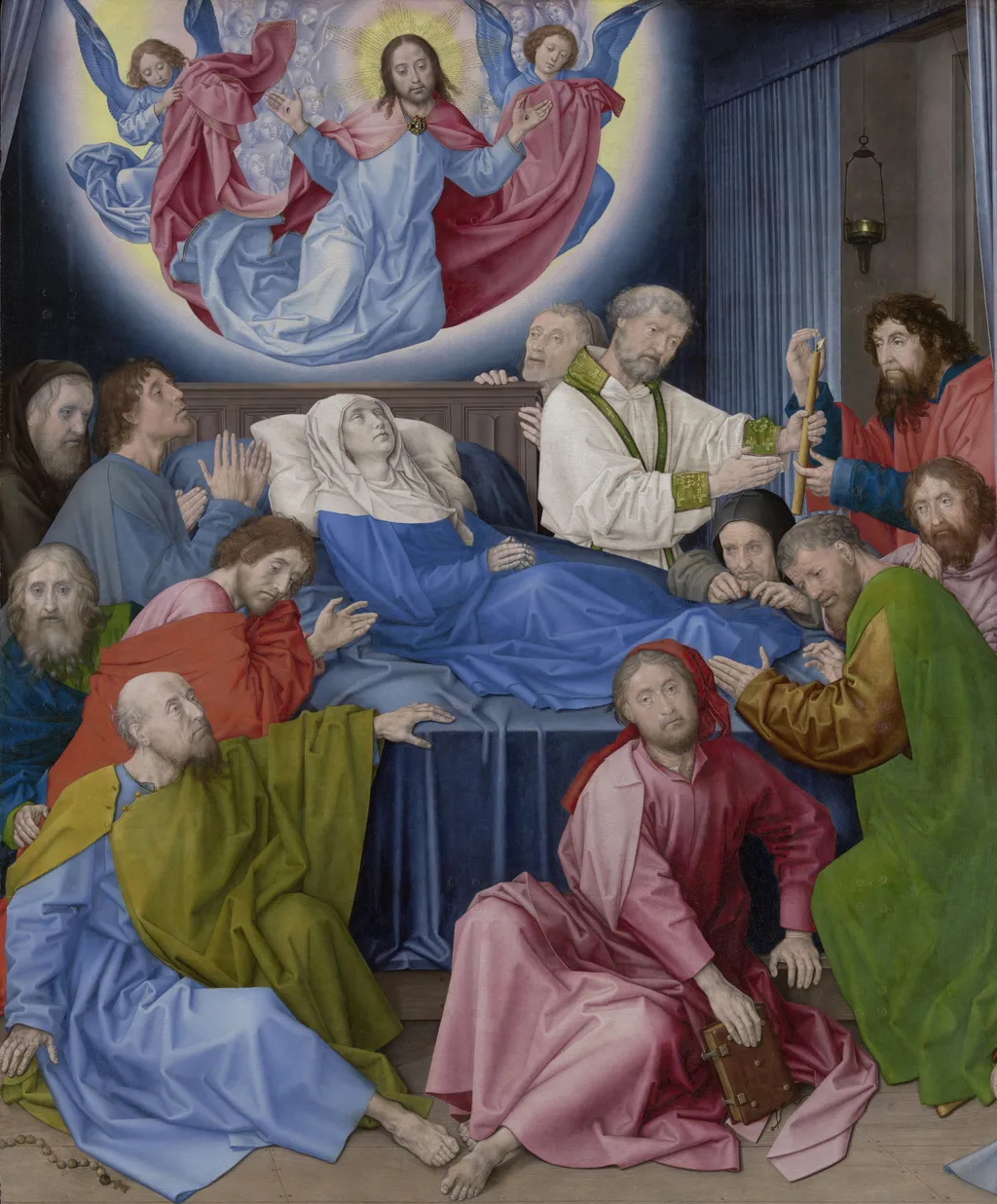
Death of the Virgin is an oil painting by the Northern Renaissance artist Hugo Van der Goes. It dates from 1475 and is held in the collection of the Groeningemuseum.
About this work
Overview
The Death of the Virgin is an oil-on-oak-panel painting by the Flemish Early Netherlandish artist Hugo van der Goes, completed circa 1472-1480.
The Death of the Virgin is an oil-on-oak-panel painting by the Flemish Early Netherlandish artist Hugo van der Goes, completed circa 1472-1480. Measuring 147.8 by 122.5 centimetres, it depicts the Virgin Mary on her deathbed surrounded by the Twelve Apostles, with Christ appearing above to receive her soul. The painting is held in the Groeningemuseum in Bruges, where it entered the collection of the Vlaamse Kunstcollectie. Along with the Monforte Altarpiece and the Portinari Altarpiece, it is considered one of van der Goes's most important works, and likely among the last he completed before his death in 1482. Art historian Till-Holger Borchert has described the panel as belonging to the most impressive and artistically mature achievements of Early Netherlandish painting, while Lorne Campbell called it van der Goes's most idiosyncr visualization masterpiece.
Subject & Meaning
The subject derives from Jacobus de Voragine's thirteenth-century Legenda aurea, which recounts how the apostles were brought on clouds by angels to a house near Mount Zion to be with Mary during her final three days. On the third day, Jesus appeared above her bed in a halo of light surrounded by angels to accept her soul at the moment his name was finally mentioned. In the painting, Mary lies in a blue robe with a white headdress on a timber bed, her head resting on a white pillow, her skin thin and pallid, her hands clasped in prayer. Christ descends in a radiant apparition, arms outstretched, flanked by two angels holding pink cloth; his open palms display the wounds of Calvary, identifying him as both redeemer and conqueror of death. Peter, dressed in white priestly vestments with green orphreys, holds a lit taper that in contemporary ritual would be handed to the dying woman. A rosary lies on the floor, and one apostle in the foreground clutches a small book. The apostles display their grief through a range of expressions and gestures, from sorrow and despair to empathy and compassion, each rendered as a unique individual rather than as conventional or idealised types.
Technique & Style
The painting is executed in oil on oak panel, executed with smooth, highly finished brushwork that achieves a polished, enamel-like quality with no visible brushstrokes. The palette is dominated by rich blues, pinks, and greens, with touches of red and white; the blue of Mary's robe at the centre is exalted by nearby apostles in red and echoed by Christ's garment in a lighter tone, heightened by a purplish mantle. Light emanates from the celestial apparition above, casting illumination downward, while the lower portion rests in softer, more diffused light. The work marks a break in van der Goes's style: line has become more important, setting is eliminated, and the image lacks depth and is tightly contracted, with only the bed, door, and the body of the Virgin giving spatial indicators. The bed is scorciato, creating an effect of distorted proportions and claustrophobia that lends the ensemble high dramatic tension. Infra-red photography reveals that the composition was planned in a highly detailed manner before the underdrawing was applied. The meticulous rendering of fabric textures, individual faces, and architectural details is notable, as is the descriptive realism reserved for the faces, individualised with care and excavated in the search for introspection, and for the hands, captured in a varied range of gestures.
History & Provenance
The painting was almost certainly commissioned; Borchert believes that Johannes Crabbe (Jan Crabbe), abbot of the Cistercian Ten Duinen Abbey in Koksijde, commissioned it for the abbey, possibly for a Marian chapel for the abbots. The earliest known record of the painting dates to 1777, when it appeared in an inventory of the Ten Duinen Abbey, by then moved to Bruges. The work is unsigned and undated; attribution to van der Goes rests on stylistic comparison with his other works and on the rare manner in which the planks of the panel are joined, which points to his authorship. Between 2018 and 2022, the painting underwent intensive conservation treatment. Following restoration, it was the centrepiece of the exhibition Oog in oog met de Dood at the Sint-Janshospitaal in Bruges.
Context
Van der Goes was a highly progressive and original artist, yet strongly influenced by contemporaries and predecessors. The inspiration for this painting is evident in Petrus Christus's circa 1457-1467 Death of the Virgin and in works attributed to the workshop of Rogier van der Weyden. Van der Goes's version bears many similarities to Martin Schongauer's circa 1470-1475 engraving of the same name, especially in tone and mood, the depiction of Mary, and the representation of the apostles seated to Mary's left, though the distribution of the apostles differs significantly and Schongauer's bed is canopied. The Schongauer is dated to at least 1475, and critical debate remains sharp and divisive as to which work came first. The painting's date and meaning have been subject to intense debate. Van der Goes spent his final years in depression; his contemporary Gaspar Ofhuys recorded a night in 1480 when the artist spoke excitedly of being a doomed soul and attempted suicide. Some art historians, including Max Friedländer, view the work as painted circa 1480 and interpret the emotional intensity as an expression of the artist's mental illness. Erwin Panofsky described van der Goes as the first artist to embody the concept of a genius both blessed and cursed by difference from ordinary human beings, and characterised the work's flatness as an irrationality of space, light, colour, and expression of mental illness. Others, including Dirk De Vos and Susan Koslow, reject this interpretation, arguing that a personal conception would not have been acceptable to patrons, and that the austere, compact style serves to underscore the solemnity and miraculous nature of the event, with material richness perhaps considered distracting and indecent.
Legacy
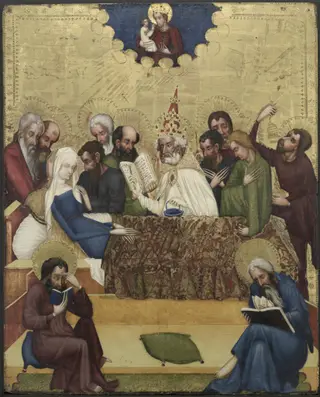
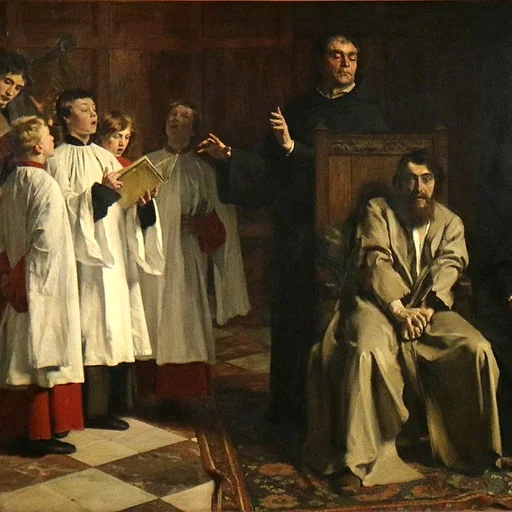
The work is the best-known of several paintings of the Death of the Virgin attributed to van der Goes or his followers. A copy is held in the treasury of St. Salvator's Cathedral in Bruges. Two similar paintings in the Berlin State Museums and the National Gallery, London, are attributed as after van der Goes. These are generally thought to be copies of a pen on paper drawing in the Herzog Anton Ulrich Museum in Brunswick, probably a copy of an original preparatory sketch by van der Goes; they show the image in reverse compared to the Bruges painting. Some scholars, including Friedrich Winkler in 1964, believed van der Goes painted at least three versions, though it is generally accepted that preparatory sketches for the Bruges work were later copied and reproduced as paintings by late fifteenth-century followers. The nineteenth-century fascination with van der Goes's psychological profile enhanced the painting's value among collectors and artists. Vincent van Gogh mentioned van der Goes three times in his letters, first in 1873 to his brother Theo, and on two later occasions when he wrote of identifying with the earlier artist's portrait in Emile Wauters's 1872 painting Hugo van der Goes Undergoing Treatment at the Red Cloister.
Own this work as a print
Artist & collection
Artist
Hugo van der Goes (c. 1430/1440 – 1482) was a Flemish painter who was one of the most significant and original Early Netherlandish painters of the late 15th century. Van der Goes was an important painter of altarpieces…

 Vienna Diptych
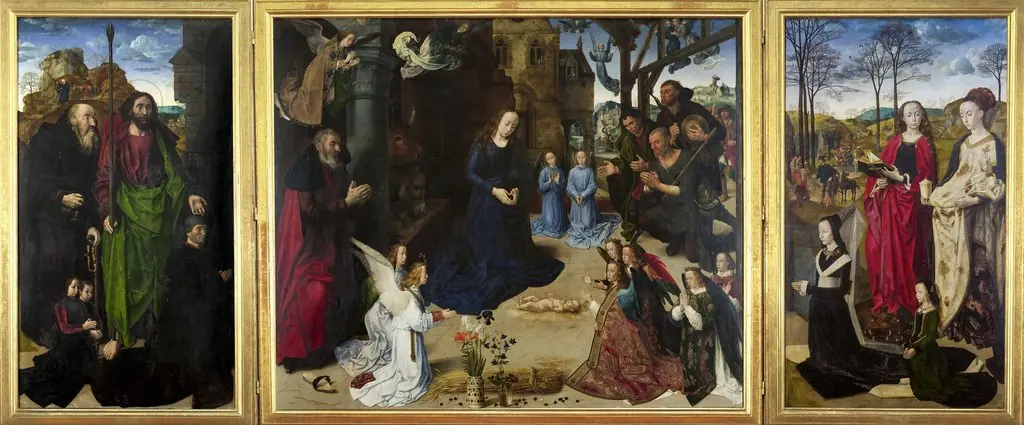 Portinari Triptych
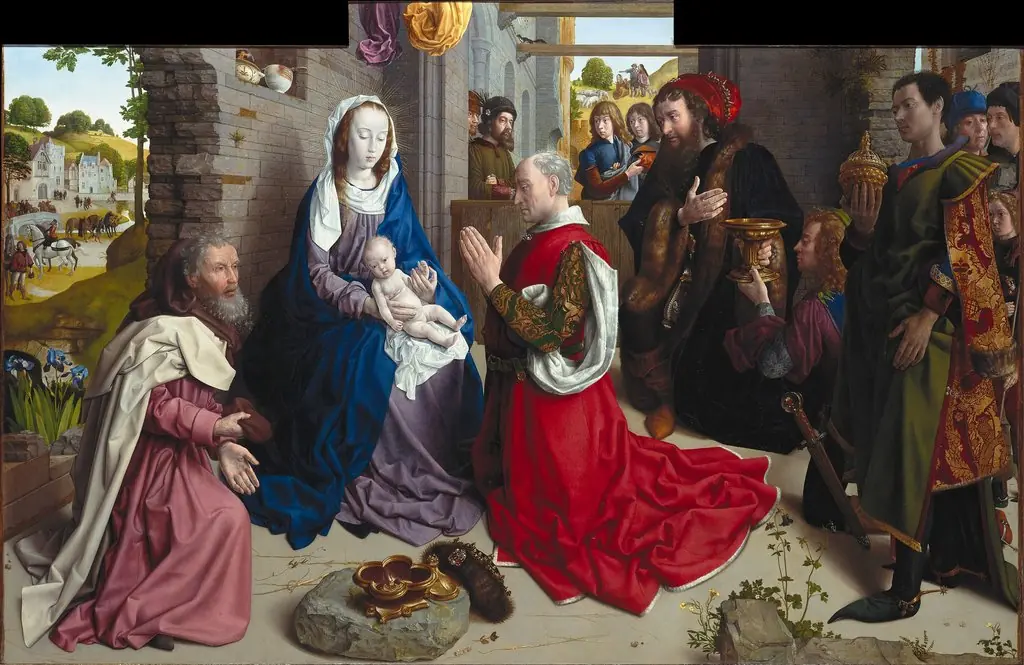 Monforte Altarpiece
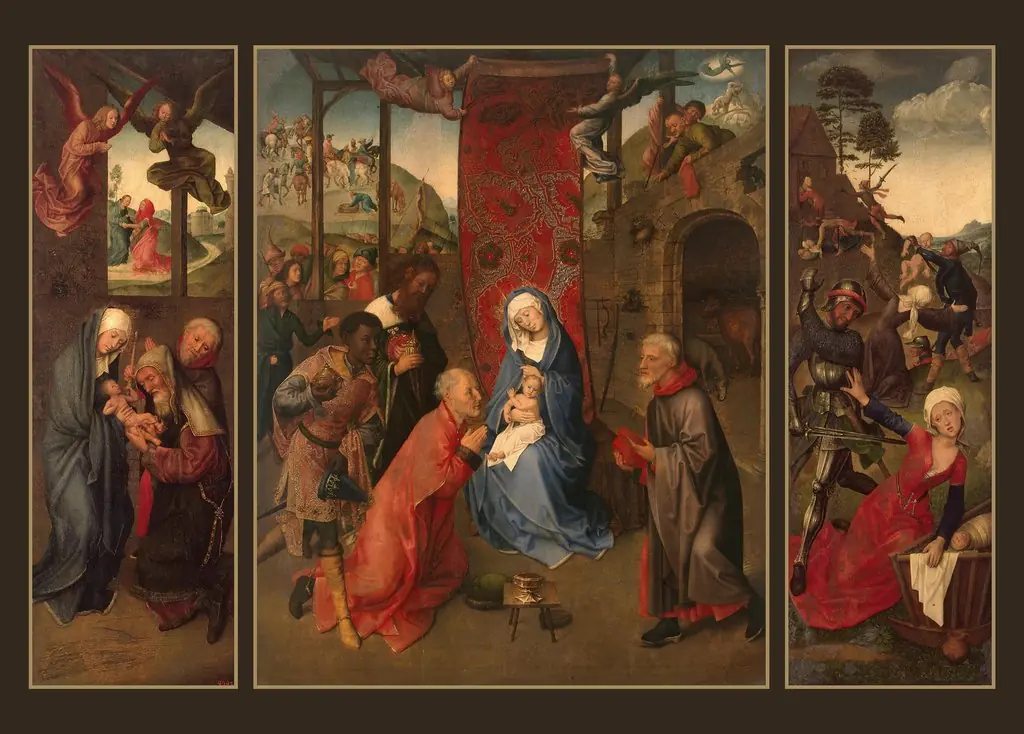 Adoration of the Magi (Triptych)
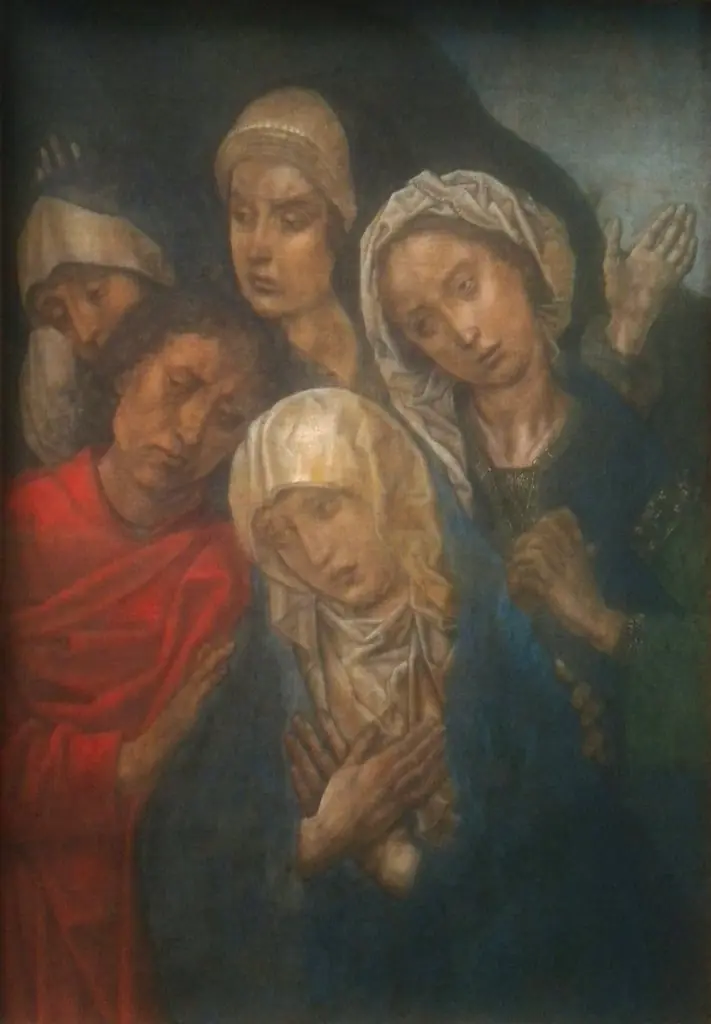 The Mourning of Christ
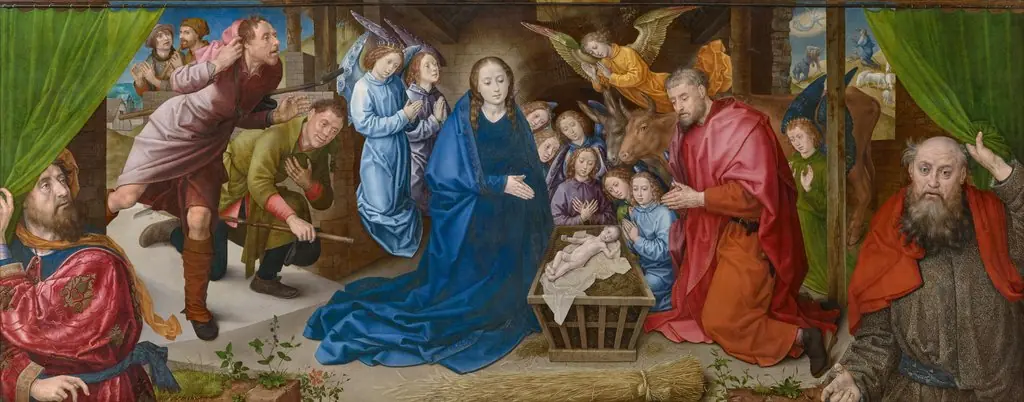 Adoration of the Shepherds
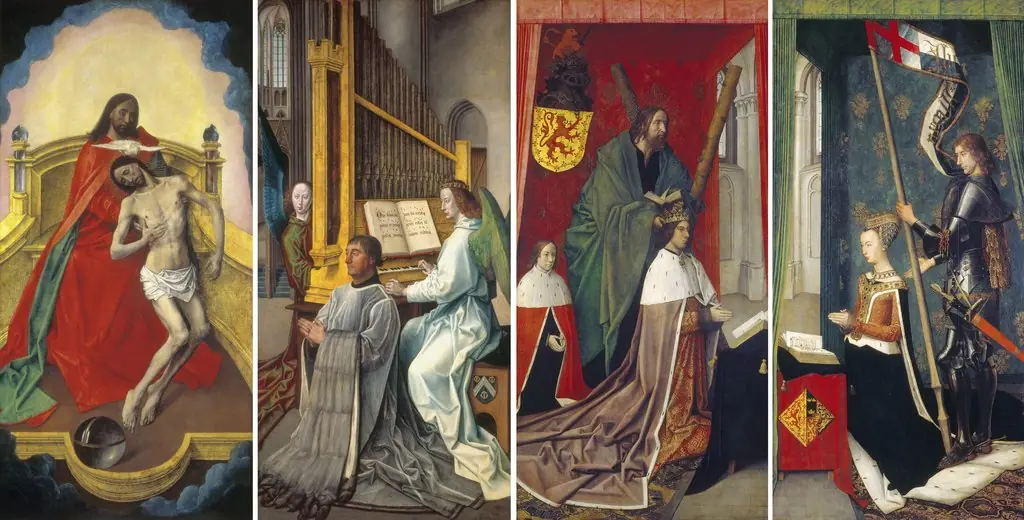 Trinity Altarpiece
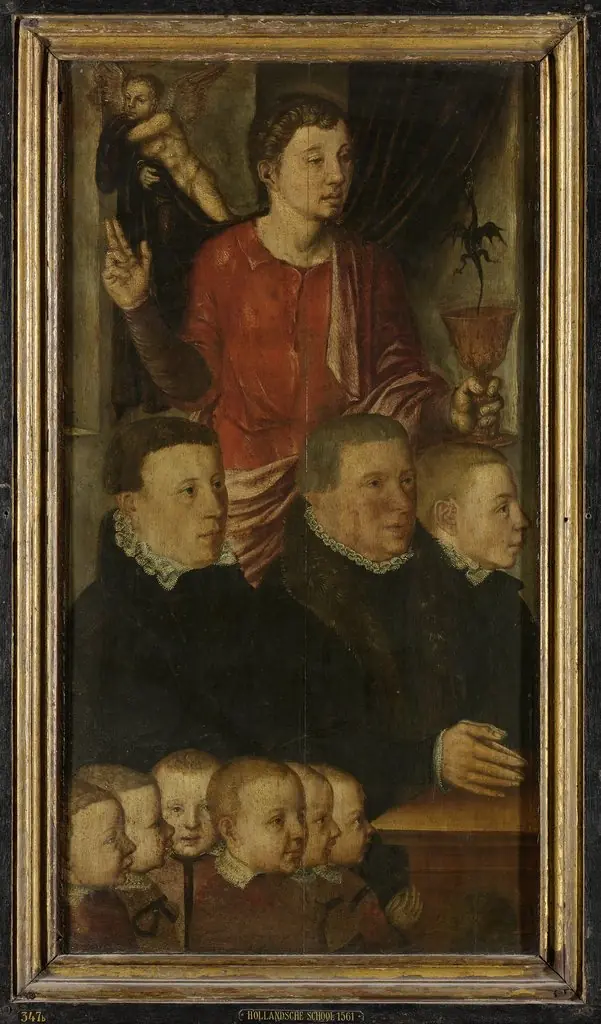 Left wing of a Memorial Triptych, formerly called the Gertz Memorial Triptych, with nine male Donor Portraits with Saint John the Evangelist (inner), and Saint Peter (outer)
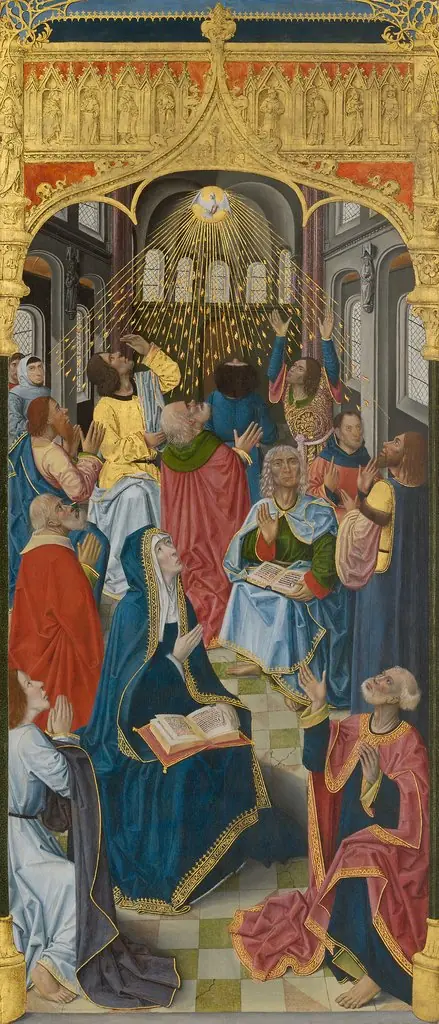 Panels from the High Altar of the Charterhouse of Saint-Honoré, Thuison-les-Abbeville: Pentecost
 The Ascension
 The Dormition of the Virgin
 The Life of Mary: the Assumption of Mary (verso: lower half of the Coronation of Mary)
 Death and Assumption of the Virgin Mary
 Altarpiece from Thuison-les-Abbeville: The Ascension
 Pentecost