Artwork
The Rope Dance
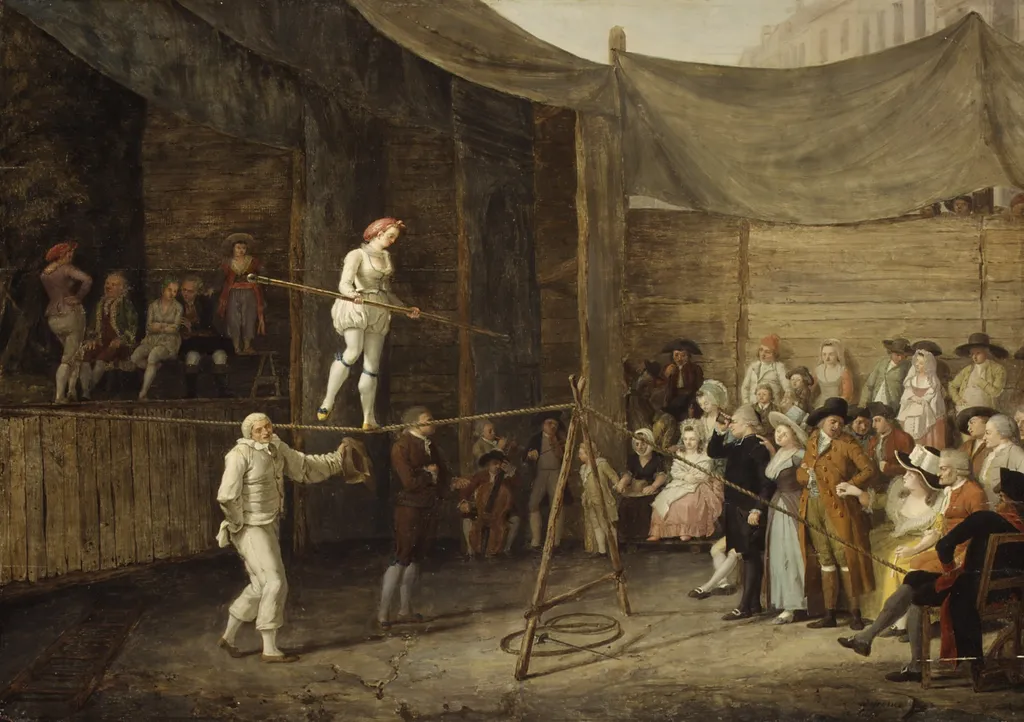
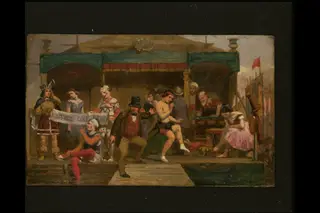
The Rope Dance is an oil painting by the Rococo painting artist Léonard Defrance. It dates from 1750 and is held in the collection of the Metropolitan Museum of Art.
About this work
A performer balances on a rope before a crowd in this oil-on-wood panel by the Liège painter Léonard Defrance, signed at lower right. The Metropolitan Museum of Art bought it in 1871 as part of its founding purchase. It had sold the year before at the Brussels estate sale of Baron de Heusch, fetching twice the price of a seventeenth-century Dutch genre scene beside it.
Subject & Meaning
The scene captures the social dynamic between performer and spectators, emphasizing the communal experience of theatrical entertainment.
The painting depicts a tightrope walking performance, a popular 18th-century public entertainment. A woman balances on the rope while a cellist plays, drawing the attention of a mixed-gender audience. Details such as a garter, shoe, and buckle hint at the performer's costume and the material culture of the spectacle.
The scene captures the social dynamic between performer and spectators, emphasizing the communal experience of theatrical entertainment. The work thus represents the festive and performative culture of the Enlightenment, celebrating both the skill of the dancer and the collective gaze of the audience.
Technique & Style
Executed in oil paint on a panel support, the painting measures 50.5 by 72.7 centimeters. The work is a genre scene depicting a performance featuring tightrope walking, with an audience of men and women, a musician playing a cello, and spectators. The composition includes details such as garters, shoes, and buckles, reflecting a detailed narrative approach typical of Léonard Defrance's style.
The use of oil on panel allowed for fine brushwork and nuanced rendering of figures and expressions, characteristic of the artist's meticulous handling. The condition and specific brushwork techniques are not detailed in available sources.
History & Provenance
Painted by Léonard Defrance in 1750, The Rope Dance was later owned by William T. Blodgett before entering the collection of the Metropolitan Museum of Art, where it remains. No further commission or ownership details are recorded in the available sources.
Overview
Léonard Defrance's painting, "The Rope Dance," executed in oil on a wood panel, captures a performer mid-act before an audience. This work exemplifies the artist's focus on scenes of daily life and popular entertainment within the Prince-Bishopric of Liège. Signed by Defrance, a Flemish painter born and active in Liège, the piece measures 50.5 by 72.7 centimeters.
It became part of the Metropolitan Museum of Art's collection in 1871, acquired as a foundational element of the institution.
Context
Léonard Defrance, a Flemish painter, received his artistic training under J. B. Coclers. His practice encompassed a range of subjects, including genre scenes, landscapes, and historical narratives, though he is particularly recognized for his depictions of everyday life. "The Rope Dance," rendered in oil on a wood panel, showcases his approach to genre painting, a field in which he meticulously observed and recorded the activities of his native Liège.
Own this work as a print
Artist & collection
Artist
Léonard Defrance (French pronunciation: ), born at Liège in 1735, was a scholar of J.