Artwork
Venus with a Mirror
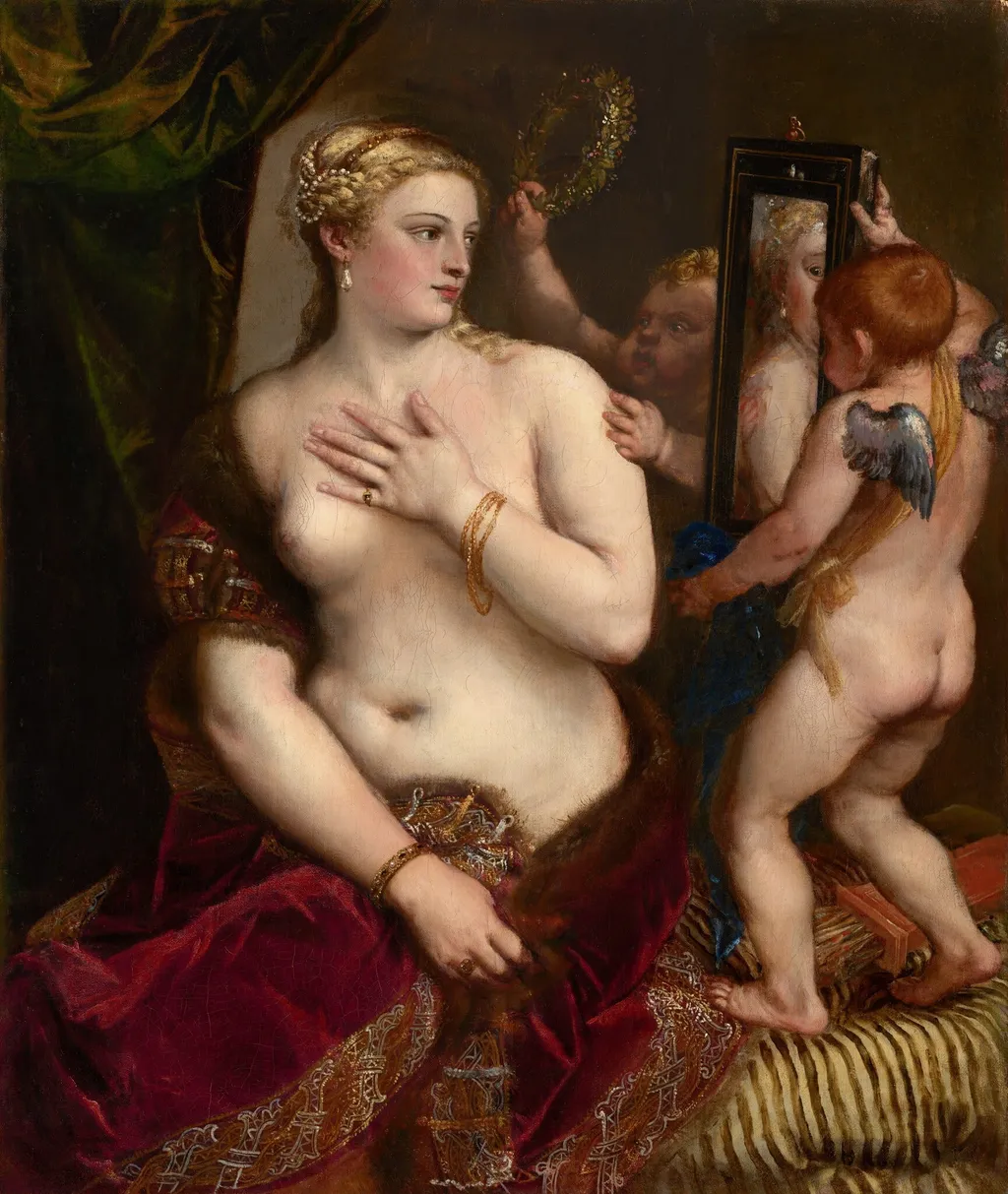
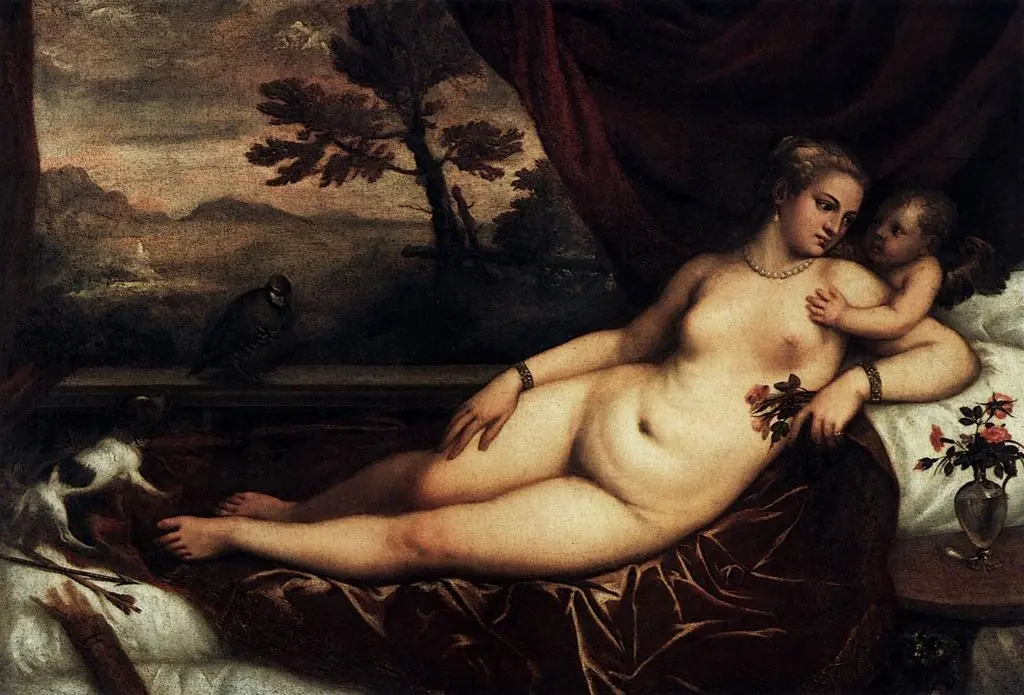
Venus with a Mirror is an oil painting by the High Renaissance artist Titian. It dates from 1555 and is held in the collection of the National Gallery of Art.
About this work
A winged Cupid steadies the glass as Venus appraises her reflection, her pale skin set against heavy crimson velvet and dark fur. Titian never sold the canvas, keeping it in his Venice studio until his death. It later reached the Hermitage before Andrew Mellon brought it to Washington in 1931.
Subject & Meaning
Her pose deliberately echoes classical "Venus Pudica" statues such as the Venus de' Medici, demonstrating Titian's study of ancient sculpture.
The painting depicts the goddess Venus at her toilet, admiring her reflection in a mirror held by a winged putto (Cupid). Her pose deliberately echoes classical "Venus Pudica" statues such as the Venus de' Medici, demonstrating Titian's study of ancient sculpture. The subject, a toilet of Venus scene, traditionally carries dual meanings: it can celebrate ideal feminine beauty or serve as a moralizing warning against vanity, and the Washington canvas may embrace both interpretations.
The mirror introduces the "Venus effect" of specular reflection, while accessories like pearls and fur symbolize purity and sensuality, enriching the iconography of self-regard and erotic allure.
Technique & Style
Titian executed Venus with a Mirror in oil on canvas, the standard medium of the Venetian school. X-radiography reveals a significant pentimento: the composition was painted over an abandoned double portrait, and the red cloak from the earlier work was retained and repositioned under Venus's arm. The pose adapts the classical “Venus Pudica” type, notably the Venus de’ Medici, which Titian encountered during his 1545–1546 Roman sojourn, a period he described as “learning from the marvelous ancient stones.”
The painting exemplifies the Venetian emphasis on colorito, with rich, warm flesh tones and deep reds that enhance the intimate toilette scene. The mirror and putto create a self-reflective, yet dynamic, visual interplay, while the overall handling balances naturalistic detail with a soft, painterly finish characteristic of Titian’s mature work.
History & Provenance
Created around 1555, Venus with a Mirror was not a commission but a studio piece Titian retained in his Venetian home. X-ray analysis reveals that Titian painted it over an earlier, abandoned double portrait. The painting remained with the artist until his death in 1576.
On 27 October 1581, his son Pomponio Vecellio sold it to Cristoforo Barbarigo. It then descended through the Barbarigo family until 1850, when it was purchased from the heirs by Czar Nicholas I of Russia and placed in the Imperial Hermitage Gallery. In April 1931, Andrew W. Mellon acquired it through a consortium of dealers (Matthiesen Gallery, Colnaghi, and Knoedler) and deeded it to his charitable trust on 5 June 1931. He donated it to the National Gallery of Art, Washington, in 1937.
Venus with a Mirror is held at the National Gallery of Art in Washington, D.C., where it is part of the Andrew W. Mellon collection (accession not specified in sources). The painting was deeded to the A.W. Mellon Educational and Charitable Trust in 1931 and gifted to the National Gallery in 1937. It was among the first masterpieces displayed at the museum upon its opening in 1941.
The work entered the Hermitage Museum in the 19th century and was sold by the Soviet government to Andrew Mellon in 1931, establishing its exhibition history as a highlight of both the Hermitage and National Gallery collections.
Context
Venus with a Mirror is considered one of the National Gallery of Art’s greatest treasures. Scholarly interpretations diverge, viewing the work as either a celebration of ideal feminine beauty or a moralizing critique of vanity. X-ray analysis has revealed that Titian painted over an abandoned double portrait, repurposing the red cloak from the earlier composition.
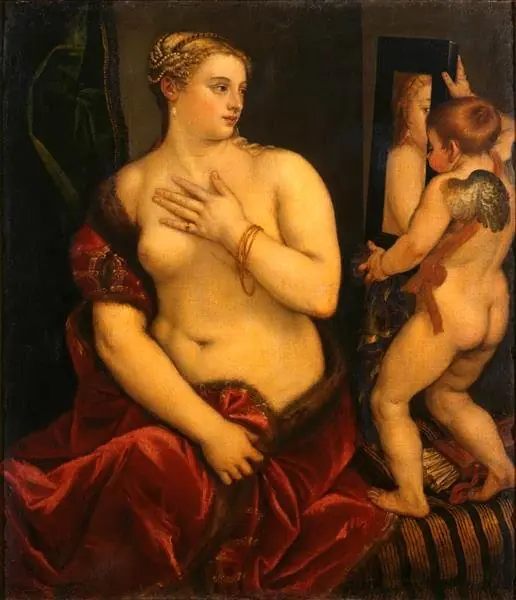
The figure’s pose directly recalls classical sculptures such as the Venus de' Medici, reflecting Titian’s study of ancient marbles. Art historians, including Stephan Poglayen-Neuwall (1934) and Peter Humfrey, have investigated the work’s dating and its relationship to lost autograph versions. The composition was widely disseminated through copies by Peter Paul Rubens and Anthony van Dyck, and it later served as inspiration for Leopold von Sacher-Masoch’s 1870 novel Venus in Furs.
Likely the only version entirely by Titian’s own hand, the painting remained in his studio for over two decades as a sample for visitors and students.
Legacy
Venus with a Mirror has had a lasting legacy. It was copied by later masters including Peter Paul Rubens and Anthony van Dyck, and its theme was adapted by Diego Velázquez. The painting inspired Leopold von Sacher-Masoch's 1870 novel Venus in Furs, in which the protagonist imagines the scene.
Sold to Andrew Mellon and donated to the U.S. government in 1937, it was among the first masterpieces displayed at the National Gallery of Art when it opened in 1941, where it remains a highlight of the collection.
Overview
Titian's Venus with a Mirror, painted around 1555, is an oil on canvas housed in the National Gallery of Art, Washington, DC. This work is notable as the earliest known depiction by the artist on this theme, and it is considered to be solely from Titian's hand, without the involvement of his studio assistants. The painter retained the canvas in his personal possession until his death, suggesting its particular significance to him.
Own this work as a print
Artist & collection

Artist
Tiziano Vecellio (Italian:; c. 1488/1490 – 27 August 1576), Latinized as Titianus, hence known in English as Titian ( TISH-ən), was an Italian Renaissance painter. The most important artist of Renaissance Venetian…