Artwork
Leda and the Swan
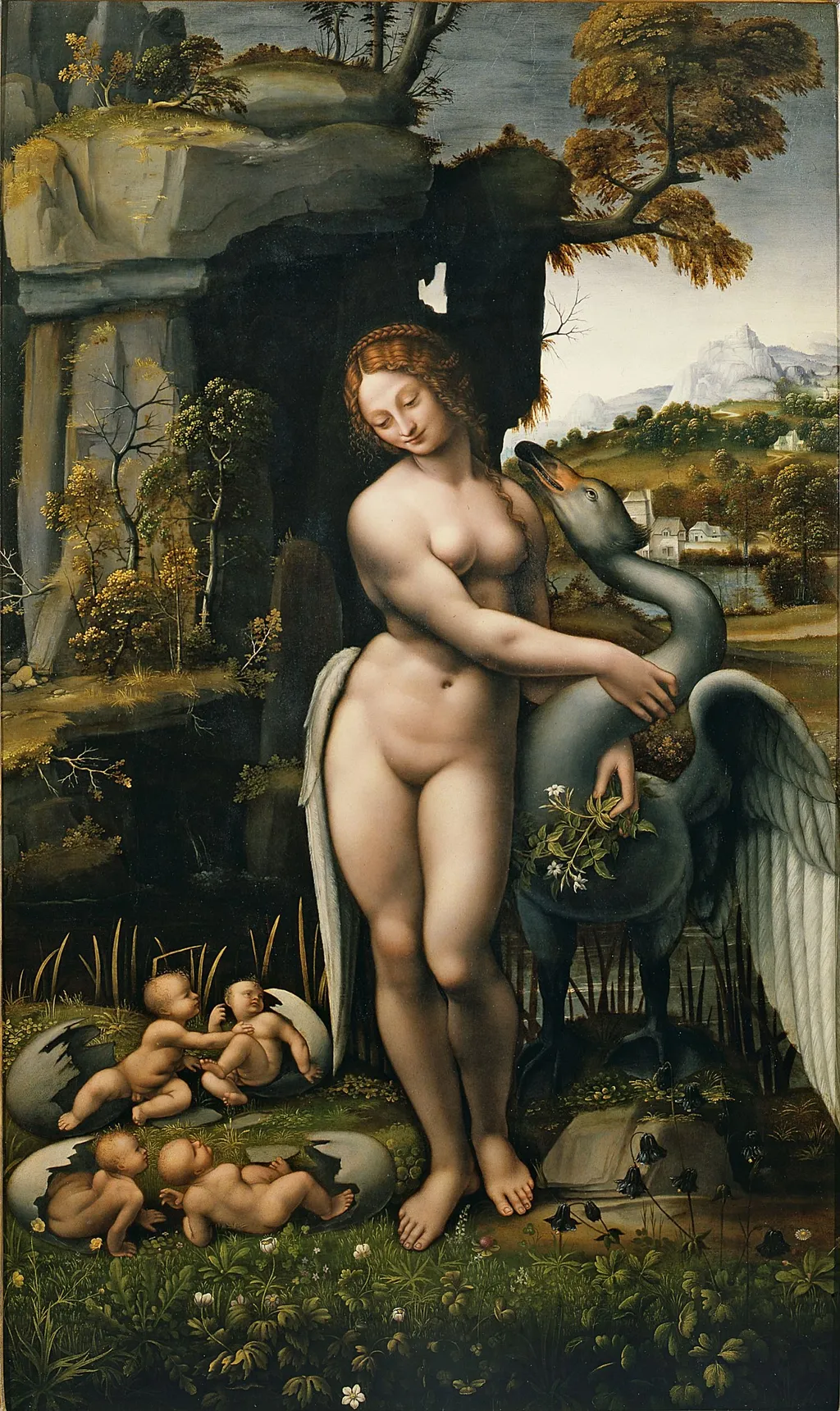
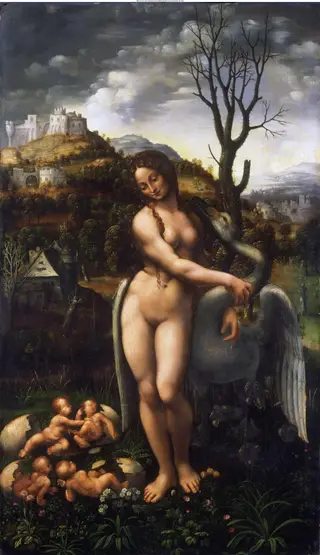
Leda and the Swan is an unspecified painting by the High Renaissance artist Leonardo da Vinci. It is held in the collection of the Uffizi Gallery.
About this work
Subject & Meaning
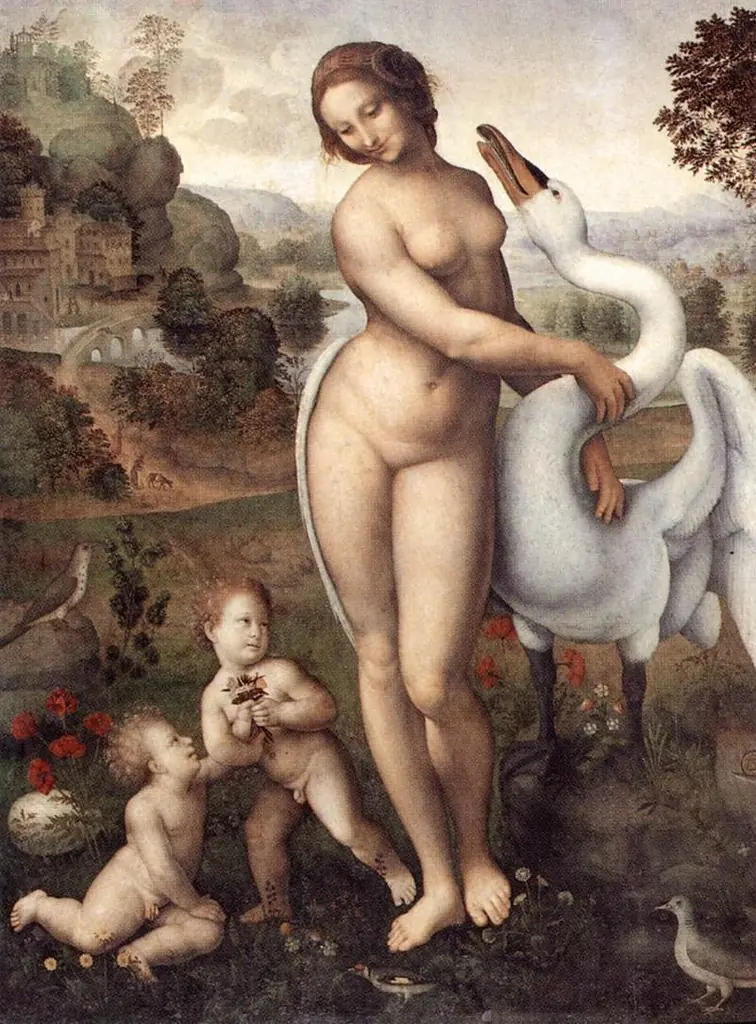
The work shows a richly detailed landscape with flora and a distant town, reflecting Leonardo's use of aerial perspective.
The painting depicts Leda, a nude woman embraced by a swan, which symbolizes Zeus in the guise of a bird. According to the myth, the swan's eggs hatch into Helen and Clytemnestra, as well as the Dioscuri Castor and Pollux. The work shows a richly detailed landscape with flora and a distant town, reflecting Leonardo's use of aerial perspective. The swan's head and mountains are rendered in near-invisible detail, typical of Leonardo's atmospheric effects.
Technique & Style
The Uffizi version of Leda and the Swan is executed in oil and resin on a wood panel, measuring 130 by 77.5 cm. It is regarded as one of the closest copies after Leonardo da Vinci's lost original, attributed to a Leonardesque painter, most often Francesco Melzi, with possible collaboration from Joos van Cleve on the landscape.
Stylistically, the composition places a sensual Leda embracing the swan, personification of Zeus, with a floral garland around the bird's neck and two eggs at her feet. Compared with other versions, the background is unusually rich, with detailed rendering of meadow grasses and flowers, a vegetation-covered cave, and a lake landscape with a small town. The treatment of the distant mountains, rendered almost invisible by mist to mark spatial depth, is characteristically Leonardesque and reflects the technique of aerial perspective.
History & Provenance
The Uffizi's Leda and the Swan is a copy of Leonardo da Vinci's lost original, dated to approximately 1505–1507. Art historical consensus attributes the work to Leonardo's student Francesco Melzi, likely executed at the end of his time in Milan before departing for France with the master, though Cesare da Sesto or Fernando Yáñez de la Almedina have also been proposed. While Bernard Berenson once argued for an autograph Leonardo, modern scholarship rejects this in favor of a student's hand, possibly with landscape assistance from Joos van Cleve.
The painting's provenance traces back to the Gualtieri Collection in L'Aquila. After passing through various private holdings, it was acquired from the Spiridon Collection in 1989 by the Uffizi Gallery in Florence.
The painting is held in the Galleria degli Uffizi in Florence, where it is known as the "Leda Spiridon" after its previous owner. It was acquired by the Uffizi in 1989 from the Spiridon Collection. The work's earlier provenance possibly includes the Gualtieri Collection in L'Aquila, and it passed through various other collections before reaching the Spiridon Collection.
The painting is sometimes associated with the Führermuseum and Munich Central Collecting Point in historical records, likely reflecting its movements during the mid-20th century. No specific exhibition history beyond its 1989 acquisition is detailed in the sources.
Context
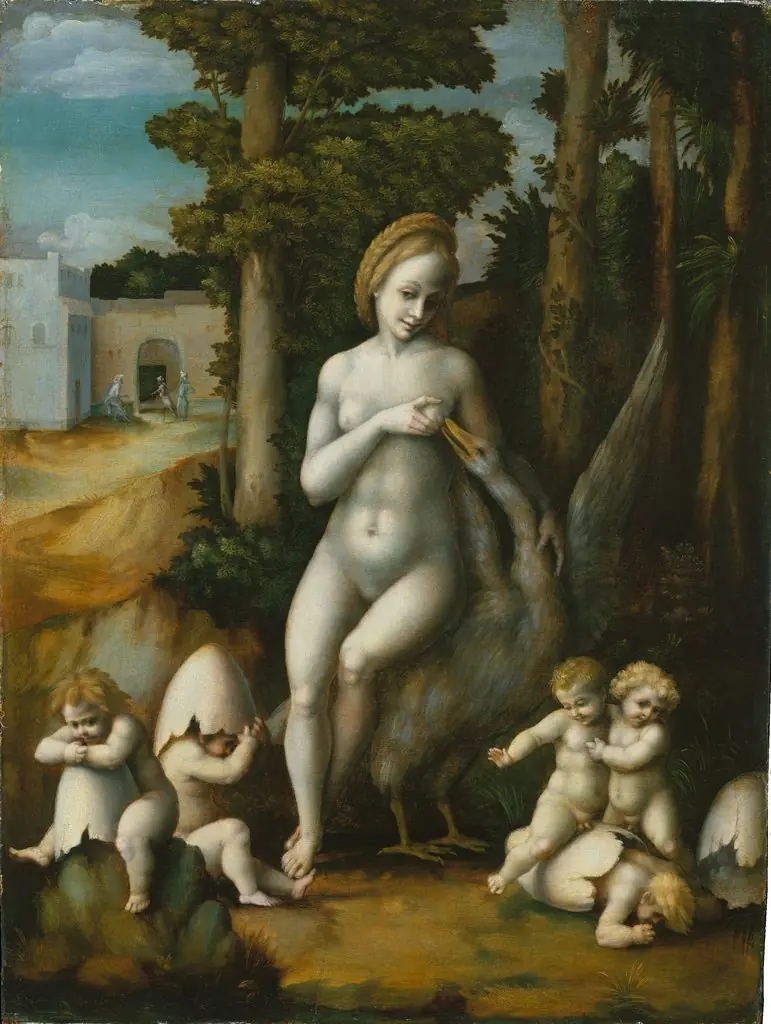
The Uffizi Leda and the Swan is regarded as one of the closest surviving copies after Leonardo da Vinci's lost original composition on the subject, alongside the versions in the Galleria Borghese in Rome and at Wilton House near Salisbury. Bernard Berenson argued that the Uffizi panel was an autograph work by Leonardo himself, but modern scholarship rejects this attribution, favoring instead one of Leonardo's pupils, most often Francesco Melzi (a view associated with Hoogewerff, 1952), with possible collaboration from Joos van Cleve on the landscape background. Other proposed authors include Cesare da Sesto and Fernando Yáñez de la Almedina, the latter identified as the "Ferrando Spagnuolo" who assisted Leonardo on The Battle of Anghiari in 1505.
The panel is generally dated to the end of Melzi's stay in Milan, before he departed for France with Leonardo. Leonardo specialist Frank Zöllner has suggested that Leonardo himself may have executed a full-scale cartoon of the composition from which pupils and collaborators later produced multiple variants; a large Leonardo cartoon of Leda and the Swan is documented in the Arconati collection in Milan in March 1671.
Legacy
The Uffizi panel is regarded as one of the closest surviving witnesses to Leonardo da Vinci's lost original, alongside the versions in the Galleria Borghese and Wilton House, and its unusually fine condition has been singled out as evidence of its extraordinary quality. Because the masterwork itself no longer survives, the work has shaped scholarly understanding of Leonardo's composition: Leonardo specialist Frank Zöllner has suggested that Leonardo may have produced a preparatory cartoon from which pupils and collaborators then generated multiple variants, a hypothesis supported by a 1671 record of a large-format Leonardo cartoon of Leda and the Swan in the Arconati collection in Milan. The painting's modern reputation has also been marked by shifting attributions, with Bernard Berenson once arguing it was autograph work by Leonardo, a view now generally rejected in favour of a pupil, most often Francesco Melzi, with possible collaboration from Joos van Cleve on the landscape.
The work entered the Uffizi in 1989 from the Spiridon Collection, a provenance that has led to its frequent designation as the "Leda Spiridon," and it remains a key reference point for studies of Leonardo's lost mythological compositions.
Overview
Created between roughly 1505 and 1507, this panel work combines oil paint with resin, a medium choice that enhances the surface’s depth and luminosity. Executed by an artist associated with Leonardo da Vinci’s workshop, the composition depicts the classical myth of Leda and the swan, a subject frequently revisited by Renaissance painters.
Artist & collection

![Ginevra de' Benci [obverse], by Leonardo da Vinci](https://artifactworldgallery.com/img/leonardo-da-vinci--ginevra-de-benci-obverse--afb6ec3a3e65f392-w320.webp)
![Wreath of Laurel, Palm, and Juniper with a Scroll inscribed Virtutem Forma Decorat [reverse], by Leonardo da Vinci](https://artifactworldgallery.com/img/leonardo-da-vinci--wreath-of-laurel-palm-and-juniper-with-a-scroll-inscribed-vi--4cdfe8467ad2438a-w320.webp)