Artwork
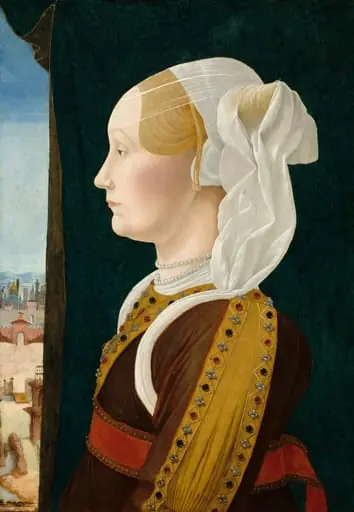
Ginevra de' Benci [obverse]
![Ginevra de' Benci [obverse], by Leonardo da Vinci, oil, 1476](https://artifactworldgallery.com/img/leonardo-da-vinci--ginevra-de-benci-obverse--afb6ec3a3e65f392-w1024.webp)
Ginevra de' Benci [obverse] is an oil painting by the Early Renaissance artist Leonardo da Vinci. It dates from 1476 and is held in the collection of the National Gallery of Art.
About this work
Subject & Meaning
The portrait depicts Ginevra de' Benci, a Florentine aristocrat, likely painted between 1474 and 1478 to commemorate her betrothal or marriage.
The portrait depicts Ginevra de' Benci, a Florentine aristocrat, likely painted between 1474 and 1478 to commemorate her betrothal or marriage. The subject is framed by a juniper bush, which serves as a visual pun on her name via the Italian word 'ginepro' and symbolizes female virtue. The reverse of the panel features a wreath of laurel and palm encircling a juniper sprig alongside the motto 'Virtutem Forma Decorat' ('Beauty adorns virtue'), highlighting the connection between her physical appearance and moral character.
These elements, particularly the laurel and palm, are associated with the personal emblem of Bernardo Bembo, a Venetian ambassador who shared a celebrated platonic relationship with Ginevra. Technical analysis reveals Bembo's original motto, 'Virtue and Honor,' was painted over, suggesting his involvement in the commission. The sitter's austere expression and lack of a smile reflect the static, reserved tradition of early Renaissance portraiture.
History & Provenance
The portrait Ginevra de' Benci [obverse] is housed in the National Gallery of Art, Washington, D.C. It entered the Gallery’s collection on 10 February 1967 after being purchased from Prince Franz Joseph II of Liechtenstein for a record price of $5–6 million. The work is listed in the Gallery’s collection and has been on continuous public display since acquisition, constituting the only Leonardo painting viewable in the Americas. Its exhibition history therefore consists of its permanent placement in the Gallery’s Leonardo collection and inclusion in special Leonardo retrospectives at the National Gallery of Art.
Context
Recognized as Leonardo da Vinci's earliest surviving portrait, the work marks a pivotal shift toward naturalism through its early adoption of oil paint and sfumato technique. Scholarship identifies strong influences from Leonardo's master, Andrea del Verrocchio, and Flemish primitives like Hans Memling, particularly in the rendering of light and landscape. While initially interpreted as a wedding portrait, art historian Jennifer Fletcher's 1989 analysis of the reverse emblem recontextualized the commission as a tribute to Ginevra's platonic relationship with Venetian ambassador Bernardo Bembo.
The painting holds a unique position in art history as the only Leonardo on public view in the Americas, following its record-breaking acquisition by the National Gallery of Art in 1967. Critics note the subject's austere demeanor and monumental presence, distinguishing it from the later psychological complexity of the Mona Lisa while establishing foundational elements of High Renaissance portraiture.
Legacy
Since its acquisition by the National Gallery of Art, Washington, in 1967 for a then-record price of about $5–6 million, Leonardo’s Ginevra de’ Benci has been celebrated as the sole autograph work by the master in the Americas and a touchstone of Renaissance portraiture. Scholars such as David Alan Brown have positioned it at the forefront of Leonardo’s early experiments with oil technique and psychological presence, influencing later Florentine and Venetian portrait traditions. Its iconography, juniper, laurel, palm and the motto Virtutem Forma Decorat, has been repeatedly cited in studies of Renaissance symbolism, while the lost lower portion and reconstructed hands have prompted technical and compositional analyses that continue to shape Leonardo scholarship.
The portrait’s prominence in exhibitions and scholarly literature has cemented its status as a canonical example of fifteenth-century female portraiture and a key reference in discussions of Leonardo’s evolving style.
Overview
This oil on panel painting depicts Ginevra de' Benci, a young Florentine noblewoman from the 15th century, rendered by Leonardo da Vinci. It holds the distinction of being the sole work by the artist accessible for public viewing in the Americas, housed within the collection of the National Gallery of Art in Washington, D.C. The portrait captures a contemplative expression, characteristic of the period's artistic developments.
Technique & Style
Leonardo da Vinci's approach to this portrait exemplifies elements of Florentine Renaissance art. The artist rendered the intricate textures of Ginevra's garments and the surrounding botanical elements with considerable precision. This detailed execution, particularly in the depiction of natural forms, reflects the period's growing interest in realism and observation, contributing to the painting's overall refined aesthetic and depth.
Own this work as a print
Artist & collection

![Wreath of Laurel, Palm, and Juniper with a Scroll inscribed Virtutem Forma Decorat [reverse], by Leonardo da Vinci](https://artifactworldgallery.com/img/leonardo-da-vinci--wreath-of-laurel-palm-and-juniper-with-a-scroll-inscribed-vi--4cdfe8467ad2438a-w320.webp)