Artwork
Benois Madonna
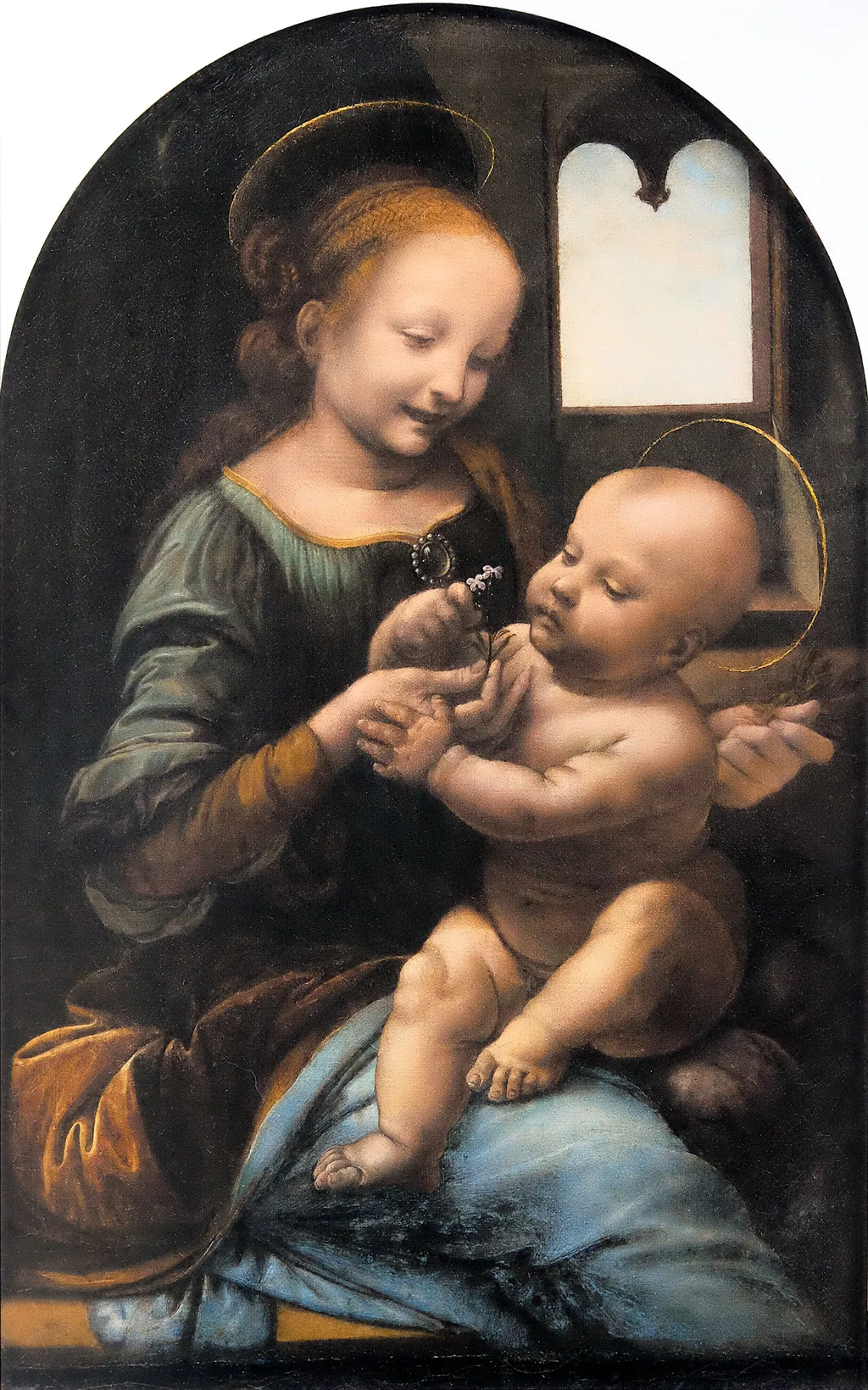
Benois Madonna is an oil painting by the Early Renaissance artist Leonardo da Vinci. It is held in the collection of the Hermitage Museum.
About this work
Subject & Meaning
Both figures have delicately gilded haloes, and a double‑arched window in the dark interior reveals a pale blue sky.
The Benois Madonna shows the Virgin Mary seated on a bench with the Christ Child outstretched on her lap; she wears an olive and brown garment with blue underwear covering her knees, while the child grasps a cruciform sprig of flowers that she holds. Both figures have delicately gilded haloes, and a double‑arched window in the dark interior reveals a pale blue sky. The flowering sprig, shaped like a cross, serves as a symbol of the future crucifixion, and Leonardo linked it to his exploration of sight versus insight, noting that the child cannot yet see the cruciform shape clearly, foreshadowing his eventual understanding of sacrifice.
Despite this solemn motif, the Virgin is depicted as joyous and youthful, appearing to speak or laugh while playfully engaging with the child, and the child’s attempt to seize the flower like a toy underscores his innocence.
Technique & Style
The Benois Madonna is a small oil-on-panel painting executed between 1478 and 1480, now transferred to canvas, measuring approximately 49.5 cm in height and 33 cm in width. Executed in oil paint, the work features delicate sfumato transitions and a restrained palette dominated by earthy browns and olive greens, enlivened by the Virgin’s blue undergarment and the Christ Child’s pink flesh tones. Stylistically, Leonardo emphasizes naturalistic interaction and psychological engagement: the Virgin’s lively, rounded face and animated posture contrast with the Child’s tentative grasp of a cruciform flower sprig, a motif read as prefiguring the Crucifixion.
The composition is organized around a central vertical axis formed by the flower, with light modeled softly across forms to suggest three-dimensionality. The background’s dark interior opens through a double-arched window to a narrow glimpse of sky, focusing attention on the figures. Some areas, such as the window, the Virgin’s neck, and her mouth, show pentimenti and later repaints, indicating unfinished passages and subsequent restorations.
History & Provenance
Likely Leonardo da Vinci's first independent work, the Benois Madonna was begun in October 1478 and completed circa 1480. Presumed lost for centuries, the painting resurfaced in Russia during the 1790s in the collection of General Aleksei Ivanovich Korsakov. Following his death, his son sold it for 1,400 roubles to merchant Alexander Petrovich Sapozhnikov.
It passed to Sapozhnikov's son and subsequently to his daughter Maria, who married architect Leon Benois, bringing the work into the Benois family inheritance. Exhibited publicly in Saint Petersburg in 1909, the piece faced attribution doubts from critics like Bernard Berenson before curator Ernst Friedrich von Liphart identified it as authentic. Despite these controversies, Tsar Nicholas II purchased the painting for the Imperial Hermitage Museum in 1914 for a record sum, with payments continuing through the 1917 Revolution. The work has remained in the Hermitage collection since.
The Benois Madonna is held in the State Hermitage Museum, Saint Petersburg, inventoried as ГЭ-235 (Hermitage catalogue number). After entering Russian ownership in the late 18th century, it was transferred from panel to canvas and has remained in the Hermitage’s collection since its acquisition in 1914. The painting was first publicly exhibited in 1909 in Saint Petersburg as part of the Benois family collection and again in 1908 at the Starye Gody exhibition. It has been on continuous display in the Hermitage since 1914.
Context
The Benois Madonna is widely regarded as one of Leonardo da Vinci's earliest independent works, likely begun in October 1478 alongside the Madonna of the Carnation. Scholars identify it as a pivotal piece of the Early Renaissance that explores the interplay of sight and perspective, with the Christ Child guiding his mother's hand toward a cruciform flower symbolizing the future Crucifixion. Although initially dismissed by Bernard Berenson for its perceived imperfections, such as a high forehead and furrowed throat, the work gained critical acclaim after its 1909 rediscovery and attribution by Ernst Friedrich von Liphart.
Its historical significance is underscored by its influence on younger masters, notably Raphael, who reportedly modeled his Madonna of the Pinks on this composition. The painting represents a joyous, youthful departure from solemn Marian iconography, establishing Leonardo's mature interest in psychological interaction and naturalism.
Legacy
The Benois Madonna became a reference point for later artists, especially Raphael, who adapted its composition in works such as the Madonna of the Pinks, demonstrating its immediate impact on Renaissance painting. After being rediscovered in a 1909 St Petersburg exhibition, the work entered the Hermitage collection in 1914, securing its place in museum narratives and scholarly discussion. Contemporary critics, including Bernard Berenson, acknowledged its authorship despite earlier doubts, and the painting’s provenance, marked by a series of ownership changes and a record‑breaking purchase, enhanced its reputation.
Its symbolic use of a flowering sprig as a cruciform motif has been cited in studies of Leonardo’s exploration of sight and foresight, cementing its lasting influence on interpretations of Marian imagery.
Overview
The painting known as the Benois Madonna, or Madonna and Child with Flowers, is an early work by the Italian Renaissance artist Leonardo da Vinci. Executed in oil paint between approximately 1478 and 1480, this piece is housed in the Hermitage Museum in Saint Petersburg. It depicts a tender moment between the Virgin Mary and the Christ Child, showcasing Leonardo's developing artistic approach to religious subjects.
Own this work as a print
Artist & collection

![Ginevra de' Benci [obverse], by Leonardo da Vinci](https://artifactworldgallery.com/img/leonardo-da-vinci--ginevra-de-benci-obverse--afb6ec3a3e65f392-w320.webp)
![Wreath of Laurel, Palm, and Juniper with a Scroll inscribed Virtutem Forma Decorat [reverse], by Leonardo da Vinci](https://artifactworldgallery.com/img/leonardo-da-vinci--wreath-of-laurel-palm-and-juniper-with-a-scroll-inscribed-vi--4cdfe8467ad2438a-w320.webp)
- Maria mit Kind
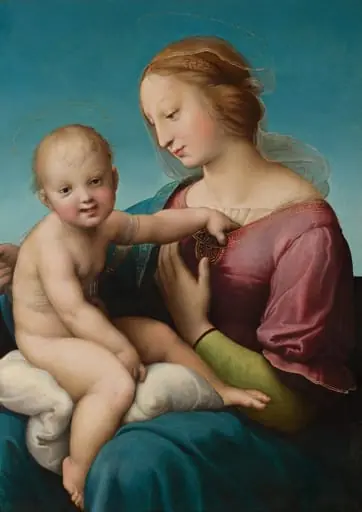 The Niccolini-Cowper Madonna
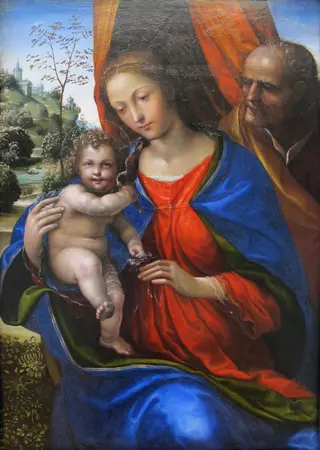 The Holy Family
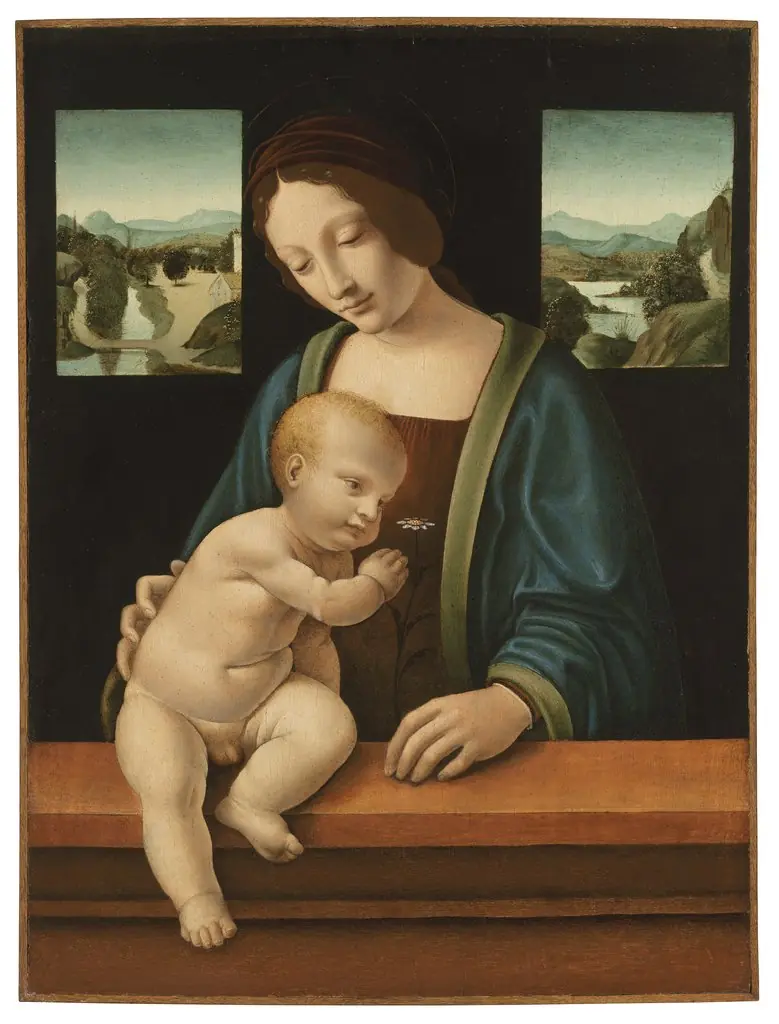 Madonna and Child
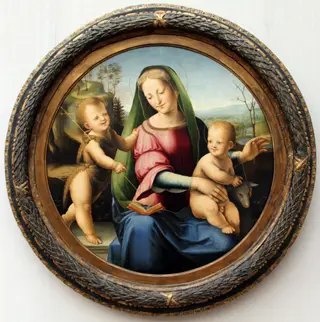 Maria mit dem Kind und dem Johannesknaben
 Virgin and Child with the Young Saint John the Baptist, Saint Cecilia, and Angels
 Tempi Madonna
 Madona cu pruncul
 Madonna and Child
 Madonna with Child, Saint Elizabeth and Saint John
 Virgin and Child
 Solly Madonna