Artwork
Portrait of a Young Man with a Lamp
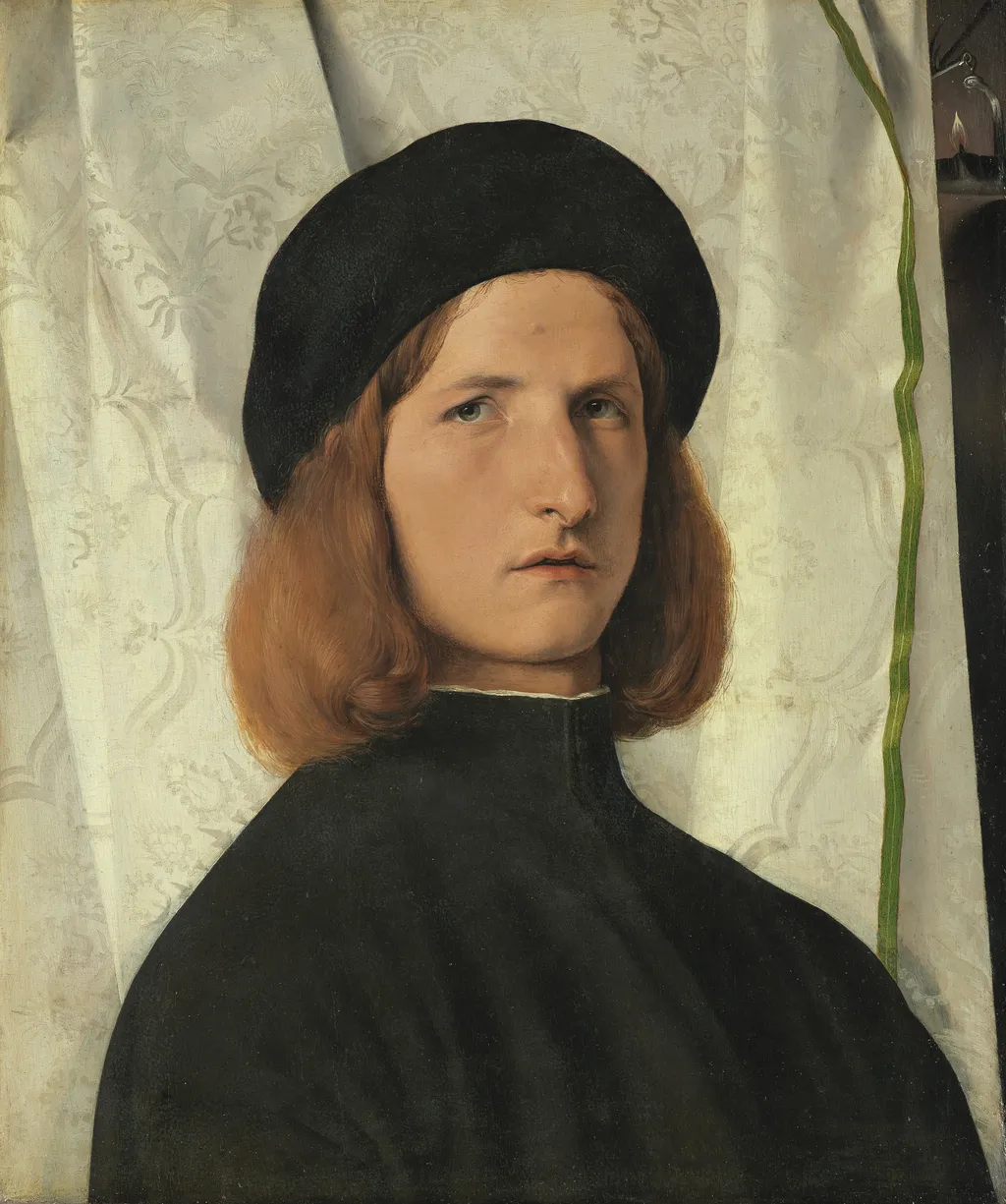
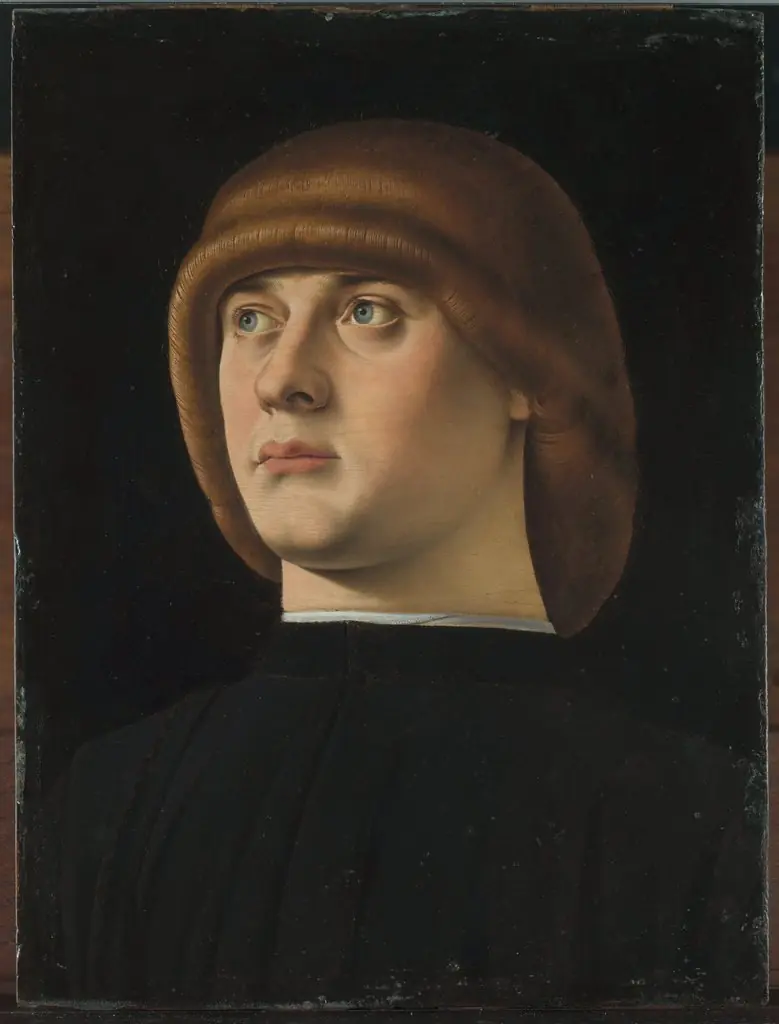
Portrait of a Young Man with a Lamp is an oil painting by the High Renaissance artist Lorenzo Lotto. It dates from 1508 and is held in the collection of the Kunsthistorisches Museum.
About this work
A quiet oil painting from 1508 shows a young man lit by a lamp. Lorenzo Lotto used oil paint to capture the moment in rich color. The work hangs in the Kunsthistorisches Museum.
Painting portraits this way was new. Lotto’s soft lighting makes the face glow against the dark background. It feels personal and alive.
Look up the museum next.
Overview
The Portrait of a Young Man with a Lamp (Italian: Ritratto di giovane con lucerna) is an oil-on-panel painting by the Italian High Renaissance master Lorenzo Lotto, dated to approximately 1506 and housed in the Kunsthistorisches Museum, Vienna. Measuring 42.8 by 35.3 centimeters, this intimate bust-length portrait exemplifies Lotto's pioneering role in developing the psychological portrait during the early sixteenth century. The work is generally assigned to the artist's Trevisan period and was acquired by the Viennese museum in 1816, where it remains a significant example of Lotto's early portraiture.
Subject & Meaning
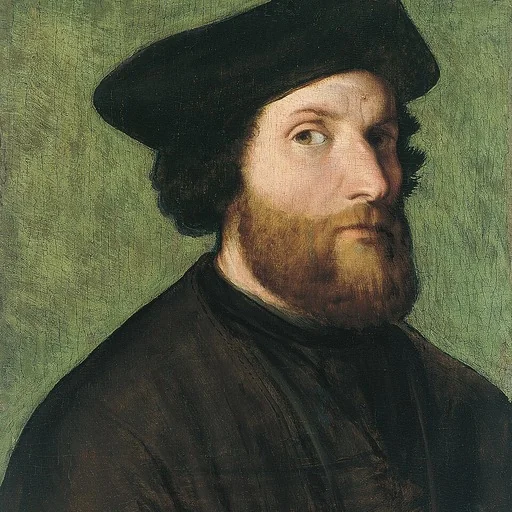
The painting depicts a young man shown in three-quarter view, his gaze directed upward and slightly to his left with an expression that has been described as contemplative, almost suspicious. He wears a dark rounded beret and black garments with a high fitted collar and thin white band at the neck, his light brown hair falling in waves to his shoulders. The most distinctive feature is the small burning lamp visible through a narrow opening in the pale patterned curtain at the right edge, its flame descending with a green cord or stem. This lamp has generated extensive symbolic interpretation: it has been read as an allusion to the Gospel of John, "lux in tenebris" (John 1:5), representing wisdom or divine light; as an emblem of the fragility and brevity of human life, suggested by the dimness of the flame; and as a reference to the parable of the wise virgins. The curtain itself carries iconographic weight, deriving from devotional painting where the velum served to veil or reveal, with Lotto's partial disclosure creating an atmosphere of enigma.
Technique & Style
Executed in oil on panel, the painting displays the smooth, highly finished brushwork characteristic of Lotto's early period, with particular care in rendering flesh tones and the subtle texture of hair. The palette is restrained, dominated by blacks, warm browns, and muted creams, with light falling evenly across the face to model the cheeks, nose, and brow through soft shadows. The surface shows fine craquelure throughout. Scholars have noted the influence of Giovanni Bellini in the traditional aesthetic of imitation, while the faithful rendering of empirical detail, especially the powerful nose and searching grey-brown eyes under a slightly knitted brow, recalls Antonello da Messina's Netherlandish-derived precision. The composition is intimate and frontal, the figure occupying most of the frame, with the descending curve of the shoulders and the incidence of light on the face linking it to Lotto's other early works, particularly the Portrait of Bishop Bernardo de' Rossi of 1505.
History & Provenance
The work is firmly associated with Lotto's stay in Treviso, a period that marked significant development in his portraiture.
The work is firmly associated with Lotto's stay in Treviso, a period that marked significant development in his portraiture. The painting entered the collection of the Kunsthistorisches Museum in Vienna in 1816, where it remains today. While specific details of its ownership prior to museum acquisition are not recorded in the available sources, its institutional home for over two centuries has ensured its place in the canon of Renaissance portraiture. The dating of the work has been subject to scholarly discussion: while most sources place it around 1506, some critics, noting stylistic and morphological similarities to figures in the Recanati polyptych, have suggested a date closer to 1508.
Context
Lorenzo Lotto, born in Venice but peripatetic throughout his career, has increasingly been recognized as a foundational figure in Renaissance psychological portraiture. The identification of the sitter has been a major focus of scholarship. A prominent hypothesis identifies him as Broccardo Malchiostro, the young chancellor of Bishop Bernardo de' Rossi of Treviso, who together with his patron had survived a conspiracy in 1503. This identification rests partly on a visual pun: the drapery behind the sitter, described variously as brocade or damask, bears a pattern that has been read as carduus (thistle), yielding "broccato-cardo" or "Broccardo." Such emblematic wordplay is consistent with Lotto's mature practice, as seen in the Portrait of Lucina Brembati. However, recent scholarship has questioned this identification, noting that the fabric appears closer to damask than brocade, which undermines the linguistic basis for the hypothesis. The painting's critical reception has emphasized its element of disquiet, the way in which Lotto presents the viewer with enigma rather than disclosure, making it a key work for understanding his approach to portraiture as a medium of psychological complexity.
Legacy
The Portrait of a Young Man with a Lamp occupies a significant position in the historiography of Renaissance portraiture as an early demonstration of Lotto's distinctive contribution to the genre. The work has entered broader cultural consciousness through its inclusion in the "imaginary museum" of the French historian Paul Veyne, who featured it in his book Mon musée imaginaire. Its influence can be traced in the way subsequent scholars have come to understand Lotto as, in the formulation of the Web Gallery of Art, "the true inventor of the Renaissance psychological portrait," a status argued with particular reference to this canvas. The painting's combination of empirical observation, symbolic density, and psychological ambiguity established a model that informed not only Lotto's own mature portraits but also broader developments in European portraiture. Its residence in the Kunsthistorisches Museum has made it accessible to generations of scholars and visitors, securing its place in the permanent canon of Western art.
Own this work as a print
Artist & collection
Artist
Lorenzo Lotto (c. 1480 – 1556/57) was an Italian Renaissance painter, draughtsman, and illustrator, traditionally placed in the Venetian school, though much of his career was spent in other north Italian cities. He…