Artwork
The Three Graces
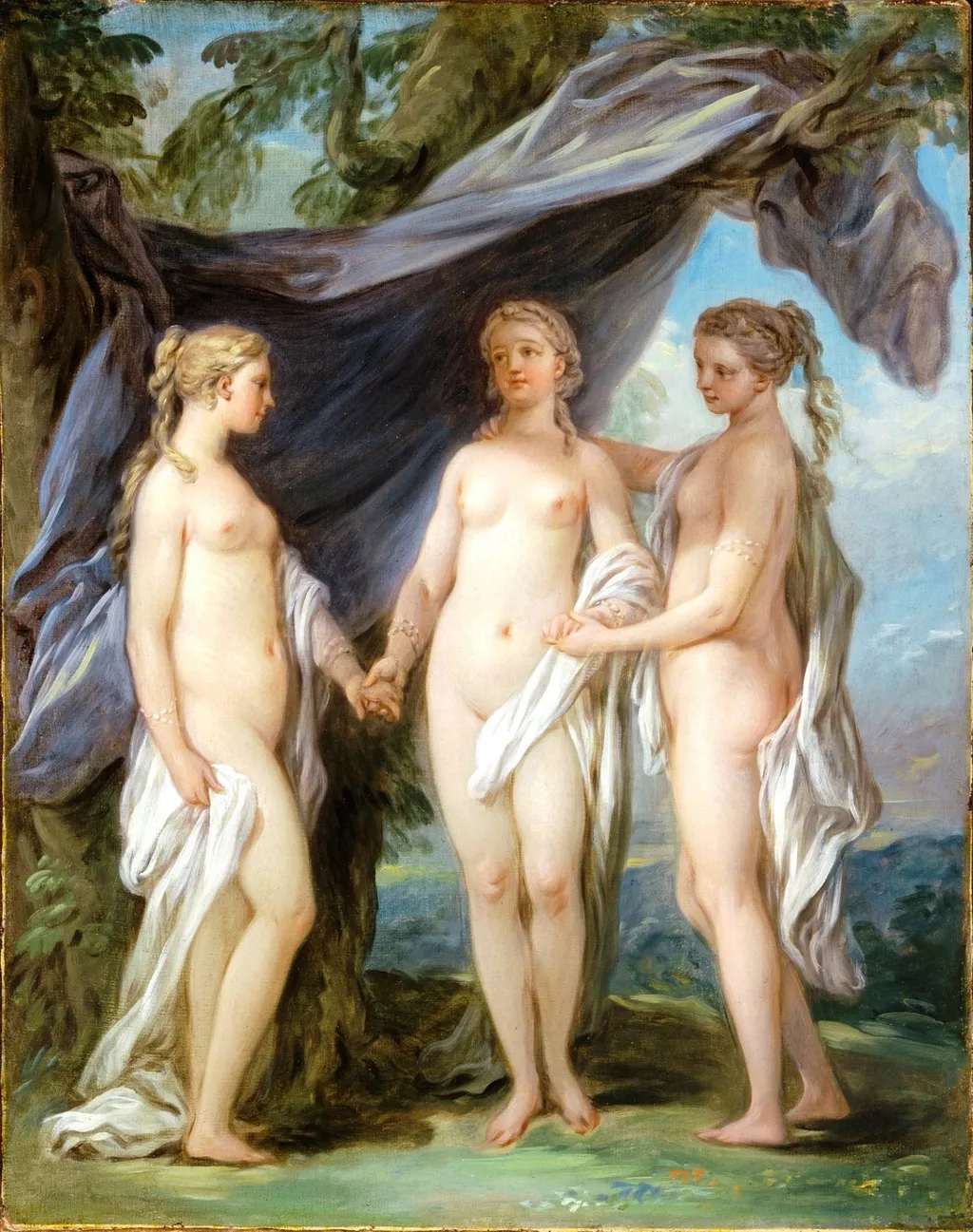
The Three Graces is an oil painting by the Baroque artist Louis-Michel van Loo. It dates from 1763 and is held in the collection of the Los Angeles County Museum of Art.
About this work
Subject & Meaning
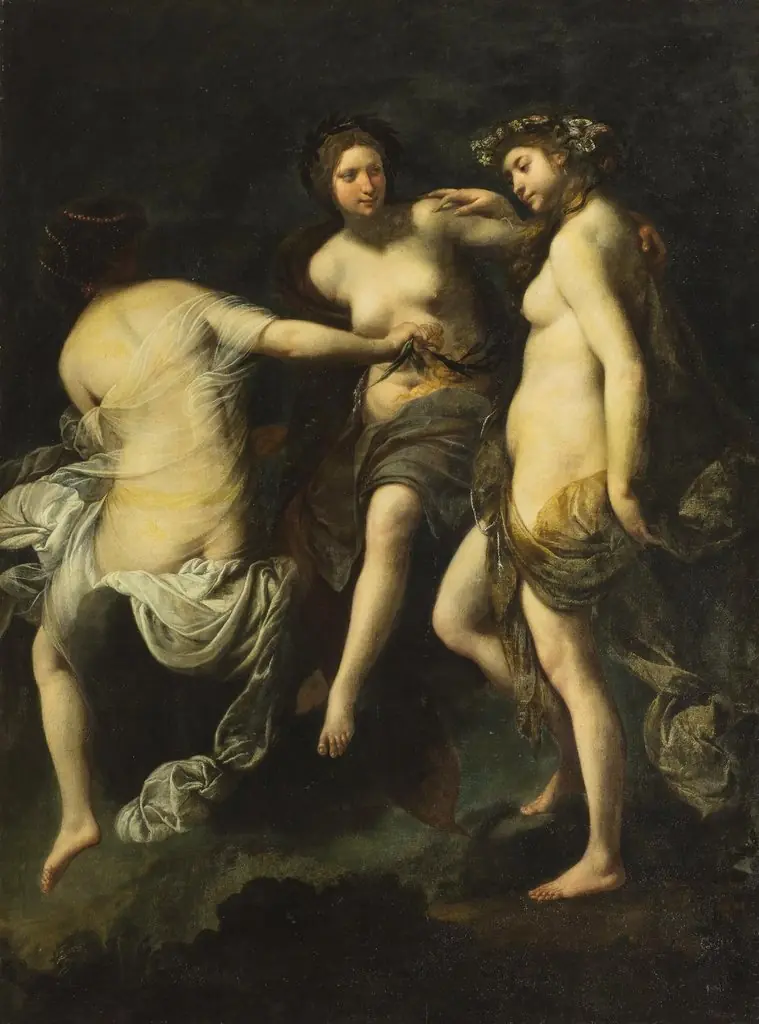
In this 1763 work, the three figures are shown practically nude, holding hands in a semicircle beneath a tree draped with a large cloth for partial coverage.
The painting depicts the Charites, or Graces, mythological daughters of Zeus and Eurinome (or Hera) who originally personified vegetation before becoming deities of beauty. These figures, Euphrosyne, Thalia, and Aglaia, symbolize the agreeable aspects of life that bring joy to both gods and humans, a concept rooted in ancient tradition and later equated by Christian art with chastity, beauty, and love. In this 1763 work, the three figures are shown practically nude, holding hands in a semicircle beneath a tree draped with a large cloth for partial coverage.
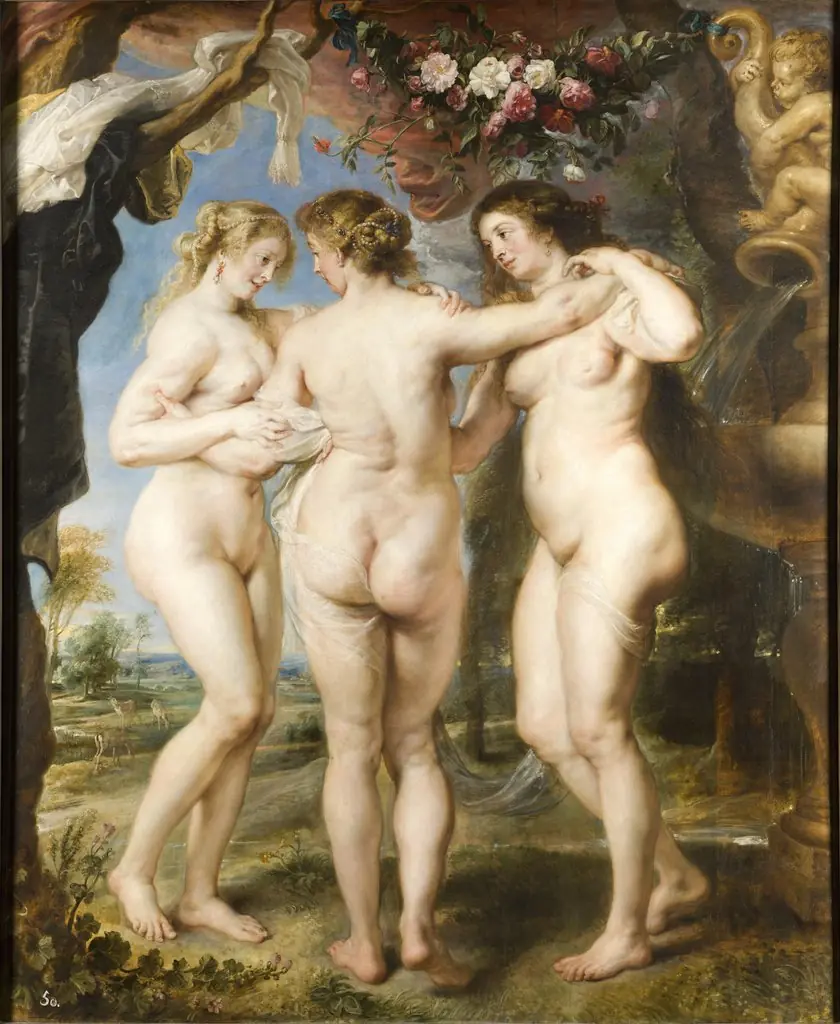
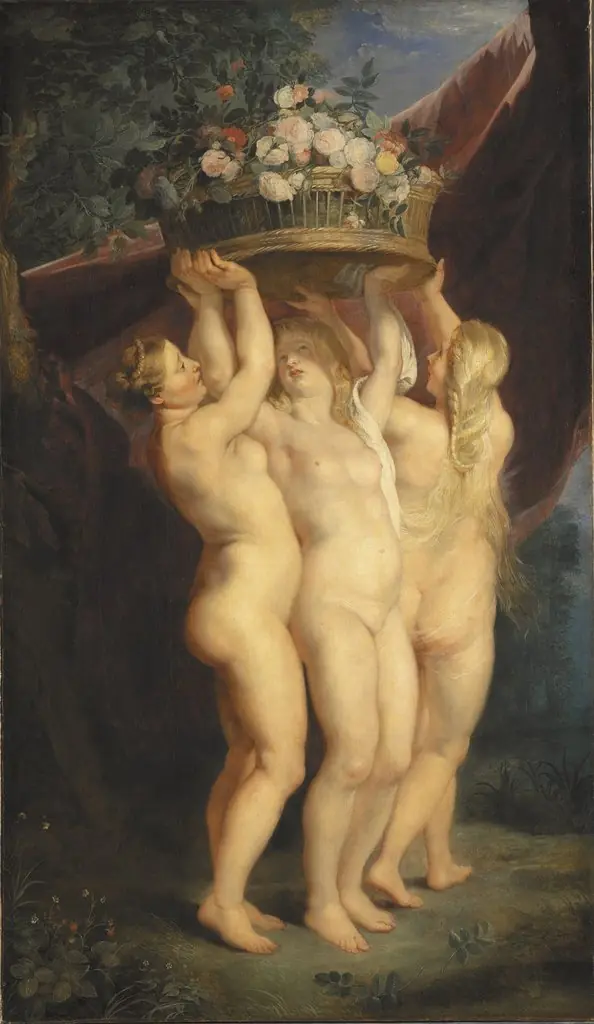
Their arrangement, with two gazing in one direction and the third looking oppositely, embodies the aesthetic beauty standards of the era while serving as a vehicle to display the female form within a society that was generally intolerant of such nudity. The composition draws upon a long artistic lineage, referencing earlier treatments by masters such as Rubens and Raphael.
Technique & Style
The painting is executed in oil paint on canvas, a standard support for mid-eighteenth-century French academic practice []. Its modest scale, approximately 23 cm in height by 18.125 cm in width, is consistent with the work's identification as a preparatory study rather than the full-scale Salon composition []. Stylistically, the canvas is associated with the Baroque and Rococo movements, reflecting the late phase of Louis-Michel van Loo's mythological output [].
The three figures are depicted practically nude, joined hand-in-hand in a semicircle and sheltered beneath a large drapery hung from a tree, a compositional formula rooted in classical representations of the Charites [][]. Two of the Graces turn their gaze in one direction while the third looks the opposite way, and the central figure is rendered with a resigned expression, framed by her companions [][]. The bodies conform to the contemporary academic canon of idealized female beauty, presenting the nude within a mythological pretext [][].
History & Provenance
The Three Graces by Charles-André van Loo was commissioned in 1763 by the Countess Mniszech, daughter of the Polish chief minister, and first exhibited at the Paris Salon of 1763 as a study for a larger, finished composition.
Dissatisfaction with the initial version prompted van Loo to destroy it and execute a new painting, which was posthumously shown at the Salon of 1765. The second version, now at the Château de Chenonceau, differs from the Los Angeles County Museum of Art’s canvas, which is the study created for the original commission.
The work’s creation history is documented through Salon records and later accounts, clarifying that the LACMA version is the preparatory study rather than the Salon-exhibited painting.
The painting is held by the Los Angeles County Museum of Art in Los Angeles. This specific canvas, dated 1763, is identified as a study for the original work commissioned by Countess Msiszech. The original version was exhibited at the Paris Salon in 1763 but was subsequently destroyed by the artist, Charles-André van Loo, following criticism.
A second version, created after the initial exhibition, was shown posthumously at the Salon of 1765 and is currently located at the Château de Chenonceau. The Los Angeles work remains the surviving study associated with the 1763 Salon debut.
Context
The work’s critical reception in 1763 centered on the Paris Salon, where the first version of van Loo’s Three Graces reportedly displeased critics and Madame de Pompadour, prompting the artist to destroy it and execute a replacement exhibited posthumously in 1765. The second version, now at Chenonceau, refined the composition and settled the debate over the Graces’ identities, traditionally linked to the Nesle sisters despite their prior deaths.
Within the broader context of eighteenth-century French art, van Loo’s treatment aligns with Rococo taste for mythological subjects and the nude, echoing Rubens and Raphael while anticipating Neoclassical restraint. The painting’s allegorical framework, three Graces as embodiments of beauty and harmony, reflects a long iconographic tradition extending from antiquity through the Renaissance and Baroque.
Overview
Louis-Michel van Loo completed The Three Graces, an oil painting, in 1763. This work depicts the mythological Charites, embodying the ideals of beauty and charm. The painting is characteristic of the Rococo movement, known for its delicate ornamentation and lighthearted themes. It is currently housed in the collection of the Los Angeles County Museum of Art.
Own this work as a print
Artist & collection