Artwork
Armida and Rinaldo
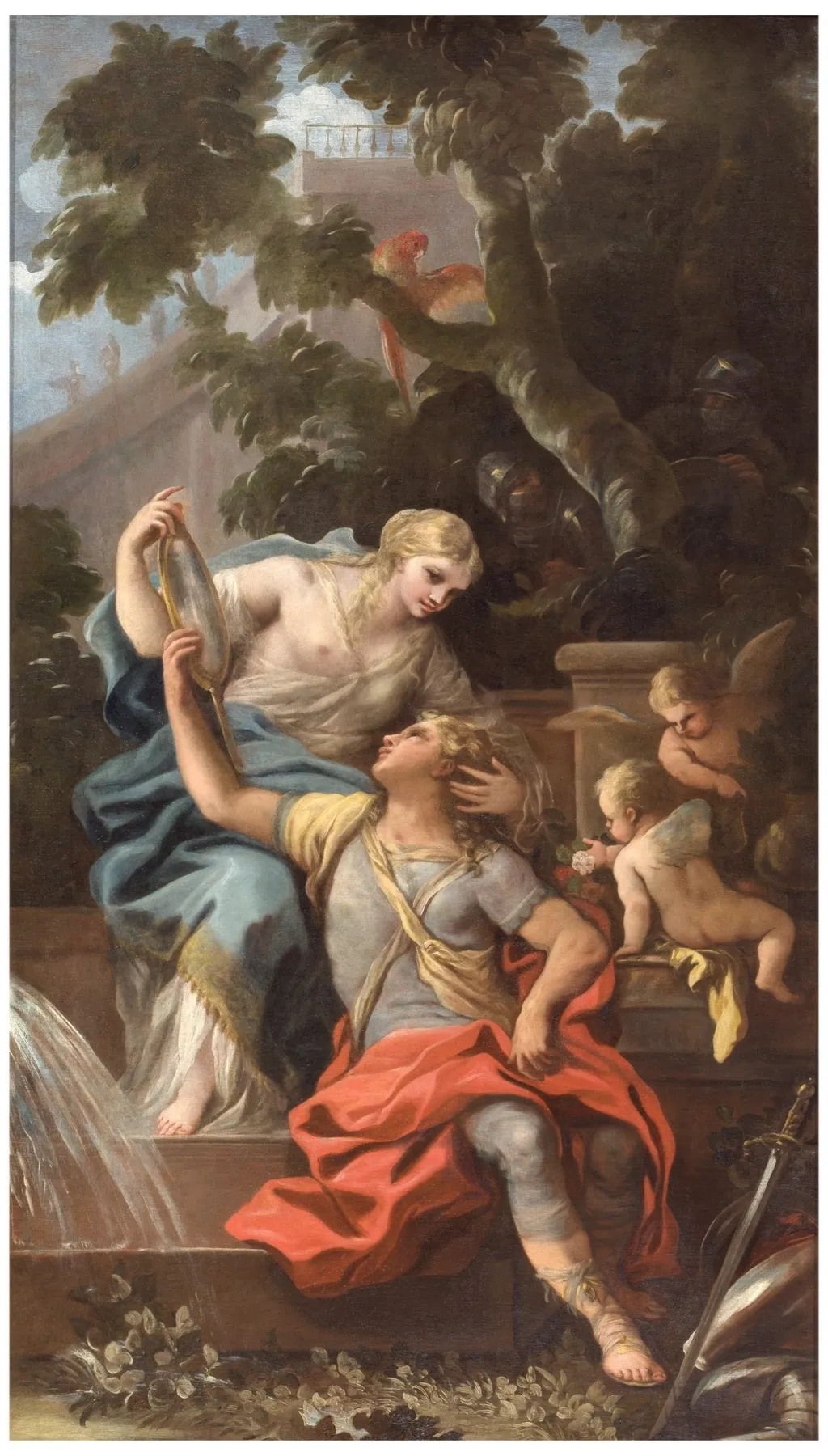
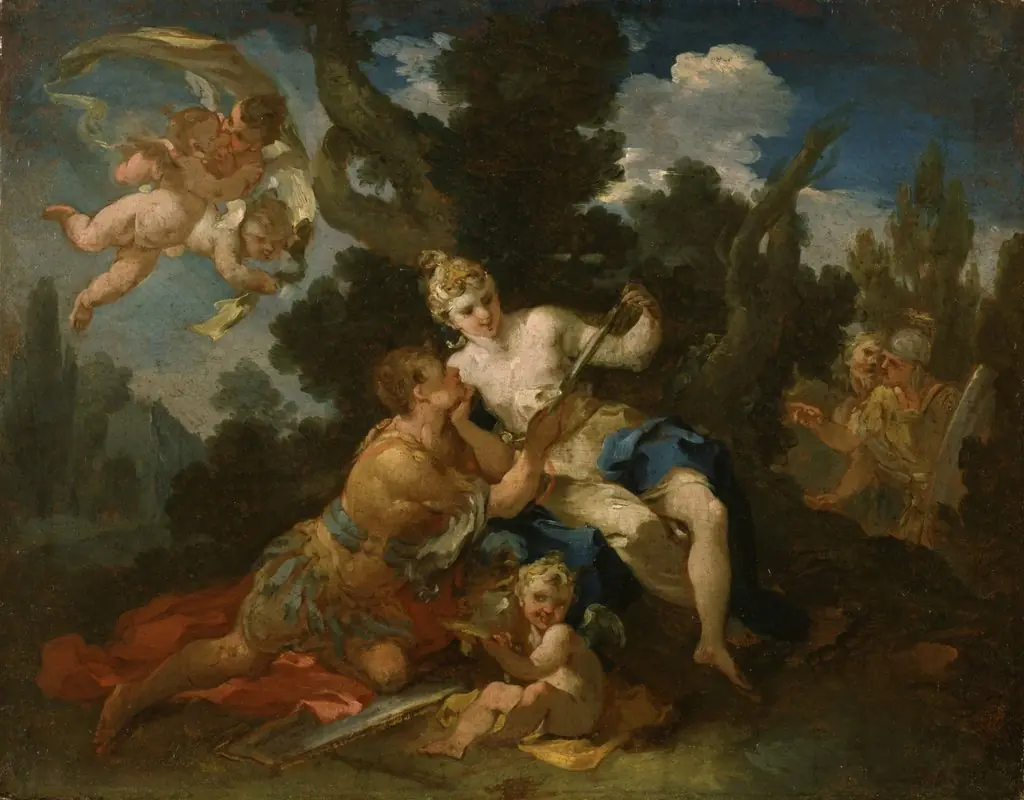
Armida and Rinaldo is an oil painting by the Early Baroque Italian artist Luca Giordano. It dates from 1699 and is held in the collection of the Museo del Prado.
About this work
Subject & Meaning
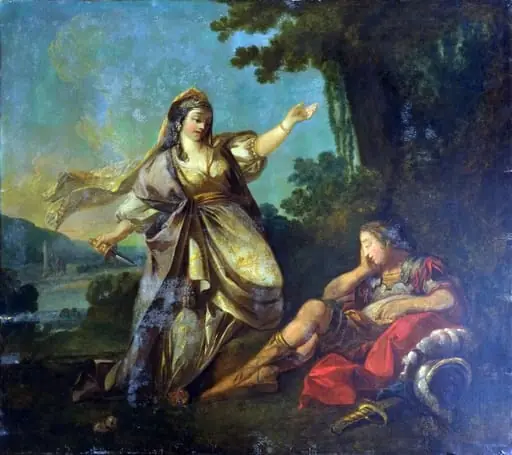
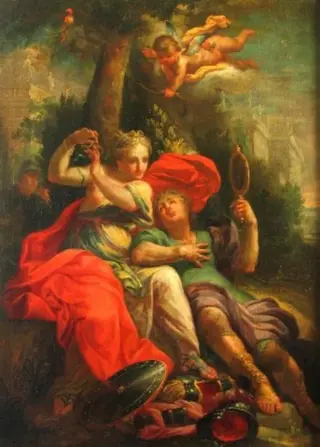
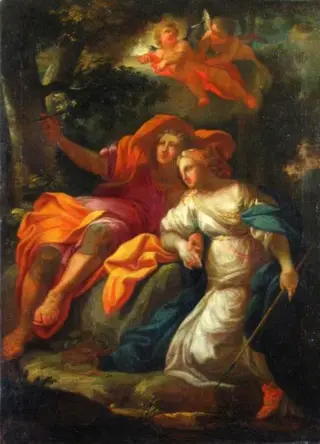
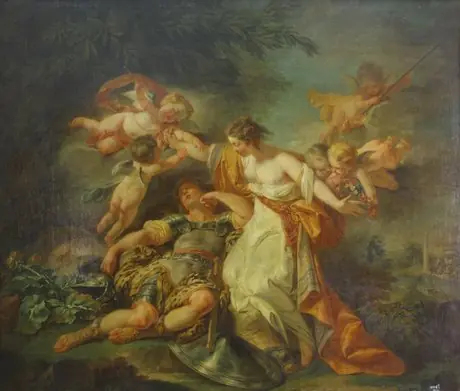
The painting belongs to the genre of mythological painting and draws on the enchanted episode from Torquato Tasso's epic Gerusalemme liberata in which the sorceress Armida lures the crusader knight Rinaldo away from the Christian army. According to the source, the canvas depicts Armida alongside attributes that signal her dual nature as enchantress and lover: a hand mirror, a fountain, body armor, and a sword. The mirror and fountain are conventional emblems of feminine seduction and the magical garden where Armida holds Rinaldo captive, while the armor and sword identify the knight she has enchanted and foreshadow his eventual return to battle.
By pairing Armida's instruments of allure with the warrior's arms, the composition stages the central conflict of the Tasso story between erotic enchantment and martial duty.
Technique & Style
It is classified as a mythological painting and depicts the hero Rinaldo in body armor with a sword, a hand mirror, a fountain and the enchantress Armida.
Armida and Rinaldo is an oil‑on‑canvas painting executed in 1697 by Luca Giordano. The work measures 221 cm in height and 124 cm in width, typical of large Baroque compositions. It is classified as a mythological painting and depicts the hero Rinaldo in body armor with a sword, a hand mirror, a fountain and the enchantress Armida.
The painting’s surface is built up with oil paint applied to a canvas support, a technique characteristic of Giordano’s late period. The composition combines dramatic chiaroscuro with vivid colour, reflecting the dynamic style of the Neapolitan school. The work remained in the Spanish royal collection, later entering the Museo del Prado.
History & Provenance
Armida and Rinaldo is an oil on canvas painting executed by Luca Giordano in 1697, as recorded in contemporary documentation. The work portrays the mythological encounter between the enchantress Armida and the crusader Rinaldo, reflecting the baroque fascination with heroic narratives. Documentation indicates the painting was commissioned by an unidentified patron and subsequently entered the Spanish royal collection, being owned by Ferdinand VII of Spain.
By the early nineteenth century the canvas was installed in the Royal Palace of Madrid before being transferred to the Museo del Prado, where it remains on display. The painting measures 221 cm in height and 124 cm in width.
Luca Giordano's oil-on-canvas painting Armida and Rinaldo is held in the collection of the Museo del Prado in Madrid, specifically located within the Royal Palace of Madrid. The work entered the royal holdings under the ownership of Ferdinand VII of Spain. Created in 1697, the painting measures 221 cm in height and 124 cm in width.
The provided sources do not contain specific inventory or accession numbers for the work, nor do they list any exhibition history or past display records beyond its current institutional location.
Overview
Luca Giordano's "Armida and Rinaldo," an oil painting from 1699, depicts a scene from mythological literature. This work, currently housed at the Museo del Prado, showcases the artist's interpretation of the encounter between the sorceress Armida and the knight Rinaldo. The composition features prominent figures, symbolic objects, and a dramatic use of light and shadow, characteristic of the late Baroque period.
Artist & collection

Artist
Luca Giordano was an Italian late-Baroque painter and printmaker in etching. Giordano was one of the most celebrated artists of the Neapolitan Baroque, whose vast output included altarpieces, mythological paintings and…