Artwork
Nativity
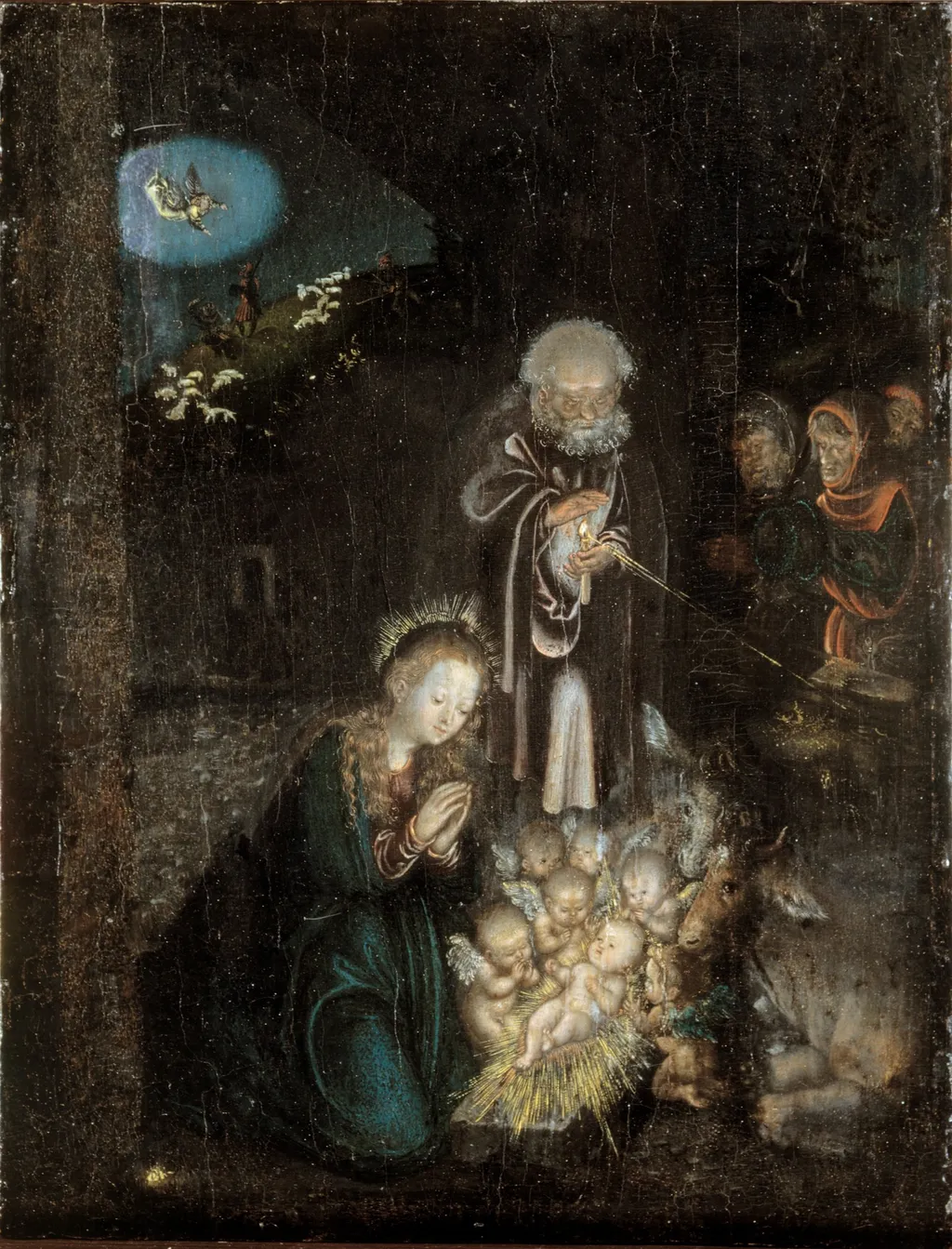
Nativity is a paint painting by the Northern Renaissance artist Lucas Cranach the Elder. It dates from 1510 and is held in the collection of the Staatliche Kunstsammlungen Dresden.
About this work
Subject & Meaning
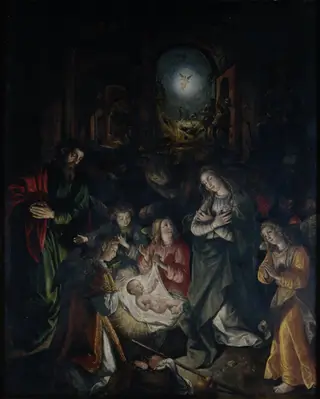
The Nativity depicted in this work centers on the adoration of the shepherds, showing Mary praying over the infant Jesus in a nocturnal setting.
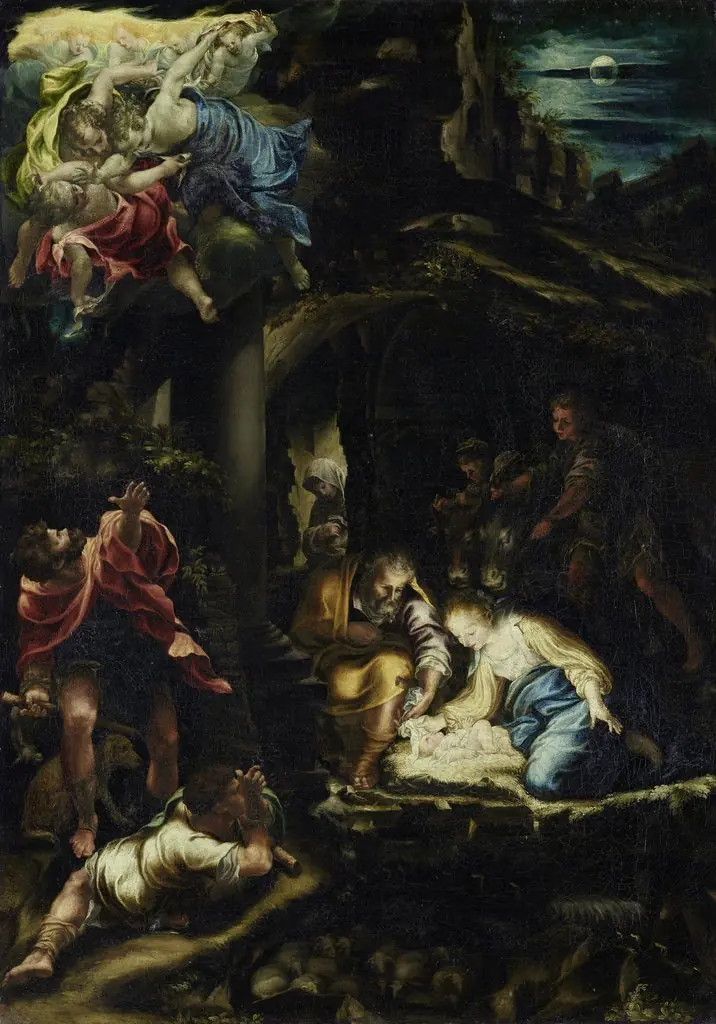
The Nativity depicted in this work centers on the adoration of the shepherds, showing Mary praying over the infant Jesus in a nocturnal setting. Joseph holds a candle above them while the primary light emanates from the manger, where the Child rests on hay that mirrors his mother's halo. Winged cherubs surround the scene, and in the upper left a moonlit landscape subtly reveals the Annunciation to the shepherds, with Gabriel appearing as the moon and three shepherds observing the holy family from behind a fence.
The composition reflects Martin Luther's use of light as a metaphor for revelation during the early Reformation, a theme Cranach conveyed through candles in his illustrations for Luther's writings. Provenance traces the painting from Richard von Kaufmann's collection to its acquisition by the Gemäldegalerie Alte Meister in Dresden in 1917, its seizure by Soviet forces in 1945, and return in 1955.
Technique & Style
The Nativity is an oil on panel painting executed on a lime panel, measuring 32 cm in height by 24.5 cm in width. Cranach renders a nocturnal scene in which the Christ Child, lying on a bed of hay, functions as the principal light source, radiating a halo-like glow that matches Mary's own modest aureole. Joseph stands above the Holy Family holding a candle, while the ox and the donkey complete the circle around the crib, and winged cherubs surround the Child.
Stylistically, the work belongs to the tradition of sober Andachtsbilder developed in the circle of Geertgen tot Sint Jans at the end of the fifteenth century. Cranach strips away ornament: the stable and landscape are barely visible, allowing him to demonstrate his ability to render divine light and darkness with subtlety and variation. In the upper left, a moonlit vista reveals the Annunciation to the Shepherds, with Gabriel embodied as the moon and three shepherds in a field; the same three figures reappear behind a fence on the right, gazing at the Holy Family.
The candle motif links the painting to Luther's metaphorical use of candlelight as revelation, a theme Cranach also explored in woodcuts for Luther's Passional Christi und Antichristi.
History & Provenance
Created by Lucas Cranach the Elder, this oil-on-panel Nativity scene dates to approximately 1515–1520. The work depicts a nocturnal Adoration of the Shepherds, a subject Cranach rendered in simplified forms for Martin Luther's publications during this period. Originally part of the Berlin collection of jurist and art collector Richard von Kaufmann, the painting was acquired by the Gemäldegalerie Alte Meister in Dresden in 1917.
The museum purchased the piece from Kaufmann's estate auction for 34,800 marks. Following World War II, the artwork was claimed by Soviet forces in 1945 as part of wartime reparations. It was subsequently returned to the Dresden museum in 1955, where it remains in the collection today.
The painting is held in the collection of the Gemäldegalerie Alte Meister in Dresden, part of the Staatliche Kunstsammlungen Dresden. The museum acquired the work in 1917 from the estate of the Berlin collector Richard von Kaufmann, purchasing it at auction for 34,800 marks. During the aftermath of World War II, the artwork was claimed by Soviet forces in 1945. It remained outside the museum until its return in 1955.
Context
Scholars contextualize this work within the early German Reformation, noting its creation coincided with Martin Luther's emerging theology that utilized the candle as a metaphor for divine revelation. The painting's nocturnal atmosphere and simplified setting align it with the sober devotional images (Andachtsbilder) pioneered by Geertgen tot Sint Jans, demonstrating Cranach's ability to render subtle variations between divine light and darkness. The composition's specific iconography, particularly the luminous crib and Joseph holding a candle, directly parallels illustrations Cranach produced for Luther's Passional Christi und Antichristi.
The work entered the Gemäldegalerie Alte Meister in Dresden in 1917, purchased from the estate of Richard von Kaufmann. Its historical trajectory includes seizure by Soviet forces in 1945 and subsequent repatriation to the museum in 1955.
Legacy
The Adoration of the Shepherds exerted lasting influence through its innovative nocturnal composition and symbolic use of light, particularly the candle as a metaphor for divine revelation, which resonated during the Reformation era. Its complex narrative layers, combining the Nativity with the Annunciation to the shepherds, inspired later interpretations of the Holy Family’s adoration, as documented in sources on its impact on Reformation iconography. The work remained in continuous public view at the Gemäldegalerie Alte Meister since its acquisition in 1917, shaping scholarly understanding of Cranach’s role in merging artistic innovation with contemporary theological discourse.
Its provenance, including post-World War II restitution, further contributed to its legacy as a symbol of cultural recovery.
The painting’s depiction of the Christ Child surrounded by cherubim and illuminated by the manger’s glow established a visual language for nocturnal Nativity scenes, influencing depictions of the Adoration of the Shepherds in early modern art. This compositional approach was referenced in contemporary accounts of Luther’s use of Cranach’s imagery to convey scriptural themes, cementing its reputation as a pivotal work in the intersection of art and religious reform.
Overview
Created around 1515–1520, this oil on panel presents a Nativity scene attributed to Lucas Cranach the Elder. The work resides in the Gemäldegalerie Alte Meister in Dresden. Central figures include a bearded man holding a candle, a kneeling woman with a halo, and the infant in a manger, surrounded by angels and animals against a darkened backdrop.
Own this work as a print
Artist & collection
Artist
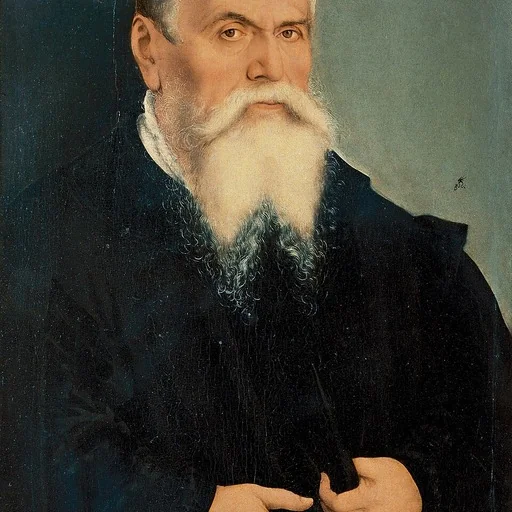
Lucas Cranach the Elder was a German Renaissance painter and printmaker in woodcut and engraving.