Artwork
Self-portrait with the Colosseum
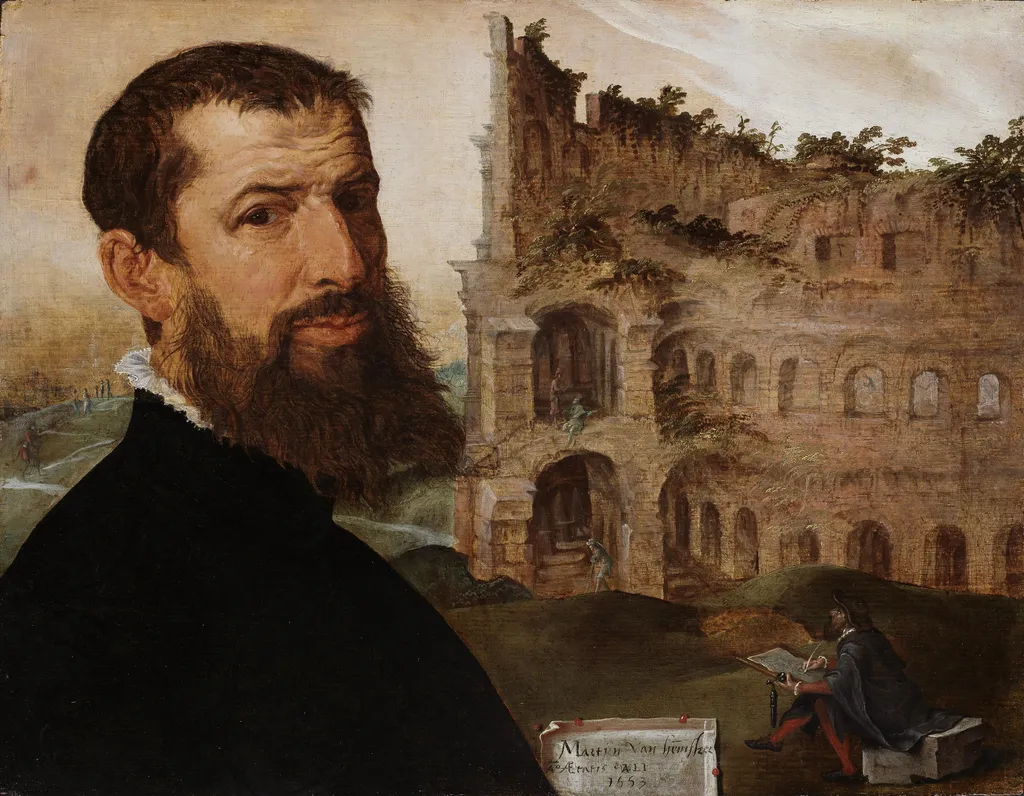
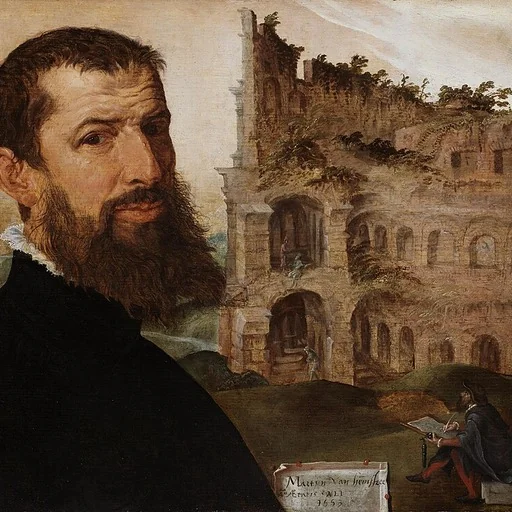
Self-portrait with the Colosseum is an oil painting by Maarten van Heemskerck. It dates from 1553 and is held in the collection of the Fitzwilliam Museum.
About this work
Self‑portrait with the Colosseum is a painting by Maarten van Heemskerck. He created it in 1553 using oil paint.
The work is an oil on canvas from the Dutch Golden Age. It now lives in the Fitzwilliam Museum in Cambridge. The painting shows the artist standing before the ancient ruins of the Colosseum. It is a self‑portrait, placing the painter in a historic setting.
Subject & Meaning
His dual depiction, facing the viewer and sketching the ruin, reflects a layered self-representation that merges personal identity with scholarly observation.
The painting presents the artist as both observer and creator, standing before the Colosseum to symbolize his journey as a Grand Tourist and his engagement with antiquity. His dual depiction, facing the viewer and sketching the ruin, reflects a layered self-representation that merges personal identity with scholarly observation. The inclusion of the Colosseum functions as symbolic reference to Rome’s classical legacy, while the signed cartellino anchors the work to his 1553 arrival in Italy and subsequent integration into the circle of Anton Perrenot de Granvella. The ruin itself operates as memento mori, juxtaposing the permanence of antiquity with the artist’s transient presence.
Technique & Style
The work is executed in oil paint on a wooden panel, measuring approximately 42 × 54 cm (H 42.2 × W 54.2 cm). It is signed and dated in the lower centre with the inscription “MARTYN VAN HEMSKER AO AETATUS SUA LV 1553”. Formal‑stylistically, the painting presents a double self‑portrait: the artist appears in bust form, gazing at the viewer, and again seated, sketching the Colosseum that occupies the background. The composition is organized into foreground, midground and background, with the ruined Colosseum serving as a memento mori. The technique reflects the Dutch Golden Age tradition of detailed oil painting, influenced by the artist’s Romanist studies of antiquities.
History & Provenance
The painting is dated 1553 and is signed on a cartellino in the lower center with the inscription “Martyn van Hemskerck Ao Aetatis sua LV.” It was created in Haarlem after Heemskerck’s return from Italy, where he had spent 1532-1537 studying antique and contemporary works in Rome. The work depicts the artist twice, once as an older figure in the foreground and again as a younger man sketching the Colosseum in the background, recalling his Roman sojourn sixteen years earlier. By 1586 the painting had entered the collection of Antoine Perrenot de Granvelle, a noted patron who had served as a cardinal and chief minister to the Spanish Netherlands. It remained in his holdings until his death that year. In 1846 the Fitzwilliam Museum, Cambridge, acquired the work as a gift from the Reverend Richard Edward Kerrich. Self-Portrait with the Colosseum is held by the Fitzwilliam Museum in Cambridge, United Kingdom. The work is cataloged under accession number 103 and entered the collection in 1846 as a gift from the Reverend Richard Edward Kerrich. The painting has been featured in exhibitions, including "Remember Me" and "To Rome."
Context
Painted in 1553, the Self-portrait with the Colosseum reflects Maarten van Heemskerck's standing as a leading Northern European Romanist, an artist who absorbed Italian antiquity and transmitted it back to Netherlandish audiences. The work belongs to a broader body of Roman ruins imagery he produced after his earlier Italian sojourn, sketches documented by Karel van Mander in his Schilder-boeck and later engraved and published by Philips Galle in 1569 as the Inventiones Heemskerkianiae and the Clades series. The Colosseum view in the painting has been linked to an undated Berlin sketch that served as a model for Pieter Jansz. Saenredam's 1631 treatment of the same monument, evidence of Heemskerck's enduring influence on seventeenth-century architectural painters. The painting's early provenance through Cardinal Granvelle and its inclusion in the Fitzwilliam's exhibition history underscore its reception as a touchstone image of the artist-as-antiquarian. Scholarly discussion, including Helmut Puff's 2011 essay in The Germanic Review, treats the ruinous Colosseum as a memento mori framing the aging sitter.
Legacy
Maarten van Heemskerck's sketches of Roman ruins, which inform the background of this self-portrait, achieved significant circulation and influence across Europe. Karel van Mander documented these drawings in his *Schilder-boeck*, noting their patronage by Cardinal Granvelle. These studies served as direct models for later artists, most notably inspiring Pieter Jansz. Saenredam's 1631 painting of the Colosseum, for which Heemskerck's undated sketches provided the visual foundation. Additionally, Philips Galle engraved and published many of these ruin studies in 1569 as the *Clades* series, further disseminating Heemskerck's vision of ancient Rome. The work itself, painted sixteen years after the artist's return from Italy, functions as a *memento mori* that juxtaposes the artist's aging self with the enduring, albeit ruined, monument he once sketched.
Own this work as a print
Artist & collection
Artist
Maarten van Heemskerck (born Maerten Jacobsz van Veen; 1 June 1498 – 1 October 1574), also known as Marten Jacobsz Heemskerk van Veen, was a Dutch portrait and religious painter, who spent most of his career in Haarlem.