Artwork
Nude Boy on the Beach at Portici
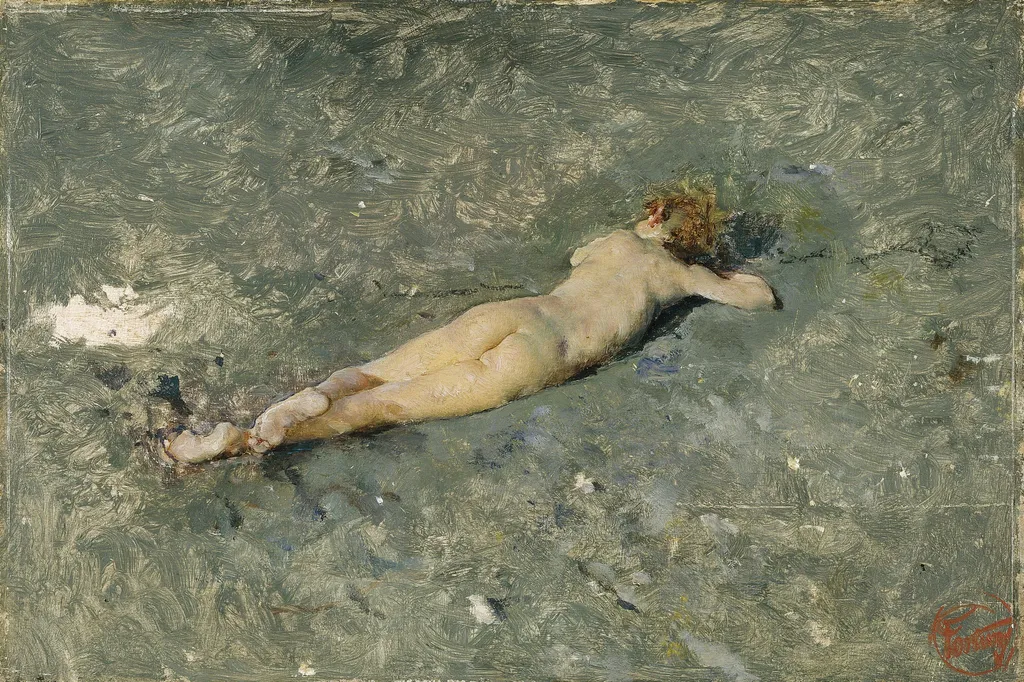
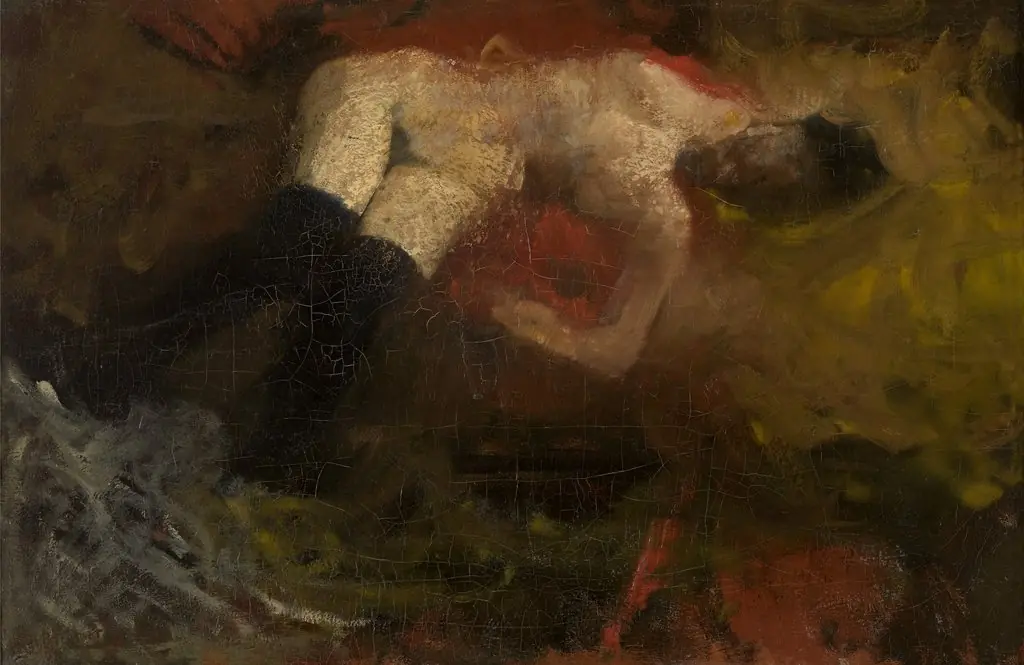
Nude Boy on the Beach at Portici is an oil painting by the Impressionist artist Mariano Fortuny Marsal. It dates from 1874 and is held in the collection of the Museo del Prado.
About this work
Technique & Style
The composition’s subdued palette and delicate transitions reflect Fortuny’s study of Mediterranean light and atmosphere during his 1874 stay in Portici.
Nude Boy on the Beach at Portici is executed in oil paint on a wooden panel, measuring 13 × 19 cm. The handling is characterized by rapid, dense strokes used to depict the sand, achieved by dragging dry paint over a white ground, while the figure of the child is rendered with finer, more precise brushwork.
The work emphasizes naturalistic light effects through varied color modeling: cool blues and greens define the shadows in the child’s hip dimples, pinks and blues appear in the left leg and hip, and warm reds highlight the ear and toes. The composition’s subdued palette and delicate transitions reflect Fortuny’s study of Mediterranean light and atmosphere during his 1874 stay in Portici.
History & Provenance
Nude Boy on the Beach at Portici was painted by Mariano Fortuny in the summer of 1874 during a stay in Portici, near Naples, where he occupied the Villa Arata with views of the sea. The work was produced without a preparatory drawing, as part of a series of paintings of nude children on the beach that Fortuny undertook for his own pleasure, free from the demands of his dealer Adolphe Goupil. It was created in the final months of the artist's life.
After Fortuny's death, the painting remained in Rome as part of his estate. The following year it was sold at the Hôtel Drouot in Paris, where it was acquired by Ramón de Errazu. Errazu later bequeathed the work to the Museo del Prado in Madrid, where it was accepted by royal order on 13 December 1904.
After the artist's death, the painting remained in Rome as part of his estate and was sold the following year at the Hôtel Drouot in Paris. It was acquired by Ramón de Errazu, who later bequeathed it to the Museo del Prado in Madrid, where it was accepted by royal order on 13 December 1904. It remains in the Prado's collection.
Since the painter's death, the work has been exhibited in a number of Spanish and international venues, including Paris (1878), Barcelona (1940), a Barcelona–Reus–Madrid tour (1974–1975), a Madrid–Barcelona–Oviedo tour (1983–1984), Madrid (1998), Barcelona (2003–2004), Madrid (2005–2006), Madrid (2007–2008), Madrid (2013), Barcelona (2014), and Tokyo (2015–2016).
Context
During Fortuny’s final years, critics emphasized his technical daring and originality. In Portici, he broke from commissioned work to paint Nude Boy on the Beach at Portici (1874), a small oil on panel (13 × 19 cm) now in the Museo del Prado, Madrid. Contemporary observers such as journalist Henry Fouquier praised its “bright, vivid sensations,” linking it to Fortuny’s intensified study of coastal light and color.
The work sits at the nexus of Fortuny’s late naturalism and his earlier orientalist scenes. After achieving renown with La vicaría (1868), he sought greater artistic freedom in Portici, where he produced rapid plein-air sketches and refined figure studies. The painting’s layered, coloristic shadows and absence of preparatory drawing reflect this exploratory phase, marking a departure from his earlier academic manner toward a more spontaneous naturalism.
Overview
Mariano Fortuny y Marsal’s oil painting Nude Boy on the Beach at Portici was executed in 1874. The canvas presents a solitary child immersed in a seaside setting, rendered with the loose handling typical of late‑nineteenth‑century Impressionism. The work now belongs to the Museo del Prado’s permanent collection, where it is displayed among the museum’s 19th‑century holdings.
Subject & Meaning
The composition centers on a young boy lying prone in the sand, his nude form relaxed as he bathes near the water’s edge. His head is turned slightly, one arm tucked beneath his torso while the other reaches outward, suggesting a moment of quiet contemplation amid the natural environment. The painting captures a fleeting, intimate encounter between the human body and the sea.
Own this work as a print
Artist & collection
Artist
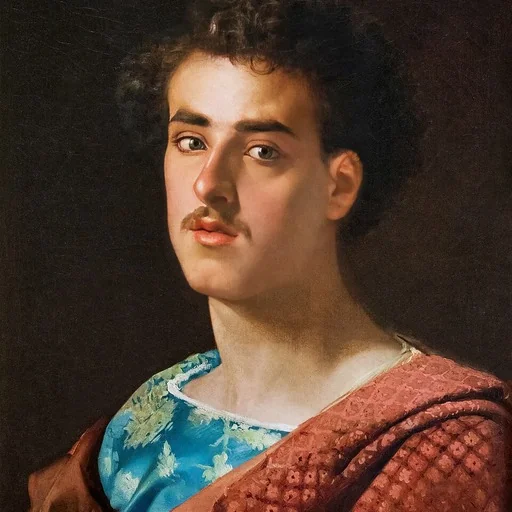
Mariano Fortuny y Marsal (Catalan: Marià Fortuny i Marsal, pronounced; June 11, 1838 – November 21, 1874) was a Spanish painter known for works focusing on Romantic fascination with Orientalist themes, historicist genre…