Artwork
Saint Jerome in His Study
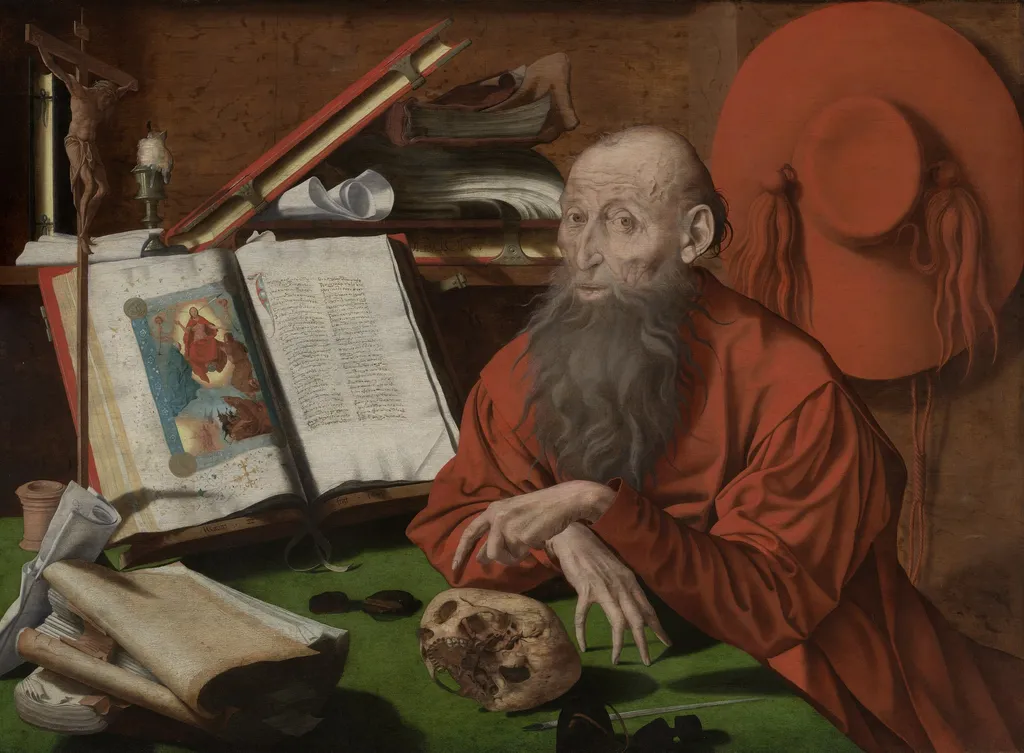
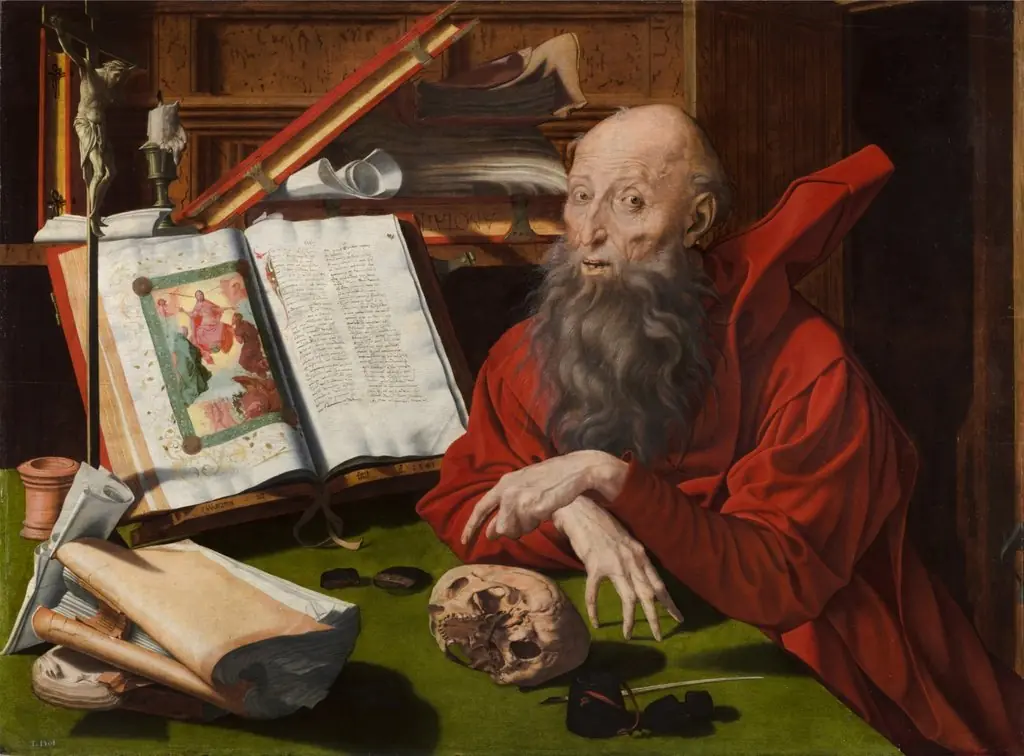
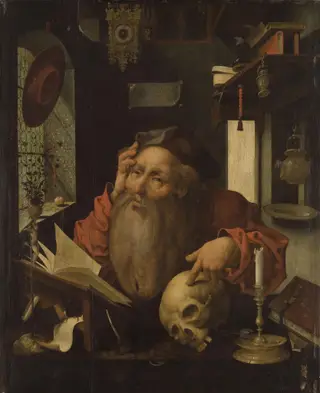
Saint Jerome in His Study is an oil painting by the Northern Renaissance artist Marinus van Reymerswaele. It dates from 1541 and is held in the collection of the Royal Museum of Fine Arts Antwerp.
About this work
Subject & Meaning
Additional symbolism includes a nearly melted, extinguished candle representing the fleeting nature of earthly life and the urgency of spiritual preparation.
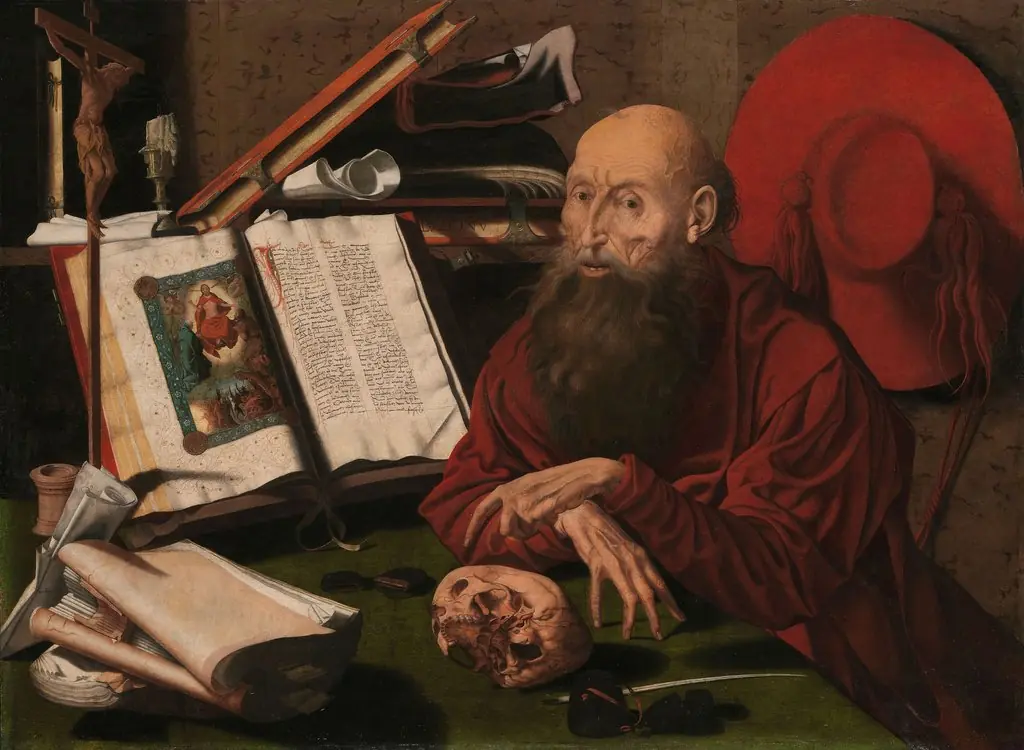
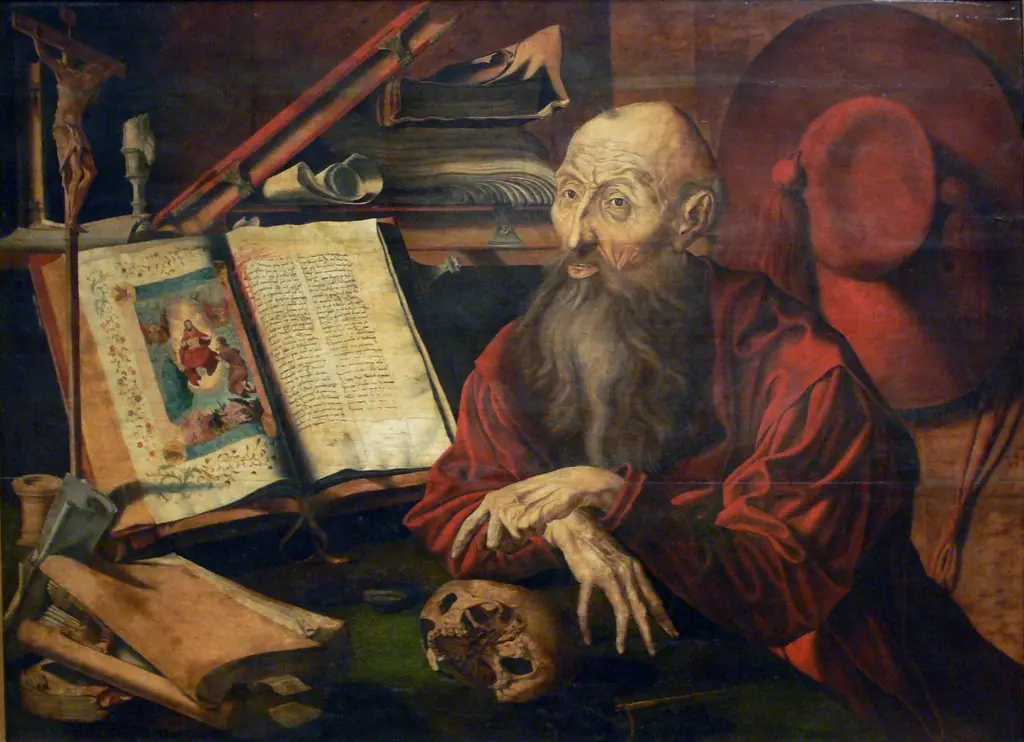
The painting depicts Saint Jerome, a Church Father, seated in his study dressed in red cardinal's robes, an anachronistic attribute reflecting his later role as a papal advisor rather than a historical office he held. The composition includes a green desk laden with books, writing implements, a crucifix, and an open Bible displaying a miniature of the Last Judgment. Jerome points explicitly to a skull on the table, a memento mori symbolizing mortality and the saint's penitential time in the desert.
Additional symbolism includes a nearly melted, extinguished candle representing the fleeting nature of earthly life and the urgency of spiritual preparation. The specific biblical text visible references Matthew 25, illustrating the separation of the blessed and the damned, with the latter depicted as the monster Leviathan. Together, these elements portray Jerome as the model of the independent believer, focused on translation, penance, and the ultimate divine judgment.
Technique & Style
Saint Jerome in His Study is executed in oil paint on panel, measuring 78 by 107 cm. The work dates to 1541 and is classified as a religious painting. According to the Dutch-language source, the Antwerp panel is a replica after Marinus van Reymerswaele's original composition, with the artist basing his design on earlier treatments of the subject by Quinten Massijs and Albrecht Dürer. The source notes that Marinus produced multiple variants of the Jerome theme with only minor differences between them, and that his later replicas employ a wet-on-wet technique not found in works predating 1541, a faster method likely adopted because the composition was in such demand.
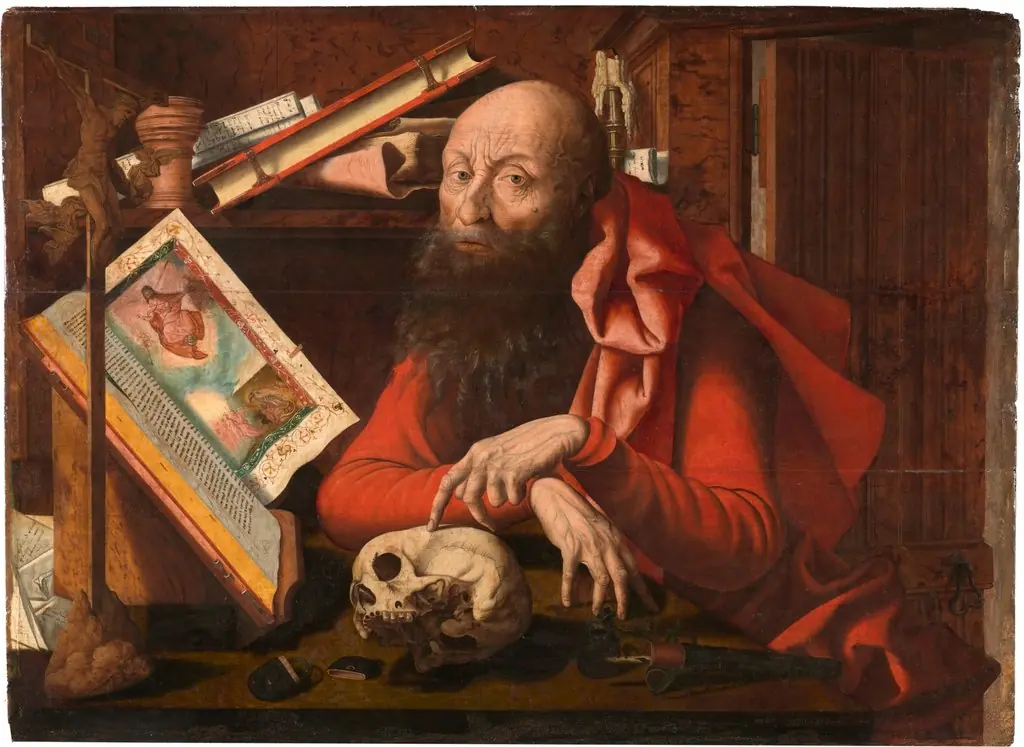
Stylistically, the painting reflects the detailed Northern Netherlandish tradition of the scholar's study, with carefully rendered objects on and around the desk, including an open Latin Bible, a lectern, documents, writing implements, a crucifix, and a skull, and shelves of books behind the seated saint. The Antwerp panel itself is described as a replica with several alterations relative to the Prado original (Madrid, inv. P2100), which bears a '1521' inscription that may actually be a misread '1541' resulting from a restoration.
History & Provenance
Saint Jerome in His Study is an oil on panel painting executed in 1541 by the Flemish artist Marinus van Reymerswaele. The work entered the collection of the Royal Museum of Fine Arts Antwerp, where it has been displayed since its acquisition. It was included in the exhibition Exposition des primitifs flamands à Bruges.
A 2015 assessment by the Vlaamse Topstukkenraad identified the painting as a key piece in the museum’s holdings. The painting is a replica of an earlier composition, differing only slightly from the original version housed in the Museo del Prado, which bears the date 1521. Its dimensions measure 78 × 107 cm.
The painting is held in the collection of the Royal Museum of Fine Arts Antwerp, which is part of the Flemish Art Collection. Dated to 1541, the oil-on-panel work measures 78 by 107 centimeters. Its exhibition history includes a showing at the Exposition des primitifs flamands in Bruges.
In 2015, the Flemish Masterpieces Council recognized the work for its significant art-historical function, identifying it as a replica with minor variations of an original housed in the Museo del Prado.
Legacy
Marinus van Reymerswaele produced multiple variants of Saint Jerome in His Study, a composition so popular that numerous replicas were created for collections across Europe, including those in Douai, Berlin, London, Brussels, Madrid, Bruges, Bamberg, and Amsterdam. The artist likely adopted a faster wet-in-wet technique for later versions to meet high demand, distinguishing them from his earlier works. In 2015, the Flemish Masterpieces Council recognized the painting's significant transitional role in art history.
Although the Antwerp version is dated 1541, it is considered a modified replica of an earlier prototype held in the Museo del Prado, which bears a 1521 inscription that may result from a restoration error. The subject's enduring appeal in the sixteenth century stemmed from Jerome's symbolism as an independent thinker and scholar.
Overview
Marinus van Reymerswaele, a Dutch Renaissance artist, completed Saint Jerome in His Study in 1541. This oil painting depicts the revered scholar Saint Jerome absorbed in his academic and spiritual pursuits. Characteristic of the Northern Renaissance, the work emphasizes intricate detail and a contemplative atmosphere, presenting a focused figure amidst a wealth of scholarly objects. It is currently housed in the Royal Museum of Fine Arts Antwerp.
Own this work as a print
Artist & collection
Artist
Marinus van Reymerswaele or Marinus van Reymerswale (c. 1490 – c. 1546) was a Dutch Renaissance painter mainly known for his genre scenes and religious compositions. After studying in Leuven and training and working as…