Artwork
Portrait of a German Officer
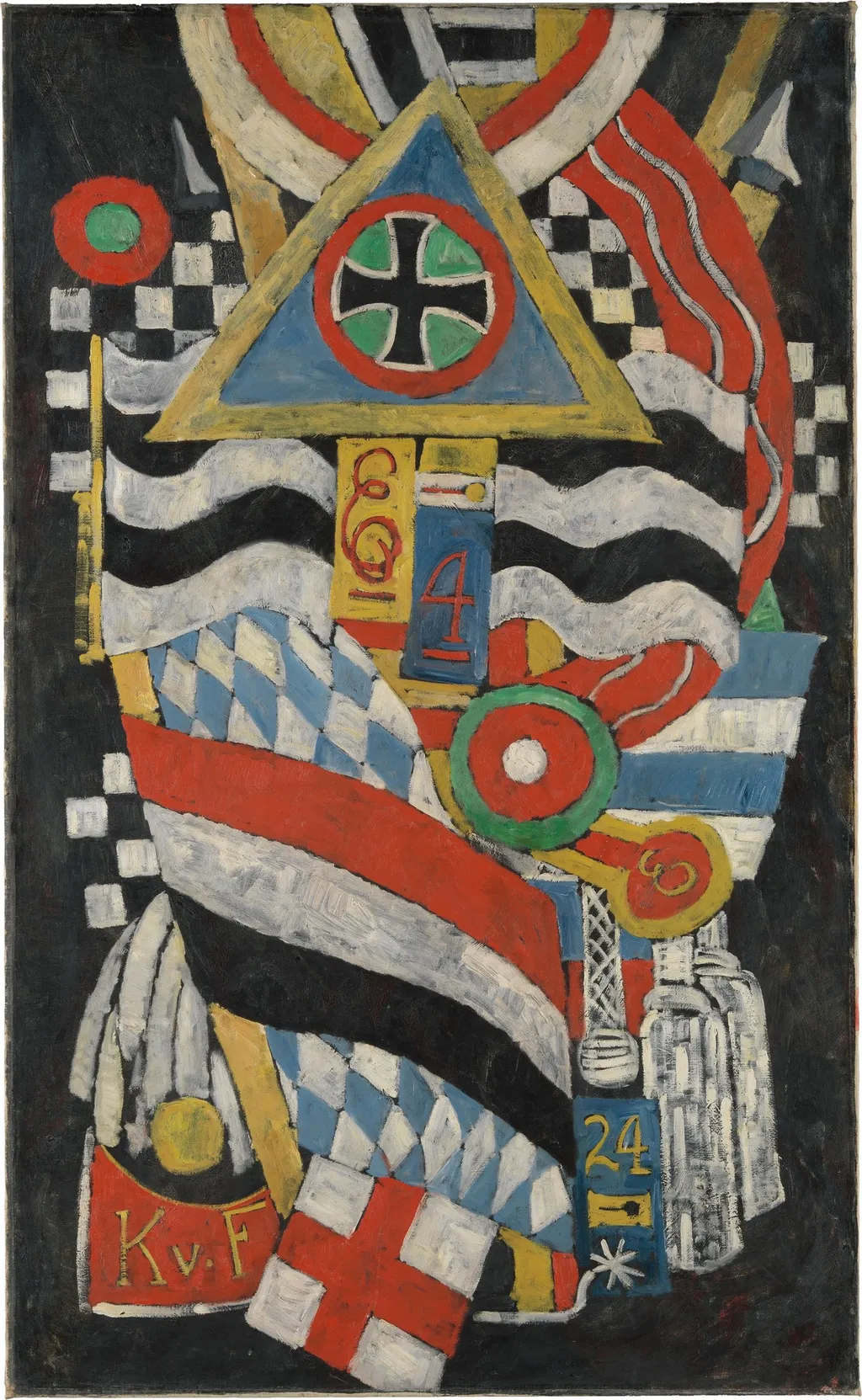
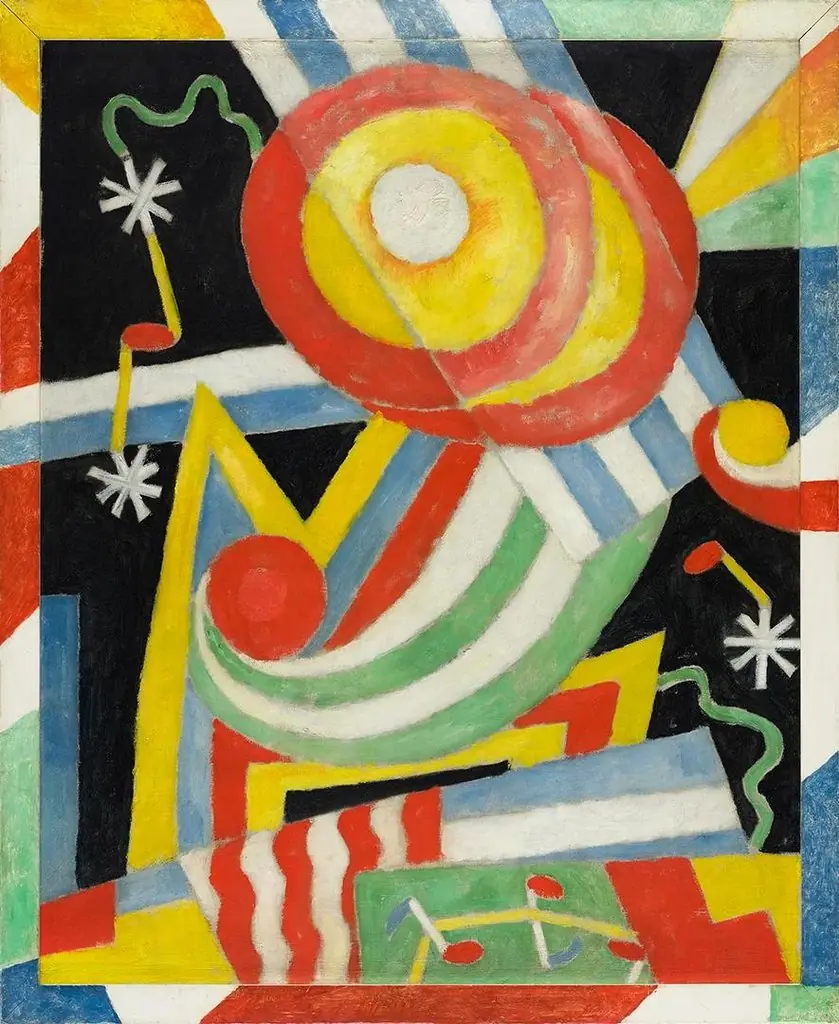
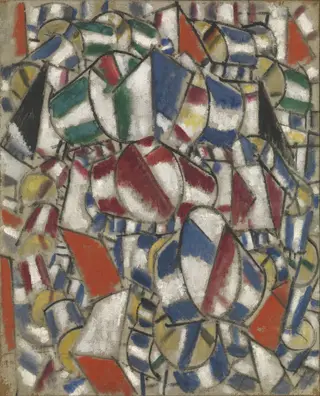
Portrait of a German Officer is an oil painting by the German Expressionist artist Marsden Hartley. It dates from 1914 and is held in the collection of the Metropolitan Museum of Art.
About this work
Marsden Hartley's Portrait of a German Officer skips the usual face and pose for shapes and symbols. Painted in 1914 as World War I began, the officer is built entirely from medals, flags, and military badges, a puzzle of war and power.
Subject & Meaning
Together these elements mourn Freyburg, reflect Hartley’s admiration for the German military pageantry, and hint at a deeper, possibly romantic, attachment.
Portrait of a German Officer depicts Karl von Freyburg, a Bavarian lieutenant who died early in World War I, rendered not as a realistic likeness but as an assemblage of military insignia and colors that function as a symbolic portrait. The central black‑white‑red German Empire flag anchors the composition, while the Iron Cross, Freyburg’s award, occupies the top center. Bavarian blue‑white checks, a white‑striped epaulet, the number 24 (his age at death), his gold‑on‑red initials K.v.F., regimental number 4, and a cavalry spur appear throughout, personalizing the tribute.
Hartley also placed the English Cross of St. George and the Belgian Tricolor at the bottom to signify Germany’s wartime enemies. Together these elements mourn Freyburg, reflect Hartley’s admiration for the German military pageantry, and hint at a deeper, possibly romantic, attachment.
Technique & Style
The work is executed in oil on canvas, measuring approximately 173.4 × 105.1 cm, and is classified as a painting within the portrait genre. Hartley employs a cubist‑derived, German Expressionist visual language, rendering the officer as an arrangement of flags, medals, and insignia rather than a naturalistic likeness. The composition incorporates the black‑white‑red imperial flag, the Iron Cross, a Bavarian checkered banner, an epaulette, and numeric motifs that reference the sitter’s age, initials, and regimental number, creating a symbolic, almost abstract formal structure.
The surface is handled with layered brushwork that emphasizes flat color fields and geometric fragmentation, reflecting the influence of early‑twentieth‑century avant‑garde painting.
History & Provenance
Painted in late 1914 while Hartley was living in Berlin, the work was commissioned by Hartley as a memorial to Karl von Freyburg, a German lieutenant killed early in World War I. Hartley’s correspondence with Freyburg suggests a personal attachment, and the composition integrates Freyburg’s regimental number (4), age at death (24), monogram (K.v.F), and awards, including the Iron Cross. After completion, the painting entered Alfred Stieglitz’s collection in New York before being acquired by The Metropolitan Museum of Art, where it remains.
The work is held by the Metropolitan Museum of Art, New York, where it is accessioned as 12.129.1. It entered the collection in 1916 through the Hartley Collection, having previously been owned by the artist and then by Alfred Stieglitz. The painting has been exhibited at the Metropolitan Museum of Art in 2003 as part of the installation Modern and Contemporary Art and in 2021–2022 in the galleries for Cubism and Abstract Art.
Legacy
Portrait of a German Officer (1914) is frequently cited as a pivotal work in Marsden Hartley’s Berlin period, illustrating his synthesis of German Expressionist motifs with Cubist abstraction. The painting, held by the Metropolitan Museum of Art, is noted for its composition of military insignia, including the Iron Cross, Bavarian flag, and Freyburg’s initials, rendering the officer’s identity through symbolic fragments. Scholars reference the piece when examining Hartley’s engagement with wartime militarism and queer subtext, and its continued exhibition at the Met sustains public awareness of Hartley’s early modernist experimentation.
Overview
Marsden Hartley's "Portrait of a German Officer" is an early 20th-century oil painting that redefines traditional portraiture. Created in 1914, this work presents an abstract depiction of an Imperial German officer not through a likeness, but through an assemblage of military insignia. The canvas, currently housed at the Metropolitan Museum of Art, exemplifies Hartley's innovative approach to representing identity and power through symbolic form.
Context
Painted in 1914, "Portrait of a German Officer" emerged at the very onset of World War I. This timing imbues the artwork with a particular resonance, reflecting on the escalating militarism and nationalistic fervor that characterized the era. Hartley's choice to depict an officer through the lens of his regalia underscores the pervasive influence of military culture and its symbols during a pivotal historical moment.
Own this work as a print
Artist & collection

Artist
Marsden Hartley was an American Modernist painter, poet, and essayist. Hartley developed his painting abilities by observing Cubist artists in Paris and Berlin.